Samsung's semiconductor division posted an operating profit of 89.5 trillion won in the June quarter, a 250-fold leap from the same period last year, as artificial intelligence servers vacuum up every high-bandwidth memory chip the company can produce. The result, announced July 30, caps a staggering turnaround for a business that was bleeding cash just twelve months ago. Group-wide revenue hit 171.5 trillion won, up 130 percent year on year, and Samsung said it has already shipped first samples of its sixth-generation HBM4 memory to major customers while locking in a $200 billion supply agreement with Broadcom through 2030.
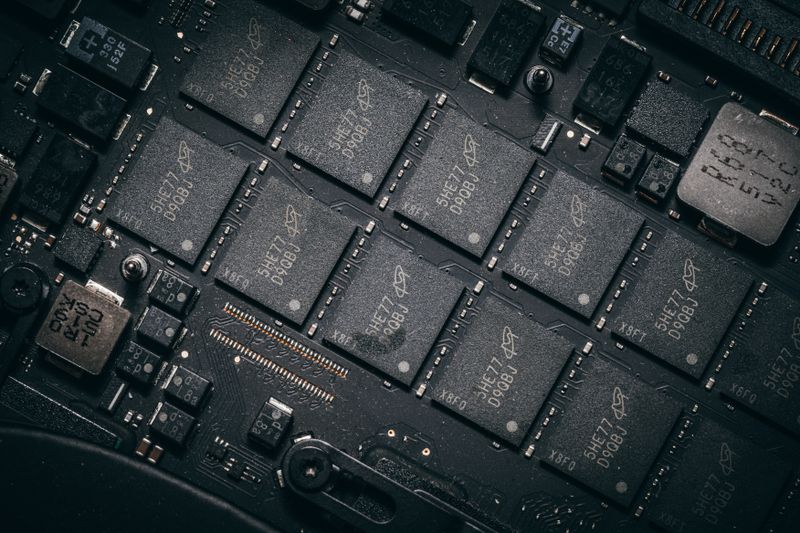
Memory boom rewrites the earnings script
The Device Solutions division, which houses memory, foundry, and system LSI, turned in an operating income of roughly $62 billion — more than the entire company earned in all of 2023. Analysts had modeled 79 trillion won; Samsung delivered nearly 90 trillion. The gap comes almost entirely from DRAM and NAND average selling prices that have climbed for five straight quarters, propelled by data-center builders racing to outfit GPU clusters for large-language-model training and inference.
Samsung's mobile and networks units, by contrast, swung to a combined 700 billion won loss. The very memory price surge that powers the chip division squeezes the handset business, which must buy DRAM and NAND at internal transfer prices that now mirror the open market. "The strength of the memory business is remarkable, but so is Samsung's dependence on it," said one Seoul-based analyst. "A single cyclical downdraft in DRAM would hit the whole group."
The company also disclosed that memory capital expenditure rose quarter over quarter as it expands its Pyeongtaek campus and pushes advanced R&D for the next process nodes. That spending pace — already the highest in the industry — is set to accelerate further in the second half. Samsung's capex for the full year is tracking above 53 trillion won, with the bulk directed at DRAM and HBM capacity additions rather than NAND, which faces a more balanced supply-demand picture. The Pyeongtaek Line 3 expansion alone accounts for roughly 20 trillion won of committed spend, and equipment deliveries for the EUV layers are already arriving at the dock.
SK Hynix, Samsung's perennial rival, posted its own record quarter with operating profit of 29.6 trillion won, but the gap between the two Korean giants has widened. Samsung's DRAM market share by revenue now sits above 45 percent, the highest in three years, while SK Hynix holds roughly 33 percent. Micron trails at 22 percent. In HBM specifically, Samsung's early qualification with Nvidia for HBM3E and now HBM4 gives it a time-to-market edge that could prove decisive through 2027. The company's 10-nanometer-class DRAM node, which it brands 10nm D1b, has achieved yield parity with the prior generation while reducing die size by 15 percent — a cost advantage that compounds at HBM volumes.
HBM4 and the Broadcom bet
Samsung said it has begun shipping HBM4E samples, the extended-performance variant of its sixth-generation high-bandwidth memory, to key customers. HBM4 stacks twelve 24-gigabit DRAM dies with a base die that integrates logic functions, delivering more than 1.2 terabytes per second of bandwidth per stack. The first volume production is slated for late 2026, and Samsung claims a yield advantage over rivals who are still debugging their twelve-high stacking flows.
At the same time, the Broadcom deal — reported at $200 billion over six years — signals a strategic pivot. Broadcom's custom AI accelerators, built for hyperscalers that want alternatives to Nvidia, rely on massive memory bandwidth. By guaranteeing Broadcom a dedicated allocation of HBM and advanced-packaging capacity, Samsung secures a second major anchor customer alongside Nvidia. The arrangement also helps Samsung's foundry business, which will fabricate the Broadcom accelerator dies on its 4-nanometer and 3-nanometer nodes.
"Samsung is leveraging its strong position in memory to aggressively capture share across most of its business units," said a research director at Counterpoint Research. "The Broadcom partnership is as much about foundry utilization as it is about memory volume."
The agreement also includes co-development of next-generation packaging technologies, with Samsung's I-Cube4 and H-Cube hybrid bonding flows expected to play a central role in Broadcom's roadmap beyond 2027. This deepens the integration between memory and logic in a way that pure-play foundries cannot easily replicate. Broadcom's Tomahawk 6 and Jericho 3-AI switching silicon, which power the backend networks of the largest AI clusters, will be among the first products to ride the new packaging line. The partnership also gives Samsung a foothold in the merchant accelerator market, where Broadcom commands an estimated 60 percent share of custom ASICs for hyperscale data centers.
Shortage narrative extends to 2028
Perhaps the most striking disclosure was Samsung's warning that the AI chip shortage could persist until 2028. The company has signed five-year memory supply contracts with multiple data-center operators, locking in up to 70 percent of its projected output. Those deals transfer inventory risk to buyers but also cap Samsung's upside if a new architecture — say, a shift away from transformer models — suddenly reduces HBM demand.
The shortage narrative has become a self-reinforcing loop. Hyperscalers over-order to guarantee allocation, which inflates Samsung's backlog, which justifies higher capex, which expands capacity that won't come online for two to three years. In the meantime, spot prices for HBM3E and HBM4 remain multiples of standard DRAM, and every quarter of delay in competitor ramps — SK Hynix's HBM4, Micron's HBM3E — widens Samsung's window.
Foundry and system LSI still trailing
While memory prints money, Samsung's foundry division remains in the red. The 3-nanometer GAA process has yet to win a flagship smartphone modem or application processor from a top-tier customer, and yield rumors continue to dog the node. Intel's completion of the U.S. government's RAMP-C program — which clears Intel 18A for classified defense work — adds a credible domestic alternative for American fabless firms wary of geopolitical risk.
System LSI, which designs Exynos mobile processors and automotive chips, posted a modest profit but lost the Galaxy S26 flagship slot to Qualcomm's Snapdragon 8 Elite for the second generation running. The division's hope now rests on the Exynos 2500, a 3-nanometer part slated for mid-2026, and on a growing automotive pipeline where Samsung's ISO 26262 certification gives it an edge.
Geopolitical crosscurrents
The earnings call also revealed how trade policy is reshaping Samsung's footprint. The U.S. CHIPS Act subsidies for the Taylor, Texas foundry have been delayed by environmental reviews and labor shortages, pushing meaningful production to 2028 at the earliest. Meanwhile, China's push for domestic immersion DUV lithography — which Samsung equipment partners are watching closely — could eventually erode the equipment moat that has protected Korean and Taiwanese foundries. Samsung's decision to keep its most advanced memory R&D in Korea while moving legacy-node packaging to Vietnam and India reflects a hedging strategy that few competitors can match.
What comes next
The second half will test whether the memory supercycle has legs or is merely a pull-forward of orders placed in panic. Samsung guided for continued HBM demand growth but acknowledged that NAND pricing has begun to soften as enterprise SSD inventories normalize. The company also faces a looming decision on its Texas foundry expansion: the $17 billion Taylor project, subsidized under the CHIPS Act, has slipped to a 2028 start date, and the incoming U.S. administration has not confirmed whether the grants will survive intact.
For now, the numbers speak. Samsung's chip division earned more in three months than Intel's entire market capitalization. The question is how long the AI build-out stays ahead of the supply curve — and whether the $200 billion Broadcom handshake marks the peak of this cycle or merely the end of the beginning.
Sources: CNBC — Samsung says chip crunch will last until 2028 as quarterly profit soars, The National — Samsung's chip profit surges 250-fold as AI memory shortages fuel demand
Internal links: Semiconductors, AI
Keywords: Samsung, Q2 2026 earnings, HBM4, high-bandwidth memory, AI chips, Broadcom, semiconductor shortage, Pyeongtaek, memory market, Device Solutions