CXMT Nears LPDDR6 Mass Production as China's Memory Push Tests Samsung and SK Hynix
ChangXin Memory Technologies, the Chinese DRAM maker known as CXMT, has nearly finished validating its first LPDDR6 chips and is closing in on commercial production, according to reports published over the past week. The milestone lands right as CXMT's blockbuster stock market debut on the Shanghai exchange has investors rethinking the balance of power in global memory.
CXMT has wrapped up most of the development validation work on its first LPDDR6 part, Pandaily reported on Friday. That puts the company past the halfway mark toward shipping commercial chips, since LPDDR rollouts typically move through four stages: single-die verification, development validation, small-batch qualification, and mass production.
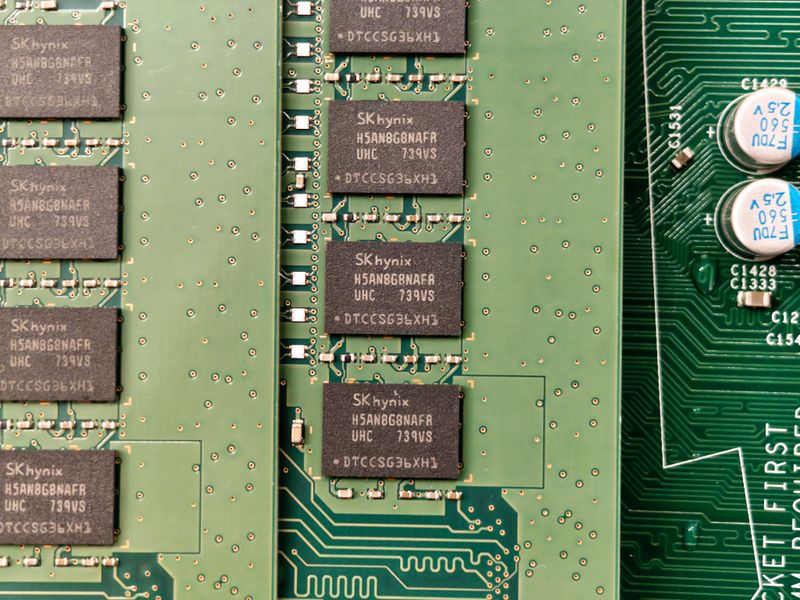
The first part targets a 12,800 Mbps data rate with 16Gb dies and 16GB capacity in a 1,295-ball package-on-package design, Sammy Fans reported. It builds on a steady progression: CXMT shipped LPDDR5 with 12Gb dies in late 2023, then moved to LPDDR5X in 2025 at 10,667 Mbps, a 66 percent speed jump over LPDDR5 with about 30 percent lower power draw.
LPDDR6 matters because it is the memory standard the next generation of flagship phones and AI-capable laptops will run on. The spec roughly doubles the bandwidth of LPDDR5X, which is why the top three DRAM makers have been racing to qualify parts through 2026. CXMT clearing development validation means it is now working on small-batch qualification with customers, the stage where chips get tested inside real devices.
The timing is awkward for Samsung and Micron. Both companies have pulled back on LPDDR6 investment, redirecting capacity toward HBM and server DRAM, where AI demand has pushed prices to record levels. That decision leaves more room in mobile memory, and CXMT is moving into exactly that gap.
CXMT's other advantage is cost. The company's fabs in Hefei and Beijing were built with domestic equipment where possible, and its operating costs sit well below the Korean incumbents, which lets it price aggressively when it needs to win sockets. So far it has chosen not to: SemiAnalysis found its first-quarter prices only 5 to 10 percent below the leaders, a deliberate strategy to rebuild margins after years of losses.
The IPO That Shook Seoul
CXMT's debut on July 27 was the loudest signal yet that China intends to become a serious force in memory. The company raised 12.56 trillion won equivalent through the offering, and its shares surged nearly 470 percent on the first day, briefly making it the most valuable listed company on the mainland, the Korea Times noted.
The fallout hit Korean markets within a day. Samsung Electronics shares closed down about 13 percent the session after the debut, while SK hynix tumbled roughly 14 percent, as investors worried the fresh capital would fund an aggressive capacity build-out.
The fear has a factual base. CXMT plans to add 100,000 wafers of monthly production capacity in Shanghai in 2027, and another 100,000 wafers in 2028. With those expansions, Nomura Securities and other market watchers estimate the company will be running about 550,000 wafers per month by the end of 2028.
CXMT's share of global DRAM revenue has already climbed from 3 percent a year ago to 8 percent in the first quarter, according to Counterpoint Research, putting it fourth behind Samsung Electronics at 38 percent, SK hynix at 29 percent, and Micron at 22 percent.
Why Device Makers Are Rooting for CXMT
The memory market has been in a supply squeeze for more than a year, and buyers are watching CXMT's rise with interest. During Apple's earnings call on Thursday, CEO Tim Cook said more suppliers would help on the supply side and possibly on pricing.
"More suppliers would be good, and it would help us on the supply side, and perhaps the pricing side," Cook said, according to the Korea Times. "It's unclear on the pricing side. But it could help on the supply side."
CXMT's chips are already inside phones from Xiaomi, Transsion, Honor, OPPO, and vivo, and Apple has reportedly begun testing CXMT memory for China-market products. The company's DRAM pricing has been notably restrained during the shortage: SemiAnalysis found its average selling prices only 5 to 10 percent below Samsung, SK hynix, and Micron in the first quarter, and Reuters reported on July 24 that CXMT priced 64GB DDR5 server modules above Samsung's comparable products while turning down a discount request from Huawei.
The Technology Gap Is Still Wide
CXMT's rise looks most threatening in segments where the gap to the leaders is narrow. In advanced memory, the distance remains large. Industry officials estimate CXMT trails the Korean makers by roughly three to four years in technology, the Korea Times reported.
Samsung and SK hynix are already sampling HBM4E, the next generation of high-bandwidth memory, while CXMT is reportedly still working to stabilize production of 8-high HBM3, with yields below industry standards according to SemiAnalysis. SK hynix led the HBM market with a 58 percent revenue share in the first quarter, followed by Samsung and Micron at 21 percent each; CXMT did not appear in the HBM rankings at all.
"LPDDR and DDR products still account for almost all of CXMT's revenue, with HBM making only a negligible contribution," an industry official told the Korea Times. "CXMT's rise looks more formidable in segments where the technology gap is relatively narrow."
That assessment matches this week's news. Herald Economy reported Tuesday that SK hynix, not CXMT, will supply LPDDR6 to Xiaomi, because the Chinese chipmaker has been slower to transition from DDR5 to DDR6.
A Pivotal Year for Memory
CXMT's progress lands at an awkward moment for the incumbents. Samsung and Micron have pulled back on LPDDR6 investment, redirecting capacity toward HBM and server DRAM, according to Sammy Fans, and that gives CXMT an opening in mobile memory even as it trails badly in AI memory.
SK hynix remains out front on LPDDR6, having confirmed development validation of the world's first 16Gb LPDDR6 chip on its sixth-generation 10nm process, with mass production targeted for later this year.
The market context explains the nervousness. Global chip stocks lost more than $1.3 trillion in combined value in the selloff that followed the late-July earnings wave, according to a CNBC analysis, with SK hynix, Samsung, AMD, and TSMC all taking heavy hits as investors questioned whether AI infrastructure spending has peaked. SK hynix shares fell from an all-time intraday high of 2.987 million won on June 25 to 1.322 million won by Thursday's close, a 56 percent drawdown that prompted SK Group chairman Chey Tae-won to buy 4.9 billion won worth of stock for the first time, a move the group said reflected his view that the sell-off had been excessive.
The correction exposed a structural fact: South Korea's stock market is now a semiconductor proxy. CXMT's debut added a new variable to that equation, and Seoul's investors are still pricing in what a well-funded Chinese rival means for the cycle.
The stakes are global. Memory is the most cyclical corner of the chip business, and a well-funded Chinese entrant that keeps prices high during a shortage, then floods the market when demand cools, is the scenario Seoul's investors have worried about for years. Nomura projects CXMT could hold roughly 18 percent of global DRAM capacity by 2028, a level that would make it a permanent structural factor in pricing.
That 18 percent figure is worth pausing on. It would put CXMT within striking distance of Micron's current share and would mean roughly one in every six DRAM wafers in the world comes from a company that did not exist a decade ago. CXMT was founded in 2016 in Hefei, backed by provincial capital, and spent its first years fighting US export controls that barred it from buying the most advanced equipment. Its climb to fourth place in DRAM revenue, on older-generation tools, is the kind of result that keeps policymakers in Washington and Tokyo awake at night.
For now, the industry's real test is qualification, not capacity. CXMT's long-term competitiveness depends on whether major device makers will qualify its chips in volume and whether its yields hold up as it scales, the Korea Times noted. The LPDDR6 validation work suggests the company is determined to find out. Semiconductors is the category we track for the next chapter of this story.