Singapore Opens S$100M Humanoid Robotics Centre to Put Embodied AI on Public Safety Duty by 2028
Introduction
On 30 September 2026, Singapore's Home Team Science and Technology Agency (HTX) opened the Home Team Humanoid Robotics Centre (H2RC) in one-north, a 29,000 square foot facility whose entire purpose is to train humanoid robots to work alongside police, firefighters, prison officers and medics. Roughly S$100 million has been committed to the effort, and the first humanoid is targeted to work in a real operational setting by 2028.
The centre matters beyond Singapore. Nearly every commercial humanoid programme on earth is being trained for a factory floor, a warehouse or a living room. Almost none are being trained for a chemical spill, a collapsed building after an explosion, or a prison cell. H2RC is an attempt to close that gap, and the interesting part is not the robot. It is the pipeline of data, simulation and validation that has to exist before a machine can be trusted near a HazMat officer.
For readers tracking the wider robotics and drone market, this is one of the clearest signals yet that embodied AI is being treated as public infrastructure rather than a consumer product.
What HTX Actually Announced
HTX's own media release is unusually specific about the motivation. The agency argued that the humanoid form factor was chosen not because it is elegant, but because it lets a machine walk through a door, turn a valve and pick up a tool that was designed for a human hand. That means an incident scene does not have to be rebuilt around the robot, which is the single most expensive line item in any hazardous-environment automation project.
The listed use cases are not speculative toys. They are: handling hazardous materials, investigating post-blast scenes, searching prison cells for contraband, and restocking ambulance emergency medical supplies. Second Minister for Home Affairs Edwin Tong, who officiated the launch, tied these directly to headcount. Singapore's Home Team faces an ageing workforce and a limited manpower pool, and its dense, high-rise, increasingly underground urban environment means emergencies routinely unfold in confined spaces with little margin for error.
Tong's framing was careful. The robots are meant to take "routine, physically demanding or dangerous work" while officers focus on "empathy, judgement and leadership." He explicitly said the aim is augmentation, not replacement, and used a sharp illustration: in a chemical leak today, a HazMat officer may have to enter the site to take samples and close valves. A humanoid could identify the source and help contain the spill without a person standing in the hazard.
Why Data Is the Actual Scarce Resource
The most important paragraph in the HTX release is the one about data. Embodied AI models that perform real missions need training data, and public safety data cannot be bought off the shelf. It has to be captured by dedicated instrumentation, then reviewed and annotated to train Vision-Language-Action, or VLA, models, and then validated in realistic environments.
This is the crux of the whole programme. A humanoid that can fold laundry or sort parcels has effectively unlimited hours of internet video to learn from. A humanoid entering a chemical plant has no such corpus. Somebody has to physically build the scenario, run the robot, collect the trajectories, and label them. That is why the facility is 29,000 square feet, described as roughly the equivalent of six basketball courts, rather than a robotics lab.
HTX laid out what sits inside: motion-capture systems for developing motor skills, teleoperation rigs, human demonstration stations, and simulation environments that generate training data. Beyond data collection, the centre supports training and evaluating VLA models, developing agentic AI for multi-step mission execution, and integrating and validating embodied capabilities for operational use. Physical mock-ups include a recreated post-blast scene with debris, a prison cell, and part of a chemical plant.
The engineering sits with HTX's Robotics, Automation and Unmanned Systems Centre of Expertise, whose existing strength in robotics hardware, electronics and software is being extended to frontier models.
The Compute Behind It
Training VLA models for physical worlds requires serious compute, and Singapore has gone at this from the sovereignty angle. HTX worked with Singtel RE:AI to upgrade its sovereign AI infrastructure, NGINE, with Singapore's first operationalised NVIDIA Grace Blackwell GB300 GPUs.
The Straits Times reported HTX as the first in Singapore to operationalise NVIDIA's GB300 chips, which allows it to train larger multimodal and embodied AI models. The important word is sovereign. HTX can point at compute that sits under Singapore's control rather than being rented by the hour from a foreign hyperscaler, which matters considerably for a national security agency that cannot send operational footage of a crime scene or a chemical incident to an overseas API.
That is a broader pattern worth noting. Across cloud and edge computing, the last two years have seen a steady shift of sensitive workloads toward infrastructure that is either physically local or contractually controlled. Embodied AI at a public safety agency is the extreme case of that, because the data is not just sensitive, it is being physically gathered in the field.
An Ecosystem, Deliberately Platform-Agnostic
A Memorandum of Understanding signed at the launch between HTX and ST Engineering covers joint research and development, technology and platform integration, industry and academic partnerships, and cybersecurity collaboration. Other collaborators named at the centre include US-based FieldAI, General Robotics, and the French company Mistral AI.
What is notable is the stance on platforms. Chin Zhihao, deputy director of HTX's RAUS Centre of Expertise, said H2RC intends to bring on more partners and will not be limited to specific platforms or providers. His reasoning is worth quoting in substance: the AI landscape moves very fast, new platforms arrive with different strengths, and locking in early would forfeit the freedom to use the latest available technology where public safety need is the deciding factor.
That is a procurement strategy disguised as an engineering philosophy, and it is arguably the right one. Buying a humanoid platform as a closed system means your training data, your simulation environment and your evaluation results all become vendor-locked to one vendor's hardware refresh cycle. For an agency that expects to run this programme for a decade, that is an expensive place to be standing.
What Has to Happen Before 2028
HTX was careful to frame the timeline as iterative: capability development first, then trials, then validation. Before any operational deployment, systems will be rigorously tested for cybersecurity and reliability. The first humanoid is targeted to work alongside Home Team officers in a real operational setting, performing defined tasks safely and reliably, by 2028.
The bar HTX set for itself is intentionally low in a way that is probably wise. "Defined tasks" is not general-purpose autonomy. It is closer to a demonstration that has to survive a working week, in a building with stairwells and lift lobbies and locked doors, without a human teleoperator quietly rescuing it. In practice that means the 2028 milestone will look more like a fire-service robot that reliably carries a thermal camera into a stairwell than a robot that runs a HazMat incident end to end.
Three years is enough to build the data pipeline and the training facility. It is not obviously enough to solve reliable manipulation in unstructured, degraded environments, which is the actual difficulty. The robotics industry has been saying for a decade that the last ten percent of a manipulation task takes most of the engineering.
Conclusion
Singapore's bet is that a small, dense, wealthy state with a shrinking labour pool cannot afford to let its most dangerous public safety work depend on recruiting more people. That is a coherent argument, and it is the same argument driving AI adoption across public services generally.
What makes H2RC worth watching is the sequencing. Instead of buying robots and then figuring out what to do with them, HTX started with the training environment, the mock-ups and the data pipeline, and the robots come afterwards. If the 2028 target holds, the centre will have produced the first publicly documented humanoid deployment in a genuine emergency-response role, and a rare dataset of physical police and fire work that nobody else has.
If it slips, the likeliest reason will not be funding. S$100 million is not the constraint. It will be the unglamorous work of getting a machine to open a cell door reliably on the hundredth attempt.
Images
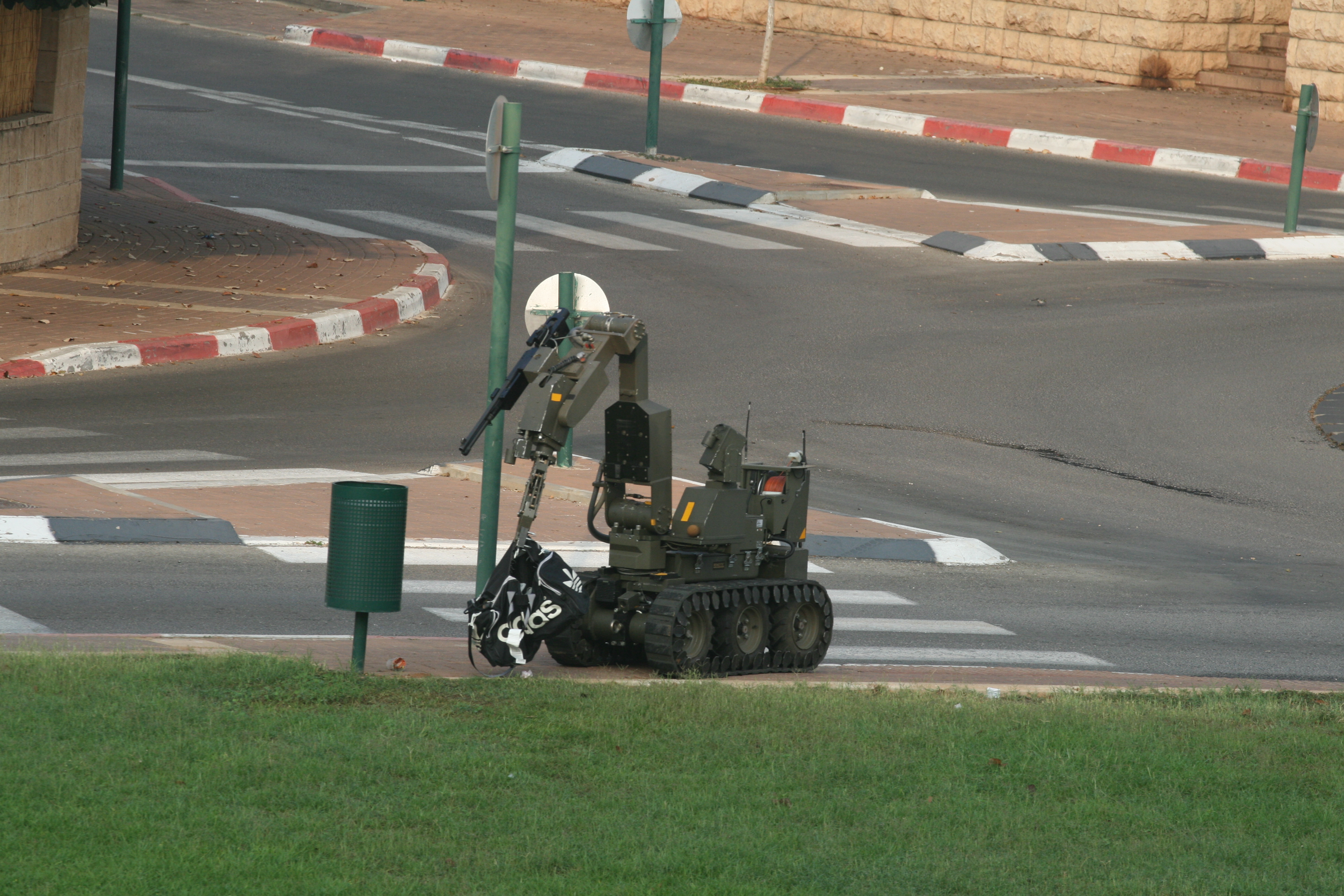
Illustrative only: a bomb-disposal robot operated by another agency, not Singapore's H2RC equipment. Photo by Israeli Police via Wikimedia Commons.

Illustrative only: an experimental mobile robot at a US research laboratory, not H2RC hardware. Photo by US Navy via Wikimedia Commons.

Illustrative only: a data centre aisle, not NGINE itself. Photo by Ifremer via Wikimedia Commons.