How 2026 Finally Delivers Smart-Home Mesh That Works
Thread 1.4, Wi‑Fi 7, and Matter converge to end two decades of fragmentation — and the result is invisible.
After more than 20 years of broken promises, the smart-home mesh network is finally arriving in a form that just works. Not as a single dominant standard, but as three interoperable technologies that have stopped getting in each other's way.
The long road to convergence
In the early 2000s, mesh networking was supposed to be everywhere. Researchers forecast hundreds or thousands of nodes daisy-chained like beads on a string, offering low cost, easy maintenance, and reliable coverage. Instead, the industry produced a succession of competing protocols — WirelessHART, Zigbee, Bluetooth mesh, Z-Wave — each claiming to be the solution, then flaming out or splintering into incompatibility.
"I expect that one mesh technology will eat all the others eventually, possibly incorporating them," said Mihail Sichitiu, professor of electrical and computer engineering at North Carolina State University. "Maybe not immediately, but eventually. Looking at how other things evolved, it's just a matter of time."
The convergence happening in 2026 doesn't look like that victory yet. It looks more like invisibility. Three separate but interoperable standards — Thread 1.4 for low-power sensors, Wi‑Fi 7 for high-bandwidth devices, and Matter as the translation layer between them — have matured simultaneously. If you open a Thread‑based smart lock from your phone over Wi‑Fi 7 and never wonder which standard carried the message, the convergence succeeded.
Thread 1.4 breaks the walled gardens
The critical piece fell into place on 1 January 2026, when Thread 1.4 became the Thread Group's only certified standard. Until then, each Thread network worked only with devices from the same brand. A Google mesh connected only to Google devices; Amazon to Amazon; Apple to Apple. That fragmentation was "a highly inconvenient stumbling block," said Aaron Striegel, professor of computer science and engineering at the University of Notre Dame.
Thread 1.4 introduces credential sharing — a mechanism that lets devices from different manufacturers securely join the same mesh. Your Amazon Echo Show and Apple HomePod mini can now both control the same Nanoleaf bulb. The feature works by allowing Thread border routers to exchange network credentials over a secure channel, so a device commissioned on one router automatically gains access to the entire mesh fabric.
"Thread 1.4 is a pretty big push toward avoiding the walled garden," Striegel said. "It is hard to have a crystal ball to look ahead, but the pieces are in place for improved interoperability."
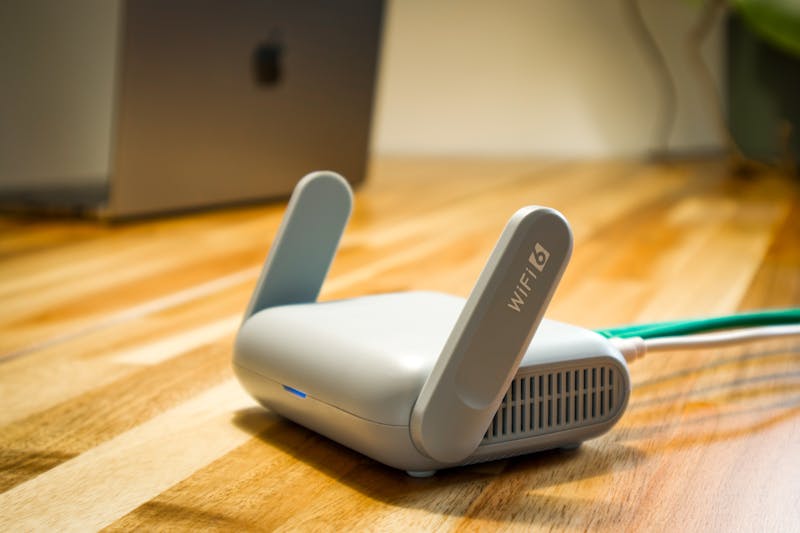
The hardware itself reflects the shift. Compact, pill-shaped nodes with Wi‑Fi 6 or Wi‑Fi 7 branding now serve as Thread border routers, bridging the low-power 802.15.4 radio used by Thread sensors to the high-speed Wi‑Fi backbone that carries video and voice. These nodes plug in unobtrusively on a desk or shelf, connected by a pair of Ethernet cables, and disappear into the room's decor — exactly where mesh belongs.
Why one standard never worked
The reason convergence took two decades isn't corporate stubbornness alone. It's physics.
"There's a second reason," said Myung Lee, professor of electrical and computer engineering at the City College of New York, who chaired IEEE 802.15 working groups on short-range wireless for over a decade. "The need for global interoperability drove the TCP/IP empire, but mesh networks largely occupy the edge. In the edge, the requirements are diverse."
Lee's working group developed separate tracks for different use cases: one for devices that need to last years on a battery (door sensors, leak detectors, environmental monitors), another for devices that need high throughput (laptops, smartphones, streaming hubs). No single standard could optimize for both ultralow power and high speed.
"That split alone illustrates why a single mesh standard is difficult," Lee said. "Because edge applications simply do not share a common set of constraints."
The three-layer stack
2026's answer is a layered approach that embraces the split rather than fighting it:
Thread 1.4 handles the low-power, always-on sensor layer — smart locks, motion detectors, temperature probes, and the thousands of battery‑operated devices that form the nervous system of a smart home. Its mesh topology means every device relays messages for its neighbors, so the network gets stronger as you add nodes. Thread's use of the IEEE 802.15.4 physical layer at 2.4 GHz gives it enough range to cross a typical home while sipping microwatts in sleep mode.
Wi‑Fi 7 (802.11be) handles the high-bandwidth layer — 4K video, gaming, video calls, and the fat pipes that plug into the internet. Wi‑Fi 7's multi‑link operation (MLO) lets a device transmit simultaneously across the 2.4, 5, and 6 GHz bands, aggregating bandwidth and slashing latency. Its 320 MHz channels and 4K-QAM modulation push peak throughput beyond 40 Gbps — throughput that Thread deliberately sacrifices for battery life.
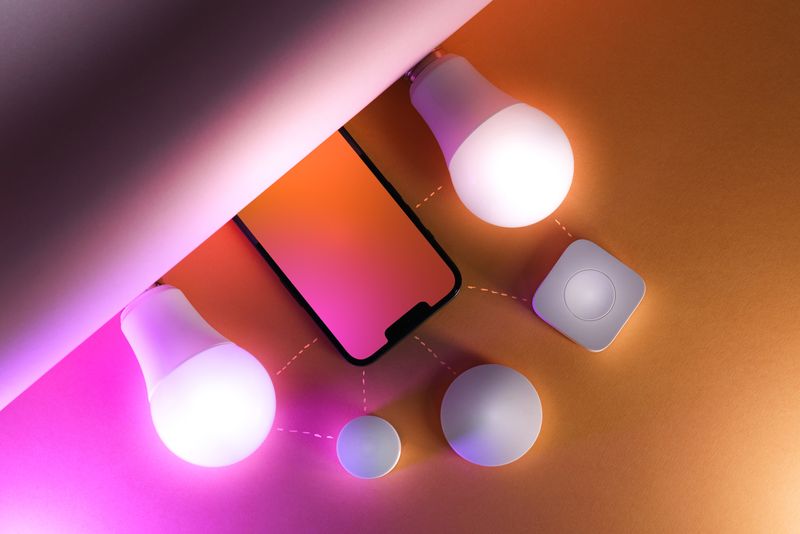
Matter sits between them as the application‑layer translator. It doesn't move bits; it defines a common vocabulary so a Thread lock, a Wi‑Fi camera, and a Zigbee bridge can all understand "lock," "open," and "is locked?" regardless of their underlying radio. Matter 1.3, finalized in late 2025, added support for energy management devices, EV chargers, and scene controllers, while Matter 1.4, expected in 2026, extends the model to water valves and ambient sensors.
Scale demands the convergence
The convergence isn't happening in a vacuum. Cellular IoT subscribers hit 4.2 billion at the end of 2025, up 11 percent year‑over‑year, and are forecast to reach 6.5 billion by 2030, according to ResearchAndMarkets' 11th‑edition M2M/IoT Communications Market Report. That's a 9.3 percent compound annual growth rate across 5G, LTE‑M, NB‑IoT, and emerging ambient IoT standards.
Inside the home, the same pressure applies. A typical household in 2026 runs dozens of connected devices — smart speakers, thermostats, cameras, doorbells, appliances, and the sensors that feed them. The network must handle intermittent low‑power chatter from a water‑leak sensor in the basement while simultaneously streaming 8K video to the living‑room TV. Thread and Wi‑Fi 7 divide that labor; Matter makes the division invisible to the user.
The installer's perspective
For system integrators who have spent years stitching together bespoke bridges between walled gardens, the convergence changes the economics of deployment. Previously, a smart-home project might require a dedicated Zigbee coordinator, a Z-Wave stick, a Thread border router, and a proprietary hub for each vendor's ecosystem — each with its own app, its own firmware update cadence, and its own failure modes.
With Thread 1.4 credential sharing and Matter's common device model, a single Thread border router can now serve as the gateway for every Thread device in the home, while Matter bridges expose Zigbee and Z-Wave devices through the same application layer. The result: fewer boxes on the wall, fewer apps on the phone, and a support burden that scales with the number of devices rather than the number of protocols.
"Standardized deployment mechanisms lower onboarding friction for new device fleets," said one integration lead at a mid-size security firm who asked not to be named. "Repeatable processes reduce project risk. And the hidden cost of one‑off configuration knowledge — the tribal lore that lives only in a senior technician's head — begins to erode."
The invisibility test
Success in 2026 doesn't look like a new logo on the box. It looks like nothing at all.
Consider a user opening an app on their phone, tapping a button to open a smart door lock, and the door opens — no setup headaches, no incompatibility warnings, no need to know whether Wi‑Fi 7 or Thread 1.4 ultimately relayed the message. The technologies themselves haven't merged into a single standard. But they have at least stopped getting in each other's way.
That invisibility — the way mesh fades into the background of daily life — is what makes the convergence worth marking. It represents a transition from networking as a specialty concern to networking as infrastructure, the way electricity stopped needing explanation once it worked reliably enough to power a lightbulb without a thought.
The mesh network of 2004's forecasts has arrived. It just doesn't announce itself.
Read more on this topic: IoT | Semiconductors
Source: IEEE Spectrum special report "Top Tech 2026" — "Three technologies are converging where one wasn't emerging" by Margo Anderson.