Galaxy SmartTag3 Breaks the Galaxy Lock: Bluetooth 6.0, iOS Sharing, and a 60-Meter Compass
Introduction
For most of its life, Samsung's item tracker has been the one consumer gadget in the SmartThings lineup that made an obvious, uncomfortable demand on buyers: buy a Galaxy phone. The Galaxy SmartTag line has been a Galaxy accessory since 2021, usable only through Samsung's own find network, useful only to people already inside the world's largest Android handset ecosystem. That constraint was the product's clearest weakness, and rivals have not been shy about naming it.
On September 30, 2026, Samsung Electronics announced the Galaxy SmartTag3 and removed the biggest of those constraints. The third-generation tag is the first in the SmartTag family to support iOS devices, opening its core location and sharing features to Apple hardware through SmartThings Find. It also moves the radio stack forward with Bluetooth 6.0 Channel Sounding, expands its directional Compass View range to roughly 60 meters, adds geofence-style Place Notification, and stretches its claimed coin-cell battery life to 550 days in normal use. For an IoT category that has spent five years being defined by which phone ecosystem owns your keys, that is a structural change rather than a spec-sheet refresh.
The Ecosystem Problem, and Why Cross-OS Changes It
Bluetooth item trackers work on a simple and often misunderstood principle. The tag itself has no network connection. It broadcasts a rotating Bluetooth identifier, and compatible phones nearby detect that broadcast and anonymously relay the location back to the owner's cloud account. The usefulness of a tracker is therefore not a property of the tag at all. It is a property of how many phones around you are willing to listen.
That number is where the competitive gap has lived. Apple's Find My network is described by Apple as spanning more than a billion iPhones, iPads and Macs. Google's Find Hub taps more than a billion Android devices, and Google finally put its own hardware behind it with the Pixel Tag announced in August 2026. Samsung has historically been the outlier, because its find network was confined to Galaxy hardware. Comparisons of the three platforms have consistently framed the SmartTag as the most restrictive of the major trackers, requiring a Galaxy phone for everyday use and a UWB-equipped Galaxy for the full precision experience.
Samsung's own numbers underline both the strength and the ceiling of the approach. The company says more than 900 million participating Galaxy devices worldwide can act as finding nodes, detecting a SmartTag and updating its location once it moves beyond the owner's direct connection range. That is a genuinely enormous relay fabric, and in markets where Samsung holds high handset share it is one of the densest available. But it is a closed fabric. An iPhone in the same airport terminal cannot hear a SmartTag, and a Pixel cannot either.
This is why the iOS support in the SmartTag3 matters more than a typical cross-platform checkbox. Through SmartThings Find, users on Galaxy and iOS devices can check and share a tag's location and use Search Nearby. Samsung's stated use case is the borrowed suitcase: a friend takes your luggage on a trip and can check its position from their own phone. That is a modest-sounding feature, but it points at a real household pattern, the split-ecosystem home where one person carries an iPhone and another carries a Galaxy, and where the previous SmartTag simply could not be shared at all.
The limits of the cross-OS work are worth stating plainly, because the footnotes matter more than the headline. Compass View, Ring Phone and Left Behind Alert are not available on iOS, according to Samsung's own documentation. The directional arrow experience that makes these tags genuinely useful remains a Galaxy-only feature. What iOS users gain is location checking and sharing, not parity. And Samsung has not confirmed whether non-Samsung Android phones will be supported, which The Verge noted it was still trying to establish. The tag becomes shareable, not universal.
Bluetooth 6.0 Channel Sounding and the 60-Meter Compass
The hardware story is more substantive than the compatibility story. The SmartTag3 relies on Bluetooth 6.0 Channel Sounding to drive Compass View, providing distance and directional guidance from up to 60 meters away. Samsung frames that as roughly three times the range of the previous generation, and SamMobile reported the same claim.
Channel Sounding is the mechanism that makes this possible. Rather than inferring distance from signal strength, which degrades badly indoors and around walls, the technique measures the phase difference between multiple radio frequencies to compute a genuine geometric distance. It is a fundamentally better approach to the ranging problem, and it is the same class of technology that has been reshaping the wider IoT sensing market, where accurate distance measurement without a cellular radio or a satellite fix is exactly the kind of capability that unlocks indoor automation, occupancy detection and asset positioning in warehouses and factories. It is worth noting for readers tracking the wider smart home connectivity roadmap that Google put the same technology into its Pixel Tag, which suggests this is becoming a category-wide baseline rather than a Samsung differentiator.
Two caveats apply. First, Samsung states that the 60-meter figure is measured under line-of-sight conditions with no obstacles between transmitter and receiver, and that accuracy degrades around electronic devices, walls and other physical obstructions. In a real house or a real city, expect considerably less. Second, Compass View requires a Galaxy device running Android 12 or later with either UWB support or Bluetooth Channel Sounding, and Samsung currently lists Bluetooth Channel Sounding as available on only four models: the Galaxy Z Fold8 Ultra, Galaxy Z Fold8, Galaxy S26 Ultra and Galaxy S26 Plus. Ultra-wideband takes over as users close in, delivering the finer precision that Bluetooth ranging cannot. The result is the layered finding experience the industry has converged on, coarse-to-fine, but it remains gated behind a short list of expensive handsets.
The physical design supports the story. The SmartTag3 is approximately 35% smaller by volume and 33% lighter than its predecessor, finished with an aluminum-decorated button and offered with a Silicone Case with keyring and a Loop Case. Notably, there is no built-in keyring cutout in the squircle body, so attaching it directly to keys or a carabiner requires buying a case. The tag retains an IP67 dust and water rating. That is a small design choice that slightly undermines the "attach it to your keys and forget it" pitch, and reviewers have noticed it.
From Passive Tag to Active Sensor
The third area of change is the alert set, and it reflects a broader shift in how IoT devices are being positioned: away from passive data loggers and toward devices that generate events. Place Notification lets a user define an area and be alerted when a tagged item enters or leaves it, drawing on Galaxy Find Network location data. The applications are ordinary and immediately legible, a pet leaving a garden, a bicycle moved out of its usual parking spot, a bag left behind at a venue. Movement Detection Alert covers smaller shifts, and Location History provides a log, retained for up to seven days.
There is also a physical control surface. SmartThings IoT Control lets the tag's button trigger preset routines on compatible connected devices, which extends the hardware beyond finding and into general smart home control, an approach already visible across current connected device platforms.
Lost Mode remains an NFC-powered feature, displaying pre-registered contact information or a short message when a lost tag is scanned with a compatible phone. Samsung states that location data is encrypted to help protect user privacy, and multiple outlets reporting the launch, including Techlomedia, repeated that the location data transmitted through the device is end-to-end encrypted.
That last point deserves more attention than product launches usually give it. A crowdsourced relay network is, structurally, a surveillance-adjacent system: strangers' phones reporting the whereabouts of an object that may be attached to a person. The industry answer has been rotating identifiers, periodic chirps audible to nearby phones, and unsolicited alerts pushed to users who did not initiate a search. Market analysis of the sector has tracked these mitigations as regulatory pressure rather than goodwill, and has noted that Samsung patched a relay-attack flaw in its SmartTag software in late 2025, forcing a firmware overhaul and introducing rotating identifiers. A tracker that now reaches iOS users inherits that entire dispute, whatever its encryption guarantees.
Battery, Price and What Actually Ships
Battery life is the SmartTag3's strongest headline number and the one Samsung is least likely to oversell by accident. The claim is up to 550 days under standard usage and up to 790 days in Power Saving Mode, running on a user-replaceable CR2032 coin cell and achieved at roughly 10% better power efficiency than the SmartTag2. Samsung is candid about the tradeoff: in Power Saving Mode, features including Compass View and ringtone settings become inaccessible, with the exception of basic finding over Bluetooth LE. Buyers wanting both the long life and the directional arrow have to pick one.
Pricing holds the category's line rather than trying to undercut it. Samsung confirmed a US price of $29.99 for a single unit and $99.99 for a four-pack, matching both the SmartTag2 and the current generation of Apple and Google trackers. Availability starts in Korea on October 7, 2026, followed by the United States in early November, with additional markets to follow in 2027. Colors are Black and White. SamMobile noted that Samsung had confirmed only the Korean date and that pricing details were still pending at the time of its writeup, so the US figures come from later reporting rather than the initial launch release.
For anyone weighing the three major trackers, the decision still starts with the phone in your pocket. AirTag remains the coherent choice for an all-Apple household, and the second-generation AirTag's January 2026 refresh added its own second-generation UWB chip, extended Bluetooth range and a 50% louder speaker at the same $29 price. The Pixel Tag is the broadest Android answer, working with Android 9 and later and sharing with up to ten people, though it did not go on sale until November 11, 2026. The SmartTag3's argument is narrower and more interesting: it is now the only major tracker offering native geofencing, cross-OS location sharing, a physical remote-control button and a 550-day battery claim at the same $29.99 price point. In a Galaxy household, or a mixed household that wants one tag everyone can see, that combination has no direct equivalent.
Conclusion
The Galaxy SmartTag3 is a routine product launch with an unusual structural change buried inside it. Samsung did not merely shrink a tag and extend its battery. It ended a three-year restriction that defined the product line, opening core location sharing to iOS users and, in the process, conceding that the Galaxy-only boundary was costing it real ground to AirTag and Pixel Tag.
The caveats are real and worth carrying into the purchase decision. Compass View and Left Behind Alert remain Galaxy-only, Bluetooth Channel Sounding currently reaches just four handsets, the 60-meter range assumes an unobstructed line of sight, and dropping the keyring cutout means buying a case before the tag can go on a set of keys. A tracker is a network before it is a device, and Samsung's 900-million-node fabric is impressive but still bounded by who owns which phone.
Still, the direction is unambiguous. Trackers are becoming event generators rather than passive locators, geofences and movement alerts are becoming table stakes, and Bluetooth 6.0 ranging is spreading across every major platform at once. The SmartTag3 is the first Samsung tracker that can participate in a mixed-ecosystem home. In a category where the phone you carry has always decided which tracker you are allowed to own, that is the update that matters.
Images
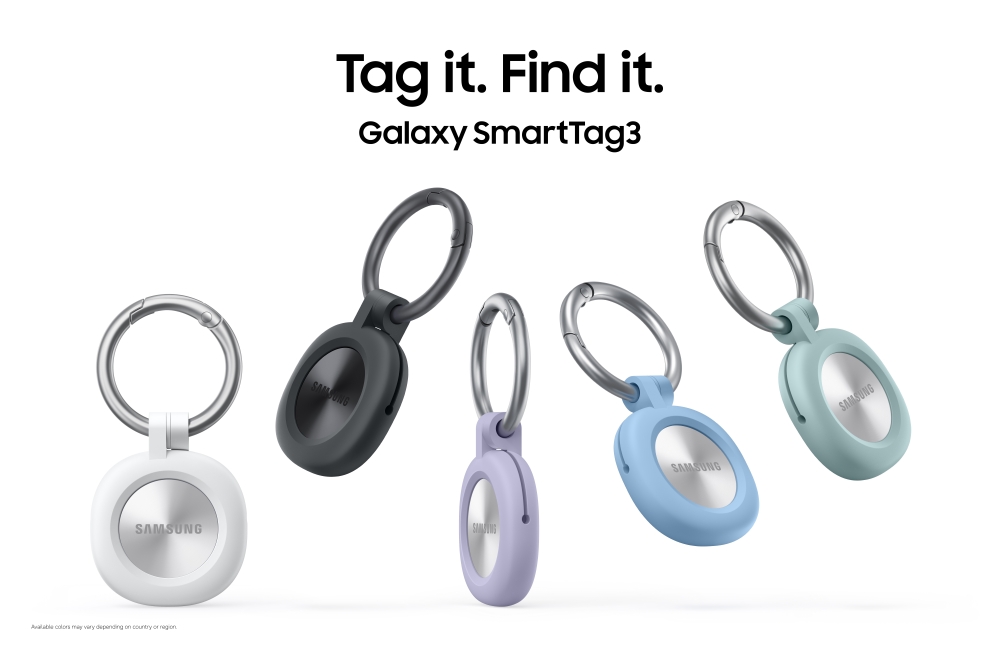
Samsung's official product graphic for the Galaxy SmartTag3 shows the tracker in five colors attached to circular key rings. Source: Samsung Newsroom.

Illustrative photograph of keys on a keyring, the kind of everyday item a Bluetooth tracker gets attached to. Source: Wikimedia Commons.
References
- Samsung Mobile Press — Galaxy SmartTag3 announcement and full specifications: https://samsungmobilepress.com/articles/samsung-galaxy-smarttag3-easier-tracking
- The Verge — Galaxy SmartTag 3 price, US release date and design details: https://www.theverge.com/tech/1002552/samsung-galaxy-smarttag-3-design-battery-price-features
- SamMobile — Galaxy SmartTag 3 iOS support, 60-meter Compass View range: https://www.sammobile.com/news/galaxy-smarttag-3-launched-lighter-smaller-ios-support/
- Techlomedia — Galaxy SmartTag3 pricing, encryption and feature summary: https://techlomedia.in/2026/10/samsung-galaxy-smarttag3-gets-smaller-design-550-day-battery-and-iphone-support-126927/