Thread Group Takes Mesh to Sub-GHz: Open IP Networking Targets the Industrial Long-Reach Gap
Introduction
For most of its life, Thread has had one radio band. The open, IPv6-based mesh networking standard runs on IEEE 802.15.4 hardware in the 2.4 GHz ISM spectrum, delivering 250 kbit/s across channels 11 to 26 with typical indoor per-hop range of roughly 20 to 30 metres. That profile is excellent for sensors inside a house and awkward for a sensor in a basement plant room, a hospital wing, or a car park on the far side of a distribution site.
On September 21, 2026, the Thread Group announced its Board of Directors had approved work to extend Thread to the Sub-GHz spectrum, opening a new physical layer for commercial and industrial deployments. The move, first reported by the Matter device tracker MatterDevices.io on September 23, targets a gap that has kept industrial buyers on closed vendor ecosystems for two decades: range and penetration without a proprietary protocol tax. The group says a distinct brand for the technology will be unveiled in the coming months, and that specification development is already underway.
Main Content
Why 2.4 GHz Has a Ceiling
The 2.4 GHz band is shared. Wi-Fi networks, Bluetooth accessories, and domestic appliances all occupy it, and low-power mesh radios sit in the middle of that congestion. The consequences are familiar to anyone who has debugged a flaky sensor network: packet retries, dropped links, and a mesh that needs extra routing nodes to bridge gaps that physics alone would not require.
Range is the other constraint. Higher-frequency signals attenuate faster and bend less around obstacles, so a Thread signal struggles with heavy concrete, dense metal structures, metal-studded walls, and long physical runs. A mesh mitigates this by adding hops, but every added hop is another battery-powered node to install, maintain, and eventually replace. In a single-family home that is a nuisance. Across a hospital campus, a multi-building industrial site, or a citywide lighting retrofit, it is a structural cost that makes the economics fall apart before the reliability question is even asked.
Sub-GHz operation sidesteps much of that. Bands around 868 MHz in Europe and 915 MHz in the Americas carry longer wavelengths, which travel farther and penetrate building materials more effectively. The trade-off is throughput: reference material puts proprietary Sub-GHz systems in the 9.6 to 100 kbit/s range, an order of magnitude below 2.4 GHz Thread. For a temperature reading, a valve state, or an occupancy bit, that ceiling is irrelevant. For video, it is disqualifying. The industrial IoT market overwhelmingly sends small packets, which is exactly why the band has been its natural home.
The Fragmentation Problem
The deeper issue is not physics. It is that industrial, healthcare, and building-management deployments adopted Sub-GHz radios years ago, but did so on proprietary or non-standard protocols. The hardware worked, and the range was excellent. What it did not produce was interoperability. Each vendor's sensors, gateways, and commissioning tools were welded to a closed ecosystem, and buyers absorbed that lock-in as the price of the range they needed.
Thread's pitch is that the problem is now solvable with open standards. Because Thread operates directly on IP, every device is individually addressable, and application data routes to and from wider networks without an application-layer gateway. The Thread specification layers 6LoWPAN adaptation over 802.15.4, carries UDP for mesh maintenance and most traffic, adds a TCP profile in Thread 1.3, and uses CoAP over UDP for request-response with retries, plus DTLS for secured commissioning. The result is a network that joins existing IP infrastructure rather than requiring a translation layer.
Border routers are the component that makes this practical. A border router provides bidirectional connectivity between a Thread network and other IP-based networks such as Wi-Fi or Ethernet, translating between them and enabling service discovery across boundaries. Extending that architecture to Sub-GHz means a large property can be covered without an army of repeaters, and without a second class of gateway that is itself a single point of failure.
"Bringing Thread's benefits to Sub-GHz is a natural next step in our mission to deliver reliable, secure, and low-power wireless mesh network to diverse IoT environments," said Ann Olivo, Vice President of Marketing for Thread Group. "To address industry fragmentation and ensure the widest success, the effort will rely on the collaborative input and efforts of our dedicated membership."
The group is inviting companies with Sub-GHz expertise to participate, which is a meaningful signal about how much of the specification is still open work.
A Standards Race With Zigbee
Thread is not making this move alone. The Connectivity Standards Alliance, which also administers Zigbee, has opened its Product Certification Program for Suzi, Zigbee's sub-GHz extension, covering hardware operating outside the 2.4 GHz band in frequencies such as 800 MHz in Europe and 900 MHz in North America. Notably, Suzi sits on top of Zigbee's existing network layer rather than replacing it, and making both bands work together depends on bridge devices that operate across 2.4 GHz and sub-GHz radios simultaneously. Those bridges let deployments expand gradually while keeping compatibility with Zigbee devices already in the field, and devices that already carry sub-GHz radios can add Suzi functionality without extensive hardware redesign.
That is the structural contrast worth tracking. Zigbee reaches sub-GHz by extending an established, non-IP network and paying for it with mandatory bridge infrastructure between bands. Thread reaches sub-GHz by extending an IP-native protocol, where an IP-capable host can address a sub-GHz node the same way it addresses a Wi-Fi device. Matter over Thread deployments, in particular, inherit the seamlessness of a single addressing model.
This is also not a retreat from the smart home. Thread's own roadmap has been progressively industrial: Thread 1.3 shipped in 2022 alongside Matter 1.0, Thread 1.4 followed in September 2024 with an explicit push toward larger commercial and industrial deployments, and by November 2025 the Thread Group reported more than 1,000 certified Thread products on the market, roughly a tenfold increase in two years, across more than 230 member companies. Sub-GHz is the logical next constraint to remove. If an application layer such as Matter eventually adopts Sub-GHz Thread transports, the near-term beneficiaries would be exactly the cases that frustrate users today: garden and perimeter sensors, outdoor lighting, detached garage and outbuilding controls, and gate and fence locks that sit beyond the reliable reach of an indoor 2.4 GHz mesh.
Conclusion
There is nothing to buy yet. The Thread Group has approved the work, not shipped it; the specification is in development, the brand does not exist, and the timeline for certification is unstated. Anyone planning a deployment in the next several quarters should treat this as a roadmap signal rather than a procurement option.
What is concrete is the direction. Thread Group is applying the same consensus process that produced every prior Thread specification to a band the industrial market already relies on, and it is doing so in a way that keeps devices on IP end to end. If the specification lands with the compatibility the group has promised, the practical effect is a narrowing of the old split between reliable long-reach industrial radio and addressable open networking, which has been the single most stubborn gap in the IoT stack for years.
For the broader Internet of Things ecosystem, this is the kind of infrastructure work that rarely produces a headline product and quietly determines what can be built on top of it. The semiconductor vendors who already ship Sub-GHz-capable silicon are the ones with the most obvious near-term interest.
Images
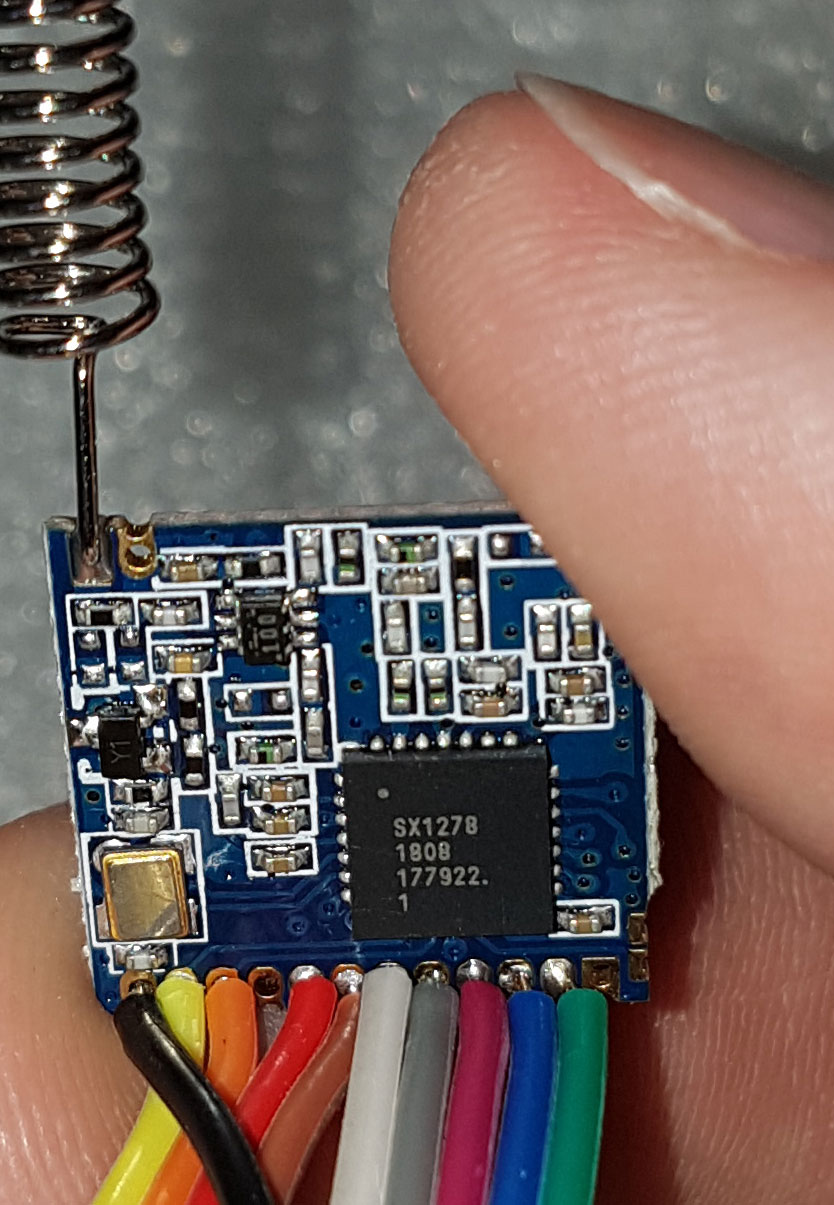
A sub-GHz radio module of the kind Thread's new physical layer will target. Illustrative hardware, not a Thread Group product — the exact frequency and protocol cannot be determined from the photo.

A compact battery-powered wireless node built for long-range, low-power sub-GHz operation. Illustrative of the device class the Sub-GHz expansion aims to serve.
References
- Thread Group is Bringing the Benefits of Thread to Sub-GHz — Thread Group newsroom, September 21, 2026
- Thread Is Getting A Sub-GHz Version — MatterDevices.io, September 23, 2026
- Thread (network protocol) — technical specification and version history
- CSA opens certification for Zigbee sub-GHz extension Suzi — IoT Tech News