Factory Digital Twins Accelerate IIoT Adoption as PepsiCo, Unilever Report Real-World Gains
PepsiCo achieves 20% throughput increase
PepsiCo reported a 20% throughput increase at U.S. facilities within weeks of deploying Siemens' Digital Twin Composer, the company said in a press release. The food and beverage giant's digital twin implementation began at a single bottling plant and has since expanded to multiple facilities, with the system integrating data from PLCs, SCADA historians, and IoT sensors across the production line. The digital twin gave them a sandbox to test changes risk-free. They could validate layout modifications and process adjustments in the virtual world before committing to physical changes. The pilot started at a high-volume bottling line producing carbonated soft drinks, where even a 1% efficiency gain translates to millions of dollars in annual savings. After the initial success, PepsiCo extended the digital twin to snack food packaging and dairy processing plants, creating a company-wide framework for continuous improvement through virtual simulation.
Unilever and Accenture see 20% waste reduction and 30% defect reduction
Unilever and Accenture reported in June 2026 that AI-enabled digital twins across five manufacturing sites in four countries delivered site-specific results including 20% waste reduction at Raeford, NC and 30% quality defect reduction at Gandhidham, India, with plans to build more than 40 new twins over the next 18 months. The Unilever Press study highlighted that the digital twin approach allowed the consumer goods company to simulate production scenarios that would have required shutdowns in the physical world — instead, engineers ran simulations overnight and implemented changes during planned maintenance windows. The Raeford facility, which produces personal care products, had struggled with raw material yield losses that averaged 8% per quarter before the digital twin. After implementing simulation-based optimization, yield improved to 5.2% within two reporting periods, representing notable cost avoidance on a high-volume production line. The Gandhidham plant, which manufactures home care products, reduced defect rates from 4.7% to 3.3% through predictive quality models that identified root causes before defects reached final inspection.
Siemens' closed-loop architecture
A factory digital twin is a continuously synchronized virtual model of a physical production environment. Sensor data from PLCs, SCADA systems, historians, and IoT devices flows into the digital model through OPC-UA, Modbus, or REST API connectors. The model reflects real-time equipment states, process variables, and material flows, then feeds optimization recommendations back to the physical plant. This closed loop distinguishes a digital twin from a static 3D model or a dashboard. A static visualization shows what happened; a digital twin simulates what will happen, then acts on it. The synchronization happens at millisecond-scale intervals for critical control loops, while less time-sensitive data such as maintenance histories are batched every few minutes. The digital twin platform can host multiple simultaneous scenarios — what-if analysis for production schedule changes, energy optimization runs, and quality prediction models — all drawing from the same real-time data foundation.
Gartner's market forecast
Gartner predicts that by 2030, semi-autonomous AI agents will orchestrate 10% of key production operations, quality control, and maintenance use cases, up from a fraction today. The analyst firm values the global digital twin market at $49.47 billion in 2026, and industry analysis reports 38.7% CAGR growth with 92% of adopting companies achieving ROI above 10%. MindInventory's independent research corroborates the high satisfaction rate among early adopters, noting that companies see payback within the first year of deployment. The firm's 2026 hype cycle places digital twins at the "innovation trigger" phase, predicting mainstream adoption within two to five years as tooling costs decline and talent availability improves. Gartner also forecasts that by 2028, 40% of large industrial enterprises will have a dedicated digital twin program managed from a central team, up from single-digit adoption today.
From BMW's 30 sites to mid-market adoption
BMW's program is the most visible, but the technology is spreading beyond automotive and consumer goods. Mid-sized manufacturers are gaining access through cloud-based twin platforms that require less upfront investment in on-premises infrastructure. The connectivity standards that underpin Industry 4.0 — OPC-UA for legacy equipment integration, MQTT for real-time data streams, and REST APIs for cloud connectivity — have lowered the barrier to entry. IoT gateways from vendors such as Siemens, Schneider Electric, and Pepperl+Fuchs now ship with digital twin toolkits as standard features, exposing pre-built connector libraries for common factory equipment such as motors, pumps, and conveyors. A food and beverage company in the Midwest deployed a digital twin for a bottling line in less than six weeks using a cloud platform and off-the-shelf connectors, achieving a 7% throughput improvement in the first quarter of operation. The total cost of ownership for a mid-sized digital twin deployment now ranges from $500,000 to $2 million annually, depending on scale and data volume, compared to $5 million-$20 million for large-scale enterprise implementations a few years ago.
Challenges remain
Despite the progress, adoption hurdles persist. Data integration remains the biggest challenge — factories often run a patchwork of proprietary protocols and legacy systems that require custom connectors. A single automotive assembly plant may run equipment from a a dozen different vendors, each with its own data format and interface protocol. Cybersecurity is another concern, as each new connected device expands the attack surface. Factory networks that were once air-gapped are now being connected to cloud platforms, requiring new segmentation and zero-trust architectures. And while the ROI case is strong for large-scale operations, smaller factories often struggle to justify the upfront investment without a clear use case. The Connectivity Standards Alliance continues to work on standardized interfaces that could further reduce integration costs, but widespread adoption of new standards typically requires three to five years from specification to production use.
The path forward
As the technology matures, the focus is shifting from individual use cases to enterprise-wide digital twin strategies. Gartner predicts that by 2027, 50% of large industrial enterprises will have a dedicated digital twin program managed from a central team. For manufacturers ready to start, the recommended path is to identify a single production line or process area, implement sensors and connectivity, and build a twin for that scope before expanding. The companies that move first will have a key advantage — not just in operational efficiency, but in the ability to experiment with new production models without disrupting ongoing operations. The convergence of digital twins with edge computing and 5G campus networks will enable real-time simulation at the shop floor level, reducing latency from sensor data to virtual model update from milliseconds to sub-millisecond ranges. This opens the door to closed-loop control where the digital twin doesn't just recommend actions — it automatically sends set points back to programmable logic controllers and distributed control systems, creating a fully autonomous optimization cycle.
Sources: BMW Group press materials, PepsiCo press release, Unilever Press June 2026 study, Gartner Market Guide for Digital Twins 2026, MindInventory industry analysis, Siemens Digital Twin Composer documentation.
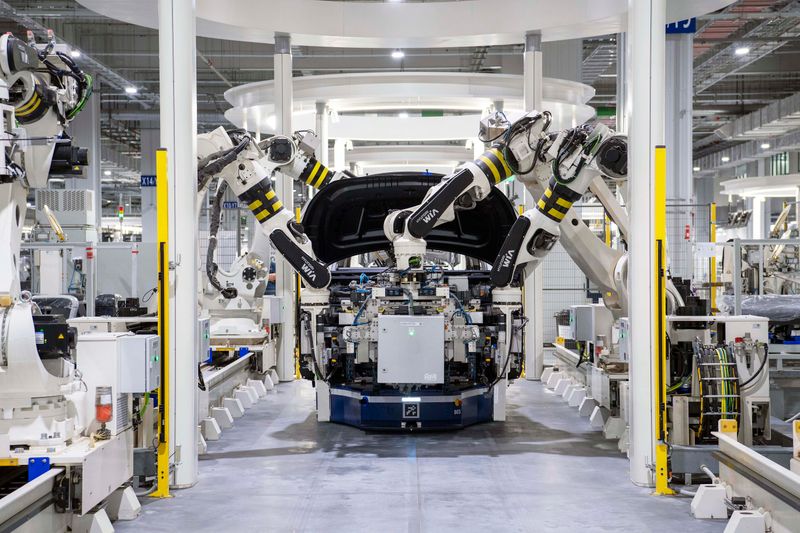
Factory floor with IoT sensors and digital monitoring screens. Photo by Pexels user.
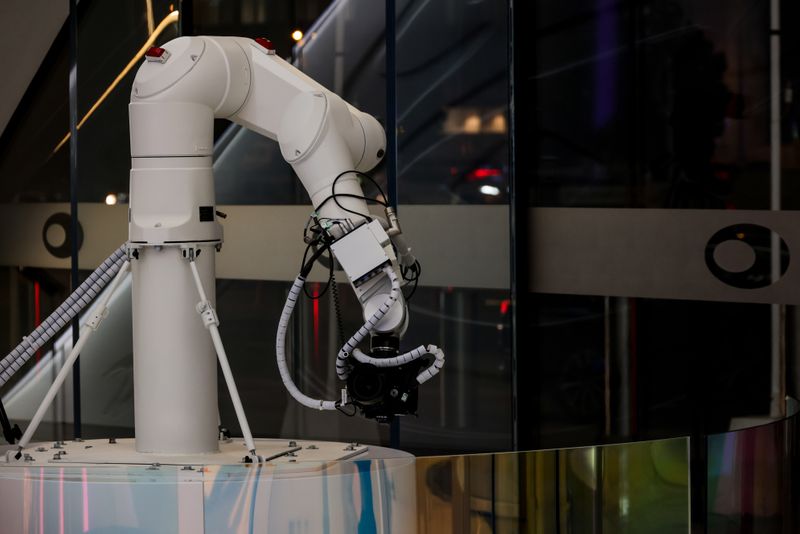
Robotic arm in modern industrial setting. Photo by Pexels user.
Keywords: iiott, digital twin, industry 4.0, IoT, manufacturing, factory automation
Internal links: IoT, Robotics & Drones, EV
Outbound links: iiiot-world.com — Build a Factory Digital Twin in 14 Weeks, Siemens Press — Digital Twin Composer, Unilever Press — AI-enabled digital twins deliver 20% waste reduction, Gartner — Market Guide for Digital Twins