Apple is finally moving to turn its smart home ambitions into real products. A new report from Bloomberg's Mark Gurman, published July 28, reveals that Apple has three new smart home devices "nearly ready to launch," as reported by Bloomberg. The lineup includes an updated Apple TV 4K set-top box, a refreshed HomePod mini, and an entirely new product category — the Home Hub — a dedicated smart display that puts Siri AI at the center of the connected home.
The hardware push marks Apple's most aggressive foray into the IoT-driven smart home space, an arena where the company has long been considered a laggard behind Amazon's Echo ecosystem and Google's Nest lineup. But with Siri AI now maturing across iOS 27 and the broader Apple software stack, the Cupertino giant appears ready to change that.
New Apple TV and HomePod Mini — Siri AI gets a hardware home
The first two devices landing this fall are iterative upgrades that will look familiar. Bloomberg reports that both the new Apple TV 4K and the refreshed HomePod mini will keep the same industrial design as their current versions. What's new is the chip inside: both products will pack faster processors to run Siri AI locally, enabling more responsive voice commands, better natural language understanding, and on-device intelligence that doesn't need to phone home to the cloud for every request.
The current Apple TV 4K runs on the A15 Bionic chip, which first appeared in the iPhone 13 generation. The current HomePod mini uses the S5 chip, the same processor that powered the Apple Watch Series 5. Both are due for an upgrade that Apple's smart home plans now demand.
Pricing stays where it is: the new Apple TV will sell for $199, and the HomePod mini will cost $129. These fall launches are timed to coincide with the broader rollout of Siri AI capabilities across Apple's operating systems, a feature set the company highlighted at WWDC 2026 but couldn't fully demo on existing hardware that lacks the necessary neural engine horsepower.
The Home Hub — Apple's long-awaited smart display
The most important product in Apple's pipeline is the Home Hub, an all-new smart display that combines a HomePod-like speaker with a roughly seven-inch square screen. This is the device Apple has been rumored to be working on for years, reportedly codenamed J490 internally, and it's slated to ship between October 2026 and early 2027.
Two versions are in development. The first, J490, places the screen on a half-dome-shaped base that resembles half a HomePod mini — a tabletop design meant for kitchens, living rooms, and bedrooms. The second, codenamed J491, is designed to be affixed to a wall using a new magnetic mounting system, similar to MagSafe but adapted for home fixtures. Apple reportedly believes customers will buy multiple Home Hub units and place them throughout their homes.
The Home Hub runs an entirely new operating system built on top of tvOS. The interface is described as a blend of tvOS, watchOS, and iOS elements — a grid of apps, widgets, and customizable clock faces that adapt to the person looking at the screen.
The hallmark feature is facial recognition. Using the built-in camera, the Home Hub can identify who is standing in front of it, then personalize the display accordingly. Your calendar, reminders, notes, and photos show up when you're near the screen, while someone else in the household sees their own information. The hub also detects how far away the user is — someone across the room sees scaled-up information with fewer details, while someone standing close gets a richer interface.
Beyond personalization, the Home Hub handles the full range of smart home tasks. It serves as a HomeKit command center for controlling lights, thermostats, locks, and sensors. It supports FaceTime video calls, acts as an intercom system for households with multiple Apple home devices, and handles audio playback through connected HomePods. It also monitors home security camera feeds, turning the screen into a security dashboard.
Apple is also working on an advanced in-home security camera to compete with Amazon's Ring, though that product is further out.
The delay in getting these products to market has been directly tied to Siri's development struggles. Apple originally planned to launch smart home hardware in spring 2025, but the timeline slipped repeatedly as the company rebuilt Siri's underlying architecture. The lack of Apple TV or HomePod announcements at WWDC 2026 was itself a clue — Apple couldn't discuss Siri AI features on hardware that didn't yet support them.
Now that Siri AI is approaching production readiness across iOS 27, iPadOS 27, and macOS 27, the hardware bottleneck is finally clearing. The new chips in the Apple TV and HomePod mini are specifically designed to run Siri AI inference locally, reducing latency for voice commands and keeping user data on the device rather than sending it to Apple's servers.
What this means for the smart home ecosystem
Apple's push comes at a pivotal moment for the smart home industry. The Matter protocol, now in its second major version, is finally delivering cross-platform compatibility between devices from different brands. Thread networking is maturing, with Thread 1.4 bringing better battery life and mesh reliability to smart sensors and locks. But the smart home still lacks a clear winner on the voice assistant front, and that's the gap Apple is aiming to fill with Siri AI.
Amazon's Alexa has the broadest device ecosystem but has struggled with monetization and AI capability perception. Google Assistant has lost strategic focus inside the company's restructuring. Siri AI, by contrast, benefits from Apple's tight hardware-software integration and its growing installed base of over 2 billion active devices. If the Home Hub delivers on its promise of a responsive, privacy-focused, context-aware smart home assistant, it could shift the competitive balance.
The timing also matters for the broader IoT sector. With the global installed base of active IoT devices projected to reach 21.9 billion endpoints by the end of 2026 — excluding smartphones, tablets, and laptops — the smart home segment is one of the fastest-growing verticals. Apple's entry with a dedicated hub validates the category and pressures rivals to accelerate their own roadmaps.
Matter, HomeKit, and the road ahead
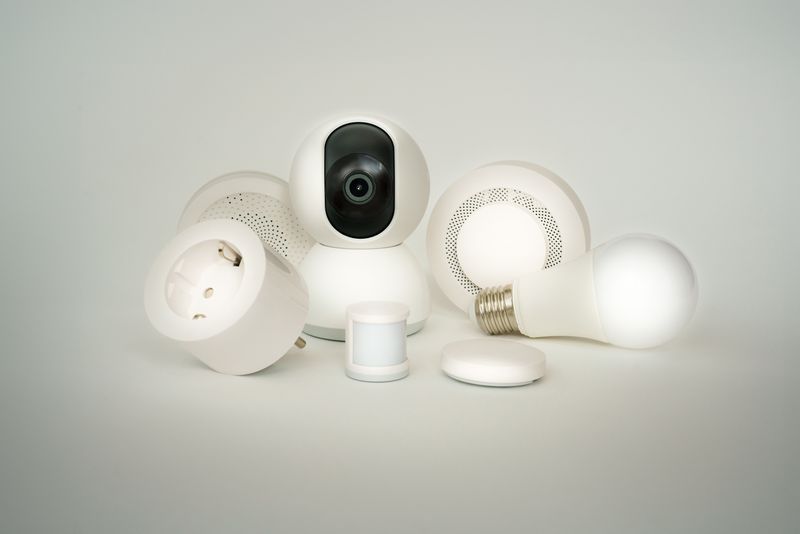
The Home Hub will support HomeKit out of the box, and given Apple's membership in the Connectivity Standards Alliance, it will also work with Matter-certified devices from third-party brands. This means a Home Hub can control a Matter-compatible smart lock from Yale, a Thread-enabled motion sensor from Eve, or a smart plug from TP-Link — not just Apple's own accessories.
Apple's long-term roadmap goes even further. Bloomberg reports that the company is developing a higher-end robotic version of the home hub with a roughly nine-inch display, set for a later release. This device would add a robotic arm that can tilt and rotate the screen to follow the user around the room. It's the kind of ambitious, design-forward product that only Apple seems willing to attempt at consumer scale.
For smart home enthusiasts who have invested in HomeKit-compatible gear over the years, the Home Hub represents the central command station that has been missing from Apple's lineup. Currently, HomeKit users need an Apple TV, HomePod, or iPad to act as a home hub — none of which were designed primarily for that role. A dedicated device with a persistent display, facial recognition, and always-on Siri AI changes the equation entirely.
The Matter 1.4 specification, which the Connectivity Standards Alliance finalized earlier this year, has also simplified the cross-platform experience. Devices that carry the Matter badge can now be set up with any major ecosystem — Apple Home, Google Home, Amazon Alexa, or Samsung SmartThings — using a single QR code scan. For Apple, this removes the objection that HomeKit users can only buy from a limited pool of accessories. A Home Hub running Matter will work with hundreds of certified products from dozens of brands.
For now, the immediate lineup of Apple TV, HomePod mini, and Home Hub gives Apple a credible three-device smart home strategy for the first time. The pieces are falling into place: Siri AI as the intelligence layer, HomeKit and Matter as the connectivity fabric, and a growing portfolio of first-party hardware that anchors the experience. The question is whether consumers — many of whom already own iPhones — will finally buy into Apple's vision of the connected home.
According to IoT Analytics, the global smart home market is projected to grow at a compound annual rate of 9.3 percent through 2030, reaching $274 billion. Apple is betting that Siri AI will be the differentiator, and readers can explore more AI coverage on the site that captures a meaningful slice of that growth. The bets start landing this fall.