
WASHINGTON, Aug. 4, 2026 — The World Bank is telling low- and middle-income countries to stop waiting for the frontier and start using the AI tools that already exist. A new flagship report argues that artificial intelligence could let developing economies cover in a decade what previously took a century, but only if governments move fast to fix the missing basics: power, connectivity, skills, and decent institutions.
This report, the World Development Report 2026, is the first comprehensive look at what AI actually means for the developing world. It is not abstract optimism about robots and chips. It is a guide about which countries are already using cheap, small AI tools to solve real problems, and which ones are at risk of falling further behind.
Why the job numbers cut the other way
The Bank found that workers in high-income countries are more than three times as likely to see their jobs automated by generative AI as workers in poorer countries. In rich nations, about 14.2 percent of existing jobs are at risk. In low- and middle-income countries, the figure drops to 4.5 percent.
That sounds counterintuitive. Western tech workers are the ones typing into ChatGPT all day, so why are they the most exposed? Because the tasks generative AI does best — writing, coding, drafting, analyzing documents — are weighted toward the office work that makes up a bigger share of rich-country economies. Poorer economies lean on farming, physical labor, and informal services, where a chatbot has less to grab onto.
The flip side matters just as much. The Bank says 16.2 percent of jobs in developing economies could see their productivity meaningfully boosted by AI. That is close to the 18.7 percent expected in high-income countries. So the gap is a lot smaller on the opportunity side than on the risk side. AI is not mainly a threat to poor countries' jobs; it is mostly a chance to make those workers more effective at what they already do.
Adopt, adapt, then advance
Indermit Gill, the World Bank Group's chief economist, put the message bluntly. "AI has thrown developing economies a lifeline, and they should seize it," he said. "They do not need large models or big data centers to reap its benefits."
Gill's point is the report's core argument, and it cuts against the instinct of any finance minister who reads about trillion-dollar data centers in the press. The Bank wants governments to adopt tools that already work, adapt them to local conditions, and only then, slowly, think about moving toward frontier AI. Trying to replicate advanced models before the foundations are in place, the report warns, is a costly way to waste money.
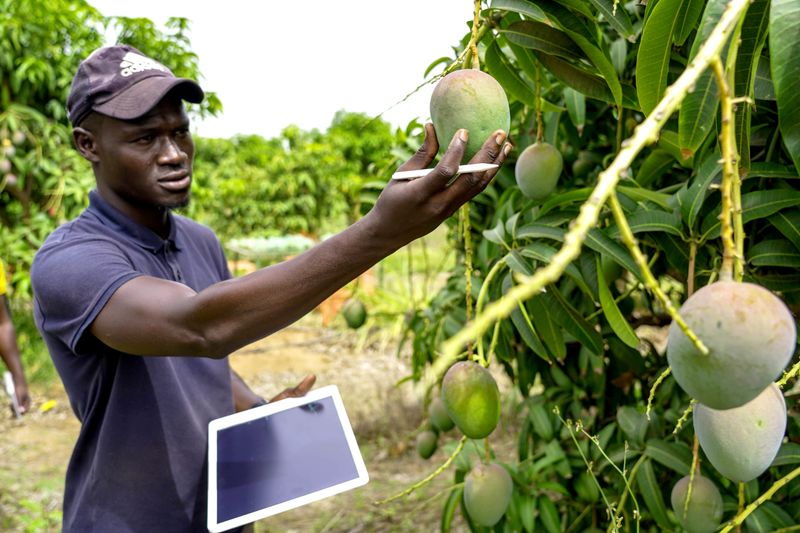
The report's examples are concrete. AI tools can help a doctor with no specialists on call make a better diagnosis. A farmer can get a more reliable read on what to plant and when, using weather and soil data that used to require an extension officer. A tax office with thin staffing can use models to spot obvious gaps in records. A ministry responding to a flood or a drought can route aid faster.
Gaurav Nayyar, who directed the report, pointed to the time pressure. "The window to get this right is narrow," he said. "AI presents a once-in-a-lifetime opportunity to solve problems that have resisted solutions for generations. Developing countries that build the foundations now — power, connectivity, skills, and institutions — will be positioned to adopt and adapt AI for their people."
The basics come first
The report is blunt that none of this works without electricity and internet. In Sub-Saharan Africa, nearly one-third of rural schools still lack reliable electricity, and more than two-thirds lack dependable internet access. That is the ground condition for everything else.
The Bank is already trying to move that needle. Through an initiative called Mission 300, it and its partners aim to bring energy to 300 million people in Sub-Saharan Africa by 2030. Those power connections, the report argues, are what make digital services and AI tools reachable for the people who need them most.
The report also calls for expanding access to computing power and for building local data sets, including in local languages. An AI model trained mainly on English news helps a Kannada-speaking farmer far less than a tool built around the crops, prices, and speech patterns it actually encounters. Without local data, the Bank says, AI will stay a product of the rich world, aimed at the rich world.
The catch: AI can widen gaps too
The report is careful not to sell a silver bullet. The most advanced systems are being built by a small handful of countries and companies. If poorer economies do nothing, AI could widen the divide between countries, push inequality up inside them, concentrate market power in a few firms, and weaken trust in public institutions.
There is also a governance angle. The Bank recommends that governments start with voluntary industry standards for responsible use, anchored in international cooperation so rules do not splinter across borders. When voluntary measures fall short, it says, apply existing laws to deal with the harm. It also warns that trust is hard to win back once people believe AI has embedded bias in government decisions or eaten away at data privacy.
How the report sees the risks of doing nothing
The World Bank's framing is built on a warning as much as a promise. AI's benefits are real, but so are the failure modes, and the report names the ones it worries about most.
Take market concentration. Frontier models are expensive to train, which means a few companies and a few countries hold most of the computing muscle. If developing economies simply consume tools built elsewhere, they pay for access with data, and they stay dependent on foreign infrastructure. The report wants local data and local computing to break that loop.
Inequality inside countries is another concern. In a place where a small, educated elite already has electricity, phones, and good internet, AI widens the gap between that elite and the rural majority who do not. The same technology that lifts one district can leave the next one untouched if the connections are not there.
And there is the question of trust in government. If a state deploys AI for tax collection, welfare payments, or public records, citizens need to believe the system is fair. A model that quietly repeats past bias in who gets inspected, who gets aid, or whose application is flagged will erode confidence fast. Once that trust is gone, the report argues, it is very hard to rebuild.
That is why the Bank pairs its enthusiasm with a governance checklist. Start with voluntary industry standards, backed by international cooperation to stop rules from fragmenting. If voluntary measures fail, fall back on ordinary law. The aim is to get the benefits without letting the harms corrode the very institutions AI is meant to strengthen.
What it means in practice
For policymakers in Jakarta, Nairobi, or Lima, the report amounts to a shift in emphasis. The AI debate in rich countries has centered on frontier models, safety labs, and billion-dollar compute clusters. The World Bank is arguing that the bigger, sooner payoff in much of the world is a narrower one: take a working tool, localize it, and put it in the hands of a doctor, a farmer, or a civil servant who has never had that kind of help before.
None of this is meant to dismiss the frontier. But the sequencing is deliberate. Build the power, the connections, the skills, and the institutions, and the door to bigger AI stays open. Skip those steps and even the best model is a machine that a large share of the population cannot plug in.
The message to governments is simple to state and hard to execute: hurry, because AI is spreading faster and is more context-specific than earlier general-purpose technologies like electricity or the internet. The full World Development Report 2026 is available on the World Bank's website . Reuters has covered the launch , and you can read more coverage in our AI section and related analysis on artificial intelligence policy at this site.