Washington Slaps Tariffs of Up to 100% on Imported Drones, and the Industry Is Already Feeling the Effects
The White House signed off on a Section 232 order on August 13 that puts a 100% tariff on the biggest, most capable imported drones, a 25% rate on smaller models, and lower bands of 15% and 10% for allied producers. The move caps a year-long Commerce Department investigation into how dependent the United States has become on foreign factories for unmanned aircraft, and it lands at a moment when drones have become the defining weapon of modern conflict.
President Donald Trump announced the measures, the latest twist in a robotics and drones trade fight that has been escalating since December in a proclamation that adopts Commerce Secretary Howard Lutnick's finding that America is "too reliant on foreign sources of UAS and UAS components," as the DroneXL trade publication summarized the investigation's conclusion. Most of the new duties take effect on September 3, three weeks after signing, with a second tranche on less sensitive components arriving 180 days later, in February 2027.

The 100% Bracket Targets Heavy Drones, Thermal Cameras, and Docking Stations
The top rate applies to drones with a maximum takeoff weight above 25 kilograms (55 pounds), any aircraft carrying a thermal imager, plus their docking stations and a list of critical components spelled out in the proclamation's annex. Nearly everything else hobbyists and small businesses fly, from a 249-gram Mini to a Mavic, falls into the 25% tier.
The duties are calculated on declared import value rather than retail price, so a 25% tariff does not mechanically add 25% at the register. What importers pass through to buyers is their own call, and the last round of China duties demonstrated that they pass through plenty.
The White House fact sheet frames the whole program as a national security matter. Drones used for both commercial and military purposes rely on foreign sources for critical components, which the administration says poses risks to U.S. security and creates cybersecurity vulnerabilities. The proclamation also authorizes Commerce to build an onshoring program for companies making new investments in American drone manufacturing, though the agency has not yet published how a company would qualify.
Allied Producers Get a Discount, With a Catch
European Union manufacturers face a 15% rate, the same band applied to Japan, South Korea, Switzerland, Liechtenstein, and Taiwan. British-built models get the lowest rate at 10%.
The discount comes with a condition that is harder to meet than it reads: to qualify, "substantially all hardware, software, and technology" must originate in those countries or the United States. The proclamation itself concedes that most commercial and industrial drones, including many assembled in the United States, incorporate parts produced overseas. Motors, electronic speed controllers, and lithium-ion batteries still come overwhelmingly out of the Chinese supply chain.
That puts Europe's drone champions in an awkward spot. France's Parrot, whose ANAFI range is certified under American defense procurement rules and is the default non-Chinese option for Western police forces, is the most directly exposed listed manufacturer. Germany's Quantum Systems, valued above €1 billion, sells reconnaissance aircraft to American customers, and Portugal's Tekever, worth over €1.1 billion, has been expanding into the U.S. For some, geography softens the blow: Quantum Systems already runs production facilities in the United States, so for them the tariff is an argument for accelerating plans already under way, as Euronews reported.
A drone that fails the origin test does not simply lose the discount. It falls back into the 25% or 100% bracket depending on size and capability.
The Tariff Stacks on Top of the Wall the FCC Built
The new duties arrive eight months after the Federal Communications Commission added all foreign-made drones and critical components to its Covered List on December 22, 2025, blocking new model authorizations. In late July 2026 the agency proposed banning imports of previously approved thermal, LiDAR, spray, and docking hardware outright under Docket 26-189.
The capability lines match almost exactly. The FCC's pending import ban targets thermal sensors, docking stations, and aircraft at 55 pounds and up; the tariff order's 100% tier covers the same features. One proceeding proposes removing these products from the market, the other doubles their landed cost in the meantime. Public comments on the FCC proposal close September 2. The tariffs hit September 3.
There is also a shared off-ramp. Products the Department of War approves for a Covered List exemption within 20 days of signing get the delayed February 2027 tariff date, the same Blue UAS and Conditional Approval channel that had previously kept some foreign hardware flowing to government buyers.
Drone Stocks Moved the Moment the Order Landed
Markets responded within hours. Unusual Machines, a small Florida parts maker whose advisory board includes Donald Trump Jr., popped 24.2% on Friday. Red Cat rallied 8.8%, AeroVironment added 1.3%, and Kratos climbed 2.9%, according to CNBC's tally. Unusual Machines has been a favorite of retail traders since Trump Jr. joined its advisory board in November 2024; he held 331,580 shares at the time.
The rally makes sense on the surface: a tariff wall should help domestic assemblers. But the reality is more complicated, because the American drone industry, like the rest of the world's, still depends on Chinese motors, batteries, and cameras. A company like Red Cat, which assembles commercial and military drones in the United States, buys plenty of components from abroad and will pay the new duties on them.
The stock action also drew scrutiny because two Trump-linked drone companies rallied on the order. DroneXL noted that neither gain is a coincidence the White House has addressed. The president's family has financial ties to at least one of the companies through Trump Jr.'s board seat and shareholding.
DJI Looms Over the Entire Debate
No discussion of drone tariffs makes sense without naming the elephant: DJI. The Chinese company, founded in 2006, has captured more than two-thirds of the global drone market in recent years, according to several studies cited by AFP. Its consumer drones dominate retail shelves worldwide, and its enterprise models are widely used in agriculture, construction, and public safety.
DJI has been in Washington's crosshairs for years. U.S. officials have accused the company of supplying products used to surveil ethnic minorities in China, particularly the Uighurs. Since 2022, DJI has sat on a U.S. list of Chinese companies linked to the country's military, subject to restrictions on access to American technology. It fought the designation in 2024, insisting it is not owned or controlled by the military.
The company is contesting a separate proceeding as well: the FCC's proposal to cut off imports of previously approved thermal and docking hardware would remove the bulk of its enterprise lineup from the American market. The tariff order does not directly name DJI, but the 25% bracket was written around its most popular products, and the 100% bracket matches the capabilities of its heavy industrial models.
A Trade War That Escalated in Both Directions
The tariff proclamation is the latest round in a dispute that has been building for months. In December 2025 the FCC moved to restrict new Chinese drone models. On August 5, China's Commerce Ministry responded with export controls on UAVs and key components to the United States, strict case-by-case review, and a ban on business with six U.S. entities, as this site covered in detail last week. The back-and-forth now spans everything from FCC restrictions on Chinese robot imports to Beijing's countermeasures on UAV exports. Days later, Washington imposed fresh tariffs on China and 59 other countries.
Joshua Steinman, a supply chain expert who served on the National Security Council under Trump, told AFP it is "critical that America be able to produce its own unmanned capabilities without parts or even raw materials from China."
The administration is now pouring money into the same goal. The drone dominance program, launched earlier this year with more than $1 billion, is scaling U.S. manufacturing of small, low-cost drones, and its second stage begins this month. For fiscal 2027 the president is asking Congress for a record $1.5 trillion defense budget, with the Department of Defense seeking a historic $75 billion for drones alone.
Clayton Swope, a senior fellow at the Center for Strategic and International Studies, told AFP the tariffs are "really targeting industrial and commercial drones, and to a lesser degree smaller drones used by hobbyists."
What the Tariffs Mean for Buyers and Builders
For American consumers, the first effect will show up in price tags on the most popular models. Importers pay the duty on declared value, and history suggests a large share gets passed through. A 25% tariff on a $300 mini quadcopter might add tens of dollars at the register; a 100% rate on a thermal-equipped enterprise drone adds thousands.
For American manufacturers, the picture is mixed. The onshoring program could become a real incentive for companies that commit to building factories in the United States. AUVSI, the industry trade group, reads the pathway as allowing duty-free import of covered products while those factories come online. But building a drone factory takes years, and the tariffs take effect in weeks. In the meantime, every American assembler pays more for the Chinese motors, cameras, and batteries that still dominate the supply chain.
The September 3 deadline also compresses decision time for importers. Companies that want to argue for exemptions, shift sourcing, or front-load inventory have roughly three weeks from the August 13 signing. The 180-day runway on less sensitive components gives a little more room, but the White House made clear the direction of travel: the United States intends to build drones at home, with or without the parts it used to buy abroad.
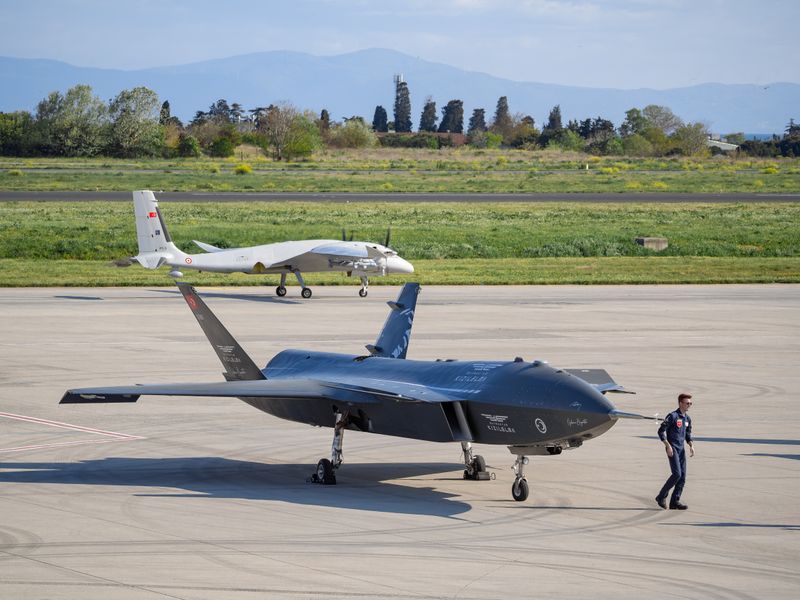
For the rest of the world, the order is a forcing function. European producers that want to keep selling into the American market now have a financial reason to localize production in the United States, as several already have. Turkish manufacturers, whose Bayraktar drones have reshaped modern warfare, were notably absent from the ally list entirely, a reminder that the tariff bands track political alliances as much as supply chains.
The proclamation is one of several defense measures moving at once. On the same day, Trump signed a memorandum ordering the construction of a fifth naval shipyard, the first in more than 80 years, alongside a new component repair center and a reorganization of the Naval Sea Systems Command. The same order instructs the navy to abandon electromagnetic catapults on its newest carriers and return to steam. Drones were part of a wider push to rebuild American military industrial capacity, not an isolated decision.
What happens next depends on the September 2 comment deadline, the September 3 tariff start, and the pace at which Commerce builds its onshoring program. One thing is already clear: the era of cheap imported drones is over, and the industry that replaces it will be built, at least in part, on American soil.