Autonomous delivery robots are about to become a regular sight on downtown Washington sidewalks, small boxes on wheels that will soon carry restaurant meals to people who order through Uber Eats and DoorDash. Washington's transportation agency handed operating permits to two robotics companies in mid-July, and the first food deliveries are expected to roll out sometime in August.
The District Department of Transportation said the permits went to Serve Robotics and Coco Robotics, two operators that run small wheeled delivery machines on pedestrian paths. They join Robot.com, the company previously known as Kiwibot, which was already cleared to work in the city. That leaves three sidewalk-delivery firms permitted to operate in the nation's capital.

DDOT director Sharon Kershbaum framed the move as an option, not a replacement. She said the devices give people an extra way to get food delivered while trimming the number of trips made by larger cars and vans. The city sees the machines as a way to pull short courier runs off the road, and officials are treating them carefully. Operators must map their routes before they start, and for the first three months each firm is limited to a zone of roughly one square mile with a fleet of no more than 25 robots at a time.
Deliveries are not running yet. Right now the robots are mapping streets and sidewalks in neighborhoods like Logan Circle and parts of the downtown core, learning the pavement before they carry food. According to the agency, orders fulfilled through services such as Uber Eats and DoorDash could show up next month. Residents have already spotted the machines navigating the streets and posting about them.
Who is running these robots
Serve Robotics traces its roots to a team that spun out of the ride-hailing company Postmates in 2021 and later took the Serve name. It is publicly traded on the Nasdaq exchange under the ticker SERV and has become one of the most visible names in the sidewalk-robot market. Coco Robotics, the other permit holder, is a younger outfit that in many cities runs its machines with teleoperation, blending a human backup with autonomous navigation.
Both operators already do food delivery for consumers. Serve says it built more than two thousand robots during 2025 and spent the year expanding service zones in every market it already touched, pushing into more than a hundred high-density neighborhoods. The company calls its fleet the largest sidewalk-delivery operation in the United States, and it works closely with restaurant chains and delivery platforms to pull short urban trips off bigger vehicles.
Coco's machines differ in approach. A remote operator stands ready to take over when a robot meets a tricky stretch, which has made it easier for the firm to win approvals in cities where fully driverless operations face more scrutiny. Together the two companies give Washington a mix of autonomy-first and teleoperation-first delivery, and both say food is the starting point rather than the limit.
What the robots can and cannot do
These machines are small box-shaped buggies with a cargo compartment on top and wheels underneath. They are built for short trips, usually under a couple of miles, and they move at steady walking pace. A typical run goes from a restaurant kitchen to a customer's door across a few blocks, with the order locked in a container that the person opens with an app.
They handle easy terrain well. Smooth sidewalks, quiet crosswalks, and campus paths are their home turf. They find trouble when the pavement is blocked or crowded, and several people who met the robots in other cities pointed to foot traffic as the biggest friction. Emily Ye, who lives in Atlanta, said the little machines sometimes end up stopped when walkers crowd a path, and that they struggle to find their way around people who clog the corner.
Not all locals are won over. Juan Gonzalez, a student at Purdue, said the robots shine in cold or snowy weather when nobody wants to step outside, but that their short range often means it is just as easy to walk over and grab the order. Both he and Ye raised the worry that follows any automation story: what happens to the couriers who earn from deliveries today. DoorDash pushed back, saying it has not seen evidence that robots have moved driver earnings in cities where the machines already run, pointing to Arizona as an example.
The bigger delivery-robot wave
Washington is not the first city to try this, and it won't be the last. Dozens of municipalities across the United States already let small robots roam their sidewalks, and the field has moved from new to mostly routine. Starship Technologies has run machines on college campuses for years, and other firms have quietly scaled in states like California and Texas.
The Robotics & Drones sector has been busy recently. The Pentagon put out a request for robot boats that launch attack drones, and several defense companies are chasing military automation deals. On the civilian side, sidewalk delivery has become one of the few robotics niches with real recurring revenue and consistent city approvals.
Costs, range, and unit economics
The math matters. A Transforma Insights report estimates that about 4.7 million delivery robots could be in use by the year 2032 if the present pace holds. The pitch behind all of them is the same: lower delivery costs, cleaner short trips, and faster turnaround on last-mile orders that now depend on a person in a car.
Serve says its fleet runs what it calls level-four autonomy in complex city settings, navigating sidewalks and intersections with a claimed 99.8 percent completion rate. Each robot makes no tailpipe emissions, and every delivery replaces a trip that would otherwise be taken by a small vehicle. Groceries, convenience store runs, small parcels, and return logistics are all seen as natural next steps.
None of this will change overnight. Rules differ city to city, and every new jurisdiction wants proof that the robots won't run over a pedestrian or block a ramp before it grants a permit. Washington's approach of a limited trial with a small fleet and a tight zone is a standard first move. If the machines behave, the city can widen the area and let operators bring in more.
Sidewalk delivery spent years being dismissed as a gimmick. Robots got stuck in leaves, people kicked them, and companies promised more than they delivered. The firms that have survived, Serve among them, focused on the repeat parts of the job: getting the same meal over the same few blocks again and again until the operating numbers start looking ordinary. Washington's permits mark the latest moment in that slow, steady climb.
What it means
The practical take is simple. If you live or work in downtown Washington and order a meal through Uber Eats or DoorDash, there is a real chance this coming year that a small six-wheeled robot with a red flag carries it the final blocks. That is new for a city that has not run courier robots at scale, and the early weeks will test how well a busy sidewalk handles a small machine that cannot simply slide onto the road when foot traffic gets tight.
Crowded sidewalks and disputed curb space keep the debate alive. Cities that run these robots well say residents warm to them once the novelty fades, while critics argue the machines are a minor convenience that does little to change dense urban logistics.
The full DDOT announcement spells out the permit terms and the operating rules. Local reporting takes a closer look at what residents think. Serve's delivery fleet news covers the company's own account of its rollout.
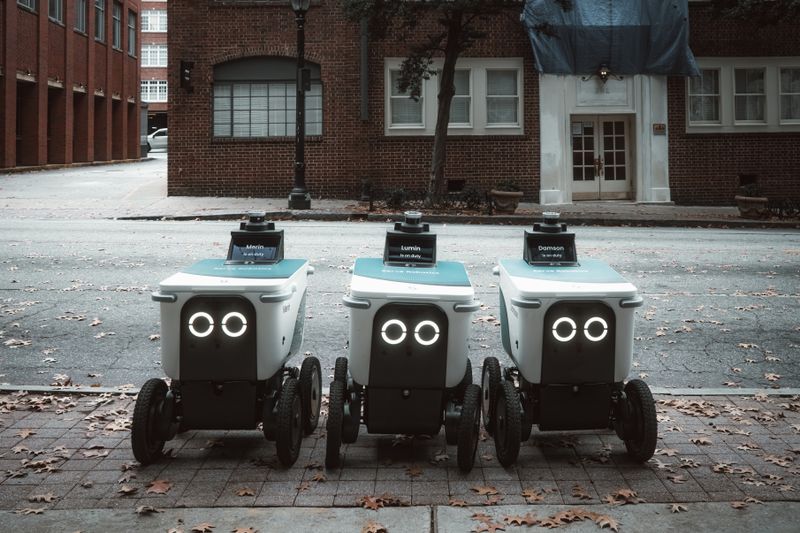
For the capital, this is the beginning of a new normal. Hundreds of dinners could be reaching doorsteps on six wheels before the month ends, and the city is betting that a small, careful fleet keeps the sidewalk safe while the unit math works itself out. The robots will be watched closely. That is the point of starting small and starting safe.