Warp Science Emerges From Stealth With $215 Million to Automate Wet Labs With Robots
Introduction
Former OpenAI science lead Kevin Weil has launched Warp Sciences, a new artificial intelligence startup focused on automating the labor-intensive work of wet labs that sits at the heart of drug discovery. The company, which trains robots to make and test promising chemical compounds identified by researchers, emerged from stealth on October 22, 2026 with $215 million in fresh funding at an $865 million valuation, according to Weil, who announced the startup and the round on X. Lightspeed led the round, with participation from IVP, Premji Invest, and Lux Capital.
The pitch is simple to state and hard to execute: take the thousands of repetitive synthesis and testing steps that currently keep chemists hunched over fume hoods and microscopes, and hand them to machines that can run around the clock. If Warp Sciences can pull that off, the company hopes to compress the calendar of early-stage drug research, where the slowest step is often not the science itself but the physical work of building molecules fast enough to test them.
Why Lab Automation Matters
For years, biotech companies have outsourced the most labor-intensive part of drug discovery — synthesizing thousands of variations of a molecule to see which one binds to a target — to contract manufacturers in China, most prominently WuXi AppTec. That arrangement kept costs low but concentrated a critical piece of the pipeline in a single jurisdiction, a vulnerability that has become harder to ignore as geopolitical tensions and export-control regimes have tightened.
Warp Sciences is betting that the economics of robotics and AI have finally crossed the line where the work can be done competitively at home. By automating wet-lab tasks, the startup aims to reshore compound synthesis and testing to the United States, insulating the drug development process from supply-chain risks that have little to do with chemistry and everything to do with geopolitics.
The timing is not accidental. Weil is a high-profile figure in the AI world — he served as science lead at OpenAI — and his decision to leave one of the most prominent AI labs in the world to build a physical-robotics company is itself a signal. It reflects a broader thesis now animating much of the robotics sector: that the next wave of value creation will come not from models that generate text or images, but from machines that can act in the physical world. That thesis has been playing out across factory floors, warehouses, and construction sites over the past two years, and drug discovery is the latest domain to be pulled into its orbit.
How the Robots Are Trained
The mechanism behind Warp Sciences is not a black-box AI agent but a deliberate, human-in-the-loop training pipeline. Human chemists wear cameras and sensor gloves while performing routine lab tasks — pipetting, weighing, mixing, filtering, plating — and the startup uses that data to train robots to replicate the same motions with consistent, repeatable precision.
The approach mirrors what has worked in other corners of physical AI, where the bottleneck has rarely been the robot arm itself and almost always the availability of high-quality demonstrations. By capturing the tactile and visual experience of trained chemists directly, Warp Sciences sidesteps the need for months of manual programming per task and instead lets the machine learn the way a junior researcher would: by watching and copying.
Once trained, the robots are expected to operate continuously, including overnight and on weekends, dramatically increasing the throughput of a lab that would otherwise be constrained by human shift patterns. The company says the goal is not to replace chemists but to free them from the repetitive bench work that currently consumes the majority of their time, allowing human researchers to spend their hours on experimental design, data interpretation, and the creative work of hypothesis generation.
Reshoring Chemistry and the Supply-Chain Argument
The reshoring narrative is central to the company's pitch, and it is one that resonates well beyond biotech. The COVID-19 pandemic, the war in Ukraine, and a series of export-control actions have all exposed how fragile global supply chains can be when a single country controls a critical input. In pharmaceuticals, that fragility is particularly acute: a drug candidate can be designed in Boston, tested in San Diego, and still depend on a synthesis step performed thousands of miles away.
By building a domestic, robot-run synthesis and testing capability, Warp Sciences is positioning itself as infrastructure for a pharmaceutical industry that has spent the past decade waking up to the risks of over-reliance on offshore contract research. The $215 million round is large by early-stage standards, and the $865 million valuation suggests investors are pricing in the possibility that the company could become a strategic asset for drug developers looking to de-risk their pipelines.
The bet is not without risk. Wet-lab work is messy, variable, and unforgiving of error in ways that factory automation is not. A robot that mis-handles a reagent can ruin an experiment in seconds, and the cost of a single failed batch can run into the tens of thousands of dollars. The company's challenge will be to prove that its training pipeline can generalize across the thousands of distinct reactions and protocols that a modern medicinal chemistry lab runs in a year.
A Robotics Robot Arm in Action
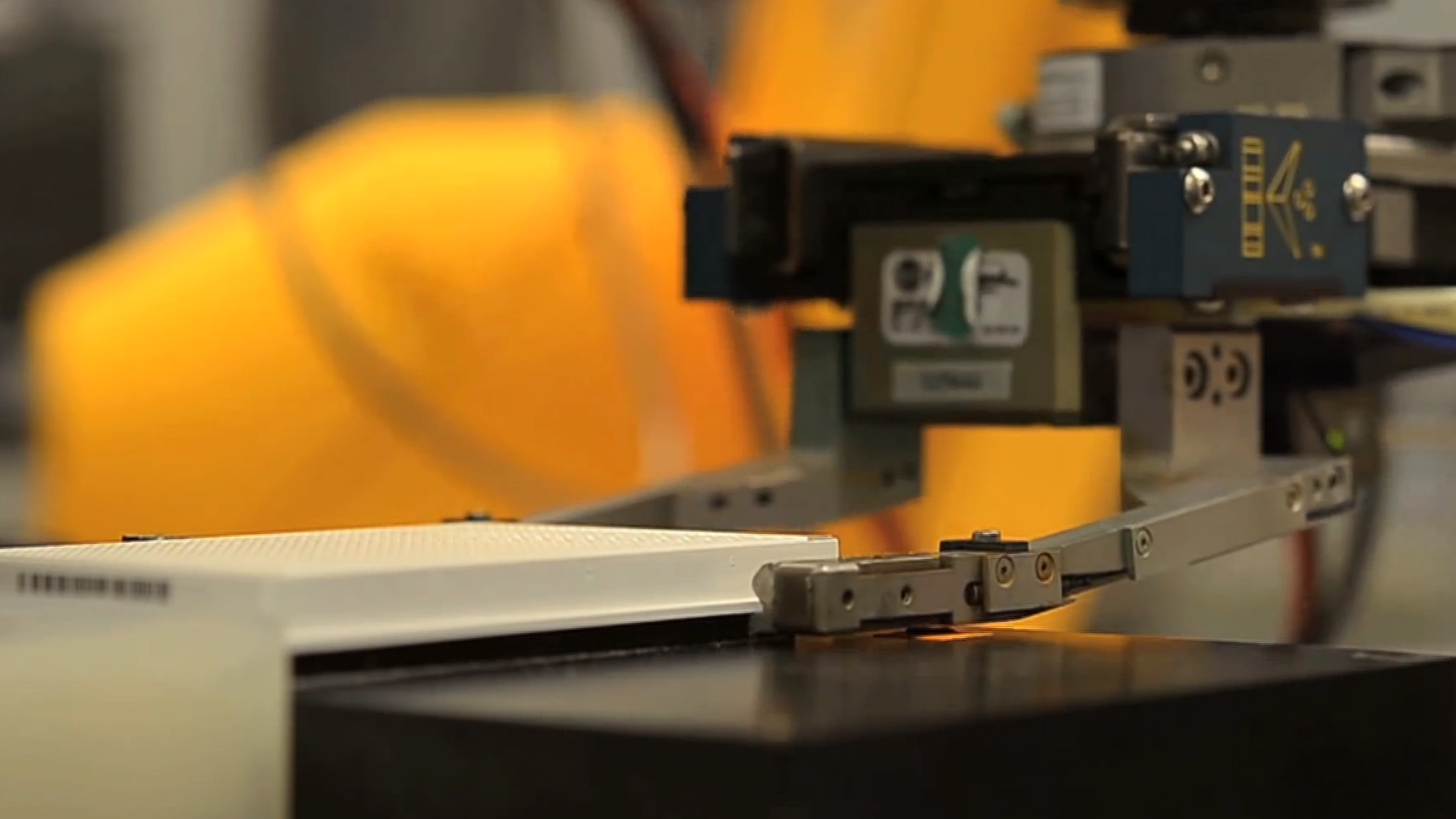
The image above shows a robotic arm manipulating an assay plate — the kind of precise, repetitive motion that Warp Sciences is betting it can automate at scale. Such machines are already common in high-throughput screening labs, but the company's ambition is to push them into the messier, less structured work of medicinal chemistry synthesis, where every reaction is a little different and the margin for error is thin.
The Broader Robotics Push
Warp Sciences is entering a robotics landscape that is crowded, well-funded, and increasingly competitive. Humanoid robots have attracted billions of dollars in investment over the past eighteen months, with companies like Figure AI, 1X Technologies, and Tesla's Optimus program all racing to put machines on factory floors. Autonomous mobile robots are now standard equipment in warehouses, and drone delivery networks are expanding in several major markets. The common thread is that physical AI — systems that perceive, plan, and act in the real world — has moved from research curiosity to commercial product in the span of a single funding cycle.
What makes Warp Sciences interesting is that it is not trying to build a general-purpose humanoid. It is building a specialized, task-specific system for a domain where the work is well-defined, the value per task is high, and the alternative — slow, expensive human labor in a constrained supply chain — is easy to quantify. That focus may prove to be an advantage in a market where general-purpose platforms have struggled to demonstrate clear return on investment.
Liquid Handling and the Chemistry Stack

The second image shows a BioMek FX liquid handling robot, a familiar sight in modern chemistry and biology labs where it performs the pipetting and reagent transfer steps that are the bread and butter of high-throughput screening. Warp Sciences' robots will need to handle far more varied and less predictable tasks than these specialized machines, but the underlying principle — replacing human dexterity with machine consistency — is the same one that has driven automation in pharmaceutical research for the past two decades.
What Comes Next
The company has not disclosed a timeline for its first commercial deployment, and it has not named any pharmaceutical partners. Those gaps are normal for a stealth-stage startup, but they will be the questions that matter most over the coming year. Investors will want to see evidence that the training pipeline can generalize beyond a handful of demonstration tasks, and potential customers will want to know whether the robots can handle the full diversity of reactions that a medicinal chemistry lab runs in a typical week.
For now, the signal is clear: one of the most experienced AI scientists in the world has decided that the next frontier is not a better language model but a robot that can hold a pipette. In a robotics market that has spent the past year chasing humanoid headlines, that focus on a specific, high-value, physically messy problem may be exactly the kind of bet that pays off.
References
- TechCrunch, "Former OpenAI science lead launches Warp Science to automate wet labs with robots," October 22, 2026, https://techcrunch.com/2026/10/22/former-openai-science-lead-launches-warp-science-to-automate-wet-labs-with-robots/
- Google News, "Warp Sciences Emerges From Stealth With $215 Million to Build U.S. Chemistry Services for Drug Research," October 22, 2026
- Wikimedia Commons, "Robot arm handles an assay plate" (CC BY-SA 3.0, user-contributed)
- Wikimedia Commons, "BioMek FX P200 96 liquid handling robot" (CC BY-SA 3.0, user-contributed)
For more on robotics and drones coverage, see our robotics and drones category.