Unitree Goes Public: China's Best-Known Humanoid Robot Maker Launches a $900 Million Shanghai IPO
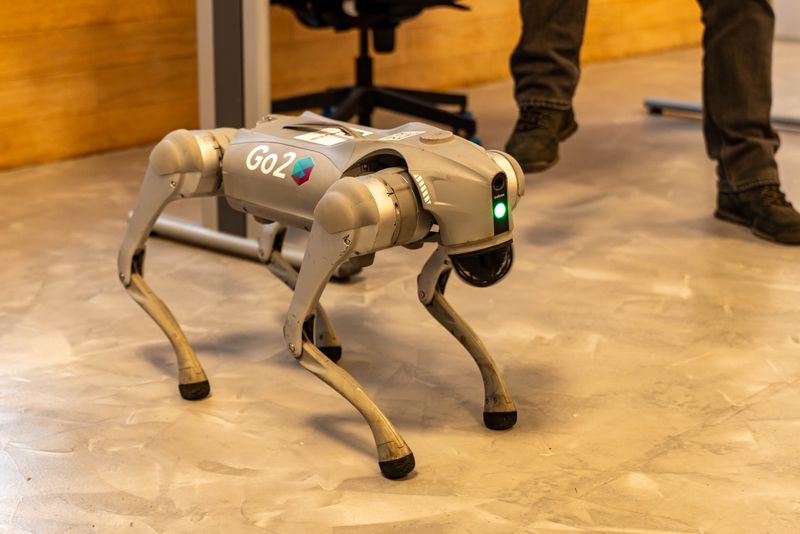
Unitree Robotics has stepped onto the Shanghai Stock Exchange's STAR Market, becoming the first humanoid robot manufacturer to trade on China's mainland exchanges. The Hangzhou-based company priced its initial public offering at 150.80 yuan ($22.34) per share, valuing the firm at roughly 61 billion yuan ($9.04 billion) ahead of the Monday subscription opening. Within hours, retail investors had flooded in with orders exceeding 8,000 times the available shares.
The IPO places a valuation multiple of 219 times Unitree's 2025 earnings on the company — a number that says less about the price of a single robot dog and more about the sheer momentum behind China's humanoid robotics push. Founded in 2016 by engineer Wang Xingxing, Unitree made its name quadruped robots that cost a fraction of what Boston Dynamics charges, then pivoted hard into humanoids that dance, run, and now walk through factory floors. The company wants to raise 6.1 billion yuan ($904 million) from the listing to pour into artificial-intelligence model research, new robot body development, and a manufacturing base it hopes will let it ship thousands of humanoids per month.
The Numbers Behind the Listing
Unitree is selling 40.45 million new shares, representing 10% of its post-offering share capital, on the STAR Market. Offline subscriptions alone reached 71.46 billion shares — roughly 2,761 times the initial offline offering size before the company adjusted for strategic placement. Retail investors faced odds of approximately 0.018% of receiving shares, following a partial reallocation away from the institutional tranche.
The financial story behind those headline figures is one of rapid scaling. Revenue quadrupled to 1.7 billion yuan in 2025 from 392.77 million yuan in 2024. Humanoid robots generated 867.8 million yuan in sales, overtaking quadruped robots as the company's largest product line for the first time. Net profit came in at 278.21 million yuan in 2025, though adjusted for one-off items, first-quarter profit fell 52.6% to 40.3 million yuan — a sign that Unitree is spending heavily on research and marketing ahead of the listing.
Overseas sales accounted for 43.65% of main-business revenue in 2025, generating 731.66 million yuan. The United States alone made up 13.3% of Unitree's revenue last year, a figure that now carries real geopolitical weight.
DeepSeek, Meituan, and a Star-Studded Investor List
The IPO filing on Thursday also revealed that DeepSeek — the Chinese AI lab that stunned Silicon Valley with its low-cost, high-performance language models — is among Unitree's strategic investors. Chinese food delivery giant Meituan holds the largest outside stake at 9.65% through several affiliates. Tencent, Alibaba Group, Ant Group, China Mobile, and Geely all invested through affiliated vehicles in a June 2025 funding round, linking Unitree to some of the country's biggest internet, telecom, and automotive conglomerates.
Two of China's most active startup investors, HSG and MPCi, hold 7.11% and 5.45% respectively. A cluster of state-backed funds rounds out the cap table: the Beijing Robotics Industry Development Fund at 3.83%, the China Internet Investment Fund at 2.11%, and Shenzhen Capital Group holding smaller slices. Direct state ownership is minimal — just 0.67% — but the pattern tells a familiar story of public-private alignment in China's broader embodied-intelligence agenda.
Wang Xingxing, Unitree's founder and controlling shareholder, built the company from a small Hangzhou workshop into a firm whose G1, H1, and R1 humanoids have gone viral running stairs, performing martial arts moves, and — in the latest demos — picking up and sorting packages for hours at a stretch. The company competes directly with Tesla Optimus, Agility Robotics' Digit, and Boston Dynamics' Atlas, though Unitree's price point undercuts all three by a wide margin.
Trade Tensions Hang Over the Listing
The timing of the IPO places it squarely in the middle of an escalating trade war between the United States and China over robotics. On July 28, the FCC added foreign-made humanoid and quadruped robots to its Covered List, citing national security risks. China's Commerce Ministry responded days later with export controls on drones and related components going to the U.S., a ban on business with six American entities, and a broader national-security probe of imported software.
Unitree has disclosed in its prospectus that potential American trade restrictions pose a real risk to the business. Its existing humanoid and quadruped robots hold U.S. approvals, but future models could be blocked from sale there. Tariffs, limits on government purchases, export controls, or the loss of existing approvals could all disrupt overseas expansion and cut into supply chains for imported parts.
The company moved fast on the listing front: a record 73-day timeline from filing acceptance on March 20 to listing committee approval on June 1. That speed signals how quickly China's stock-exchange apparatus moves when the government wants a homegrown robotics flagship to list before trade barriers tighten further. China holds roughly 85% of the global humanoid robot market, and Unitree alone shipped more than 5,000 humanoid units in 2025.
What Unitree Gets from the Money
Unitree plans to invest roughly 4.20 billion yuan of IPO proceeds across four projects. The largest allocation covers intelligent-robot model research — the AI backbone that gives humanoids the ability to work in unpredictable environments, pick up varied objects, and perform alongside people without constant oversight. A second tranche funds robot-body R&D focused on making the machines lighter, stronger, and cheaper to produce at scale.
A third project covers new robot products: the company's roadmap hints at next-generation humanoids beyond the current G1/H1/R1 lineup, potentially including smaller personal-assistant models and larger heavy-payload designs. The fourth allocation builds an intelligent-robot manufacturing base, the physical infrastructure Unitree needs to scale from dozens of units per day to hundreds.
The company's prospectus acknowledges that large-scale commercial adoption remains uncertain. Current demand comes mostly from universities and government-backed projects using robots for education, research, and demonstrations. Humanoids still struggle with reliability, dexterity, and performing varied tasks for long periods without human intervention. The prospectus lists task generalisation, endurance, safety, and operating in unstructured environments as the core open problems.
A Peer Group Rushing to List
Unitree's IPO is the first of several humanoid-focused listings expected in China. Leju Robotics, maker of the Kuavo humanoid, filed in May to list on Shenzhen's ChiNext market. AgiBot, a Shanghai-based rival, began preparations for a Hong Kong IPO in July. Both are chasing the same pool of capital and government backing.
China's humanoid robot industry is moving fast: the government has set a target of more than 10,000 humanoid robots in commercial use by the end of 2026. BYD, the world's largest electric vehicle manufacturer, plans to unveil its first humanoid robots at its Di Space showrooms within weeks, adding another heavyweight to the race. Unitree has an early-mover advantage — its robots have been shipping since 2019 and its humanoid line carries a two-year head start — but the field is crowded and deep-pocketed competitors are closing in.
For investors piling into the STAR Market listing at 219 times earnings, the wager is that Unitree can convert viral demo videos into factory-floor reality — and that China's humanoid market is large enough to support a valuation that would raise eyebrows even in Silicon Valley. The first test comes when the shares begin trading and the market decides whether that price reflects genuine commercial prospects or the speculative heat of a red-hot policy priority.
What the Listing Means for Southeast Asia
The Unitree IPO matters beyond China's borders, particularly for Southeast Asian markets that are watching the humanoid supply chain take shape. Indonesia, Thailand, and Vietnam have all announced robotics-friendly industrial policies over the past two years, and Chinese manufacturers have already become the dominant suppliers of industrial robots in the region — a position they built the same way Unitree built its robot dogs: aggressive pricing, dense component supply chains, and rapid iteration cycles.
Unitree's own robots have appeared at Indonesian trade shows and in regional university robotics labs, where their price tags of a few thousand dollars make them the default research platform for humanoid and quadruped experiments. A listed, well-capitalized Unitree could push that reach further, funding local distribution networks and after-sales support that unlisted rivals cannot match. For Southeast Asian manufacturers weighing automation investments, the practical question is not whether humanoids will arrive in their warehouses, but whose robots they will be running when they do.
Regional observers also note that the U.S.-China robotics trade fight could open space for other suppliers. If Chinese humanoids are locked out of American markets, Japanese and South Korean makers — and eventually Southeast Asian assemblers — could fill some of the gap. But Unitree's economics are hard to beat: the company has shown that China's ecosystem can produce a capable humanoid at a fraction of Western development costs, and the IPO only strengthens that cost advantage with fresh capital.
The listing also gives the wider robotics industry a public-market benchmark for the first time. Until now, investors valuing humanoid startups had to rely on private rounds and whispered valuations. Unitree's 219-times-earnings multiple — whether justified or not — becomes the reference point that every other humanoid company will be measured against when they raise their next round or file their own prospectus. It is the kind of moment our Robotics & Drones desk tracks closely, since the public markets rarely get a clean look at a pure-play humanoid maker.
Sources: CNBC — Unitree prices IPO at $9 billion valuation, Yahoo Finance — Unitree IPO oversubscribed 8,000 times, SCMP — BYD debuts humanoid robots as rivalry with Tesla intensifies