Robotics & Drones: The New Frontier of Autonomous Mobility
Introduction
The robotics and drones sector is experiencing unprecedented growth, with the global industrial robot stock reaching five million units in 2025, up 9% year-on-year, and annual installations exceeding 600,000 units for the first time. This surge represents more than just technological progress - it's a fundamental shift in how industries operate and how people interact with technology. The data shows China accounts for 59% of all installations, while the United States has overtaken Japan to become the second-largest market, and Europe maintains its position as the densest robot population despite slowing installation rates.
Main Content
The Five Million Milestone: Industrial Robotics Becomes Infrastructure
The International Federation of Robotics (IFR) recently reported that the global operational stock of industrial robots reached five million units in 2025, up 9% from the previous year. This represents a significant acceleration from the 9% annual growth rate that has been sustained since 2018. The stock count, which includes articulated arms, SCARA units, delta robots, and Cartesian systems used in manufacturing, has more than doubled since 2018.
What makes this milestone particularly significant is the geographical distribution. China now accounts for 59% of all installed industrial robots, with 354,000 units installed in 2025 - up 20% year-on-year. Chinese robot manufacturers also captured 55% of the domestic market share, the first time they've led in their home market. Meanwhile, the United States installed 38,500 units in 2025, up 12%, overtaking Japan to become the second-largest market globally.
The growth trajectory shows no signs of slowing, with IFR projecting installations to reach 655,000 units in 2026 and 806,000 by 2029. This sustained growth is driven by four key factors: supply-chain resilience through industrial relocation, demographic shifts with aging workforces, AI and machine vision breakthroughs, and declining deployment costs that make automation viable for smaller operations.
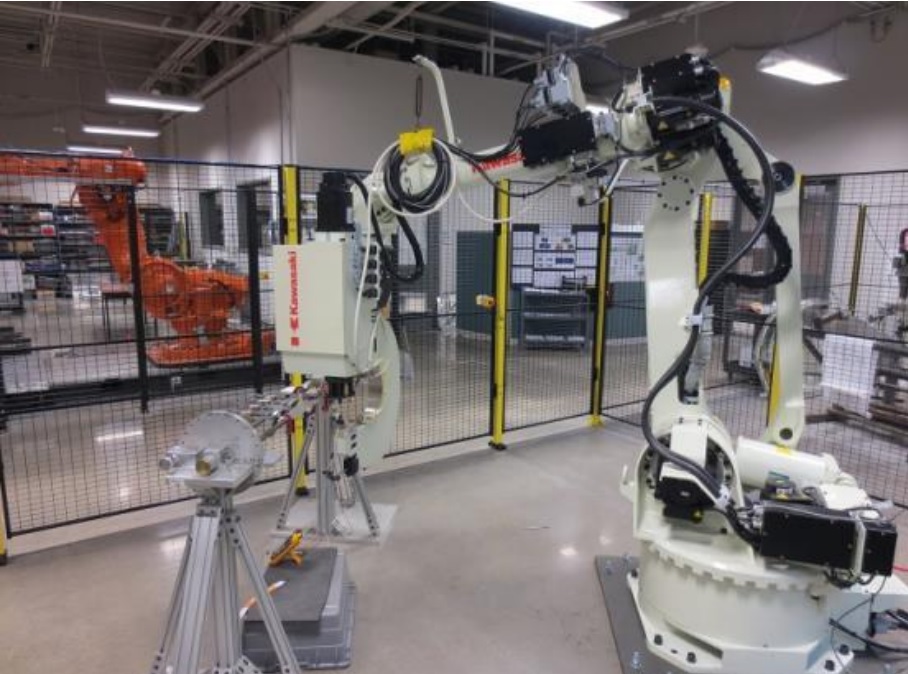 Refill friction stir spot welding work-cell: This robotic RFSSW system was designed and developed by Kawasaki Heavy Industries (KHI) and installed at Wichita State University.
China's Robotics Dominance: A New Industrial Reality
China's position as the world's largest robot market represents a fundamental shift in global manufacturing dynamics. The country installed 354,000 industrial robots in 2025, up 20% year-on-year, and captured 55% of its domestic market share with Chinese manufacturers. This combination of massive domestic demand and maturing local supply chains creates conditions for potential cost deflation in industrial robotics.
What makes China's success particularly noteworthy is the structural shift in its robotics ecosystem. Rather than relying on imported hardware, Chinese manufacturers are now dominating the market they create. This self-sustaining ecosystem, combined with strategic government support for automation in key sectors like food processing and logistics, positions China to maintain its lead for the foreseeable future.
The United States' rise to second place, with 38,500 installations in 2025, reflects a different pattern. Unlike China's domestic manufacturing dominance, the US growth is fueled by diverse sectors including food and beverage (up 30%), warehousing, logistics, and medical applications. While automotive remains the largest single customer at 13,500 units, it has actually declined slightly, with growth coming from other industries that historically had minimal automation.
Europe's Paradox: High Density, Low Growth
Europe presents a fascinating paradox in the robotics landscape. With 267 robots per 10,000 employees - the highest density globally - Europe maintains its position as the most automated region. However, annual installations have slowed, with Germany down 8% to fewer than 25,000 units and Italy down 11% to 7,800 units.
This apparent contradiction stems from the maturity of the installed base. Western Europe has reached saturation levels where new installations represent a smaller percentage of the total stock. Germany, for instance, has seen its robot density increase to 449 per 10,000 employees, but its annual growth rate has decelerated. The region's focus has shifted from new deployment to optimizing existing installations, with manufacturers competing more on service and integration than on volume.
The long-term outlook remains positive despite short-term slowdowns. IFR's projections show installations continuing to grow at 9% annually through 2029, reaching 806,000 units. This growth will be supported by continued AI advancements, improved machine vision capabilities, and decreasing costs that make automation accessible to smaller operations.
The Drone Revolution: Beyond Visual Line of Sight
While industrial robotics dominates the stock count, drones represent the fastest-growing segment of the autonomy sector. The global drone market is projected to grow at a 65% annual rate through 2034, driven by applications in delivery, inspection, agriculture, and public safety. The Uber-Zipline partnership announced in August 2026 represents a pivotal moment in this evolution, with both companies targeting one million drone deliveries per day by 2029.
This ambitious target reflects the maturation of drone technology and regulatory frameworks. Zipline, which has already completed over 2.7 million deliveries across four continents, brings proven autonomy capabilities to Uber's massive consumer base. The partnership leverages Zipline's existing infrastructure in Texas and other launch markets while expanding into dozens of U.S. cities over the agreement's life.
The technical requirements for this scale of operation are substantial. Drones carrying up to eight pounds must maintain five to ten minute delivery times, requiring advanced navigation systems, weather resilience, and efficient power management. Zipline's existing drone fleet, capable of flying a delivery every 20 seconds, provides the operational foundation for this expansion.
 Dronamics Delivery Drone used for autonomous logistics operations.
Lantronix Spotter: Closing the Compute Gap
As autonomy applications expand beyond visual line of sight operations, the compute gap has emerged as a critical bottleneck. Drone and robot fleets now require onboard processing power sufficient to run object detection, semantic segmentation and tracking pipelines simultaneously, all while maintaining single-digit watt power budgets.
Lantronix's new Spotter platform addresses this challenge with purpose-built hardware. The Qualcomm Dragonwing QCS6490 system on module delivers up to 12.5 TOPS of AI performance at single-digit watts, making it ideal for small autonomous vehicles. The 42 x 120 mm form factor is specifically designed to fit the size and weight constraints of drone and robot platforms.
Unlike GPU platforms that are ill-suited for mobile autonomy due to size, cost, and power requirements, Spotter delivers meaningful AI performance in a compact package. This enables real-time decision making without relying on cloud connections, which is essential for beyond-visual-line-of-sight operations where latency can be critical.
Spotter's compatibility with PX4, ArduPilot, Betaflight, and MAVLink protocols means developers can leverage existing autopilot investments without costly rewrites. Backed by Lantronix's unmanned systems engineering services, Spotter provides a production-ready path from prototype to fielded fleet, with Lantronix compute already certified for Blue UAS-approved drones.
Conclusion
The robotics and drones sector stands at a pivotal moment. With industrial robot installations exceeding five million units and annual growth rates maintaining double-digit percentages, the industry has moved beyond early adoption phases into mainstream infrastructure status. The geographical distribution shows China dominating the market while the United States and Europe continue to grow in their respective ways.
The future will be defined by how effectively companies can integrate these technologies into existing workflows and create scalable business models. As demonstrated by the Uber-Zipline partnership and Lantronix's Spotter platform, the most successful players will be those who can balance technical innovation with practical deployment strategies.
As we look ahead to the next decade, the robotics and drones sector will continue to reshape industries, create new economic opportunities, and fundamentally change how humans interact with machines. The five million milestone is not just a number - it's a testament to the rapid progress that has brought autonomous systems from research labs to the forefront of global commerce.
References
[1] International Federation of Robotics, "Five Million Robots now Operate in Factories Globally," World Robotics 2026 Report, Frankfurt, 24 September 2026. https://ifr.org/ifr-press-releases/news/five-million-robots-now-operate-in-factories-globally
[2] International Federation of Robotics, "U.S. now Second-Largest Robotics Market, Following China," 24 September 2026. https://ifr.org/downloads/press_docs/EN-2026-SEP-24-IFR_Press_Release_WR-USA.pdf
[3] International Federation of Robotics, "Robot Density Surges in Europe, Asia, and Americas," 8 April 2026. https://ifr.org/ifr-press-releases/news/robot-density-surges-in-europe-asia-and-americas
[4] RoboticTomorrow, "Five Million Robots Now Operate in Factories Globally," 24 September 2026. https://www.roboticstomorrow.com/news/2026/09/24/five-million-robots-now-operate-in-factories-globally/27154
[5] Uber and Zipline Partnership Announcement, August 17, 2026. https://investor.uber.com/news-events/news/press-release-details/2026/Uber-and-Zipline-Partner-to-Bring-Drone-Delivery-to-Millions-of-Americans/default.aspx
[6] Lantronix Spotter Press Release, October 13, 2026. https://www.globenewswire.com/news-release/2026/10/13/3379546/0/en/lantronix-introduces-spotter-to-close-the-compute-gap-holding-back-drone-and-robot-autonomy.html
Learn more about the robotics and drones category.