Rivian Automotive delivered a second-quarter earnings report that beat Wall Street on revenue, earnings, and margins — all while its most important product, the R2 midsize SUV, finally reached paying customers. The electric-vehicle maker also raised its full-year delivery outlook and cut capital spending by $250 million at the midpoint, giving investors reason to believe the Irvine, California-based company can survive the cash-burning phase of its production ramp.
CEO RJ Scaringe disclosed the numbers Thursday, and the headline was clear: Rivian is making more money per car, spending less to do it, and getting the R2 into driveways faster than analysts expected.
Revenue jumps 27% as software pulls its weight
Total revenue hit $1.658 billion, up 27 percent from the year-ago quarter. Automotive revenue contributed $1.143 billion of that, a 23 percent year-over-year gain fueled by a 14 percent jump in deliveries and $108 million in regulatory credit sales. But the surprise was the software and services segment, which brought in $515 million — a 37 percent increase that now accounts for nearly a third of the top line.
The software business leans heavily on Rivian's joint venture with Volkswagen Group. About $308 million of that $515 million, roughly 60 percent, flowed from the VW partnership. The rest came from Rivian's own Autonomy Plus subscription and connected-vehicle services. That software unit generated $215 million in gross profit at a 42 percent margin — far healthier than anything Rivian has ever produced on the hardware side.
Combined with automotive results, Rivian posted a consolidated gross profit of $179 million, an 11 percent margin and a company record. Five quarters ago, in Q2 2025, gross margin was negative 16 percent. The turnaround has been steady: minus 16 percent, positive 2 percent, 9 percent, 9 percent, then 11 percent in Q2 2026.
R2 ramp: $100 million in costs, but customers are lining up
The R2, a midsize SUV priced starting under $50,000, began external deliveries on June 9. Scaringe called it "attractively priced for everyday adventures" and said it should "resonate with a broad set of consumers."
The ramp came with a price tag. Rivian absorbed roughly $100 million in incremental cost of revenue during the quarter from bringing the R2 production line up to speed at the Normal, Illinois manufacturing facility. That plant has annual capacity for 160,000 units of the R2 — a capacity ceiling that will define whether Rivian can hit the second-half numbers its new guidance requires.
The company produced 12,613 vehicles and delivered 12,194 in Q2, well above the 9,000 to 11,000 range Rivian had originally projected. Those delivery numbers included both R2 units and the company's electric delivery van and flagship R1 products. Automotive gross profit was still negative at -$36 million, but that is a $299 million improvement from the $335 million loss a year ago. Scaringe and his team clearly believe the R2's bill of materials — roughly half that of an R1 — will flip automotive margins positive once volume scales.
Consumer interest is there. Rivian hosted more than 57,000 demonstration drives during the quarter, a company record. The R2 Launch Edition reservation-to-order conversion rate was "meaningfully higher" than internal projections, according to the earnings release.

Second-half math demands a big ramp
Rivian delivered 22,559 vehicles in the first half of 2026 — 10,365 in Q1 and 12,194 in Q2. The new full-year guidance of 65,000 to 70,000 vehicles means the company needs to move roughly 42,000 to 47,000 units in the back half of the year. That is close to double the first-half pace, squeezed into just two quarters.
The Normal plant can theoretically handle it. At 160,000 units of annual R2 capacity, monthly throughput for the model alone should eventually top 13,000 vehicles once the line hits full speed. Whether that ramp happens in Q3 or stretches into Q4 will determine how much confidence Wall Street places in management's forecast.
Rivian's guidance also improved on the spending side. Full-year capital expenditure was cut to $1.7 billion to $1.8 billion, down $250 million at the midpoint from an earlier $1.95 billion to $2.05 billion range. The company cited project efficiencies and timing shifts, not a pullback on its core manufacturing or technology investments.
Adjusted EBITDA loss guidance narrowed to $1.8 billion to $2.0 billion, a $50 million improvement at the midpoint. Free cash flow remained deeply negative at -$849 million for the quarter, largely because Rivian is building R2 inventory ahead of the second-half ramp.
Cash cushion and the capital stack
Rivian ended Q2 with $5.31 billion in cash, equivalents, and short-term investments. In July, it raised approximately $1.3 billion through a follow-on equity offering of 86.25 million Class A shares. Looking ahead, the company expects $1 billion in non-recourse debt from Volkswagen and a $250 million equity investment from Uber later this year, both subject to conditions.
Add in a Department of Energy loan facility backing the Georgia manufacturing site, and Rivian pegs its total available and targeted future capital at more than $14 billion. That liquidity cushion gives the company room to absorb the R2 ramp losses without an emergency fundraise — a concern that had weighed on the stock through much of the past year.
Autonomy roadmap and the Amazon fleet
The earnings release also laid out Rivian's autonomy timeline. Point-to-point autonomous driving capabilities are expected by the end of 2026, with hands-off and eyes-off functionality planned for 2027. Level 4 robotaxi capabilities are targeted for 2028, supported by the company's in-house RAP1 silicon.
On the commercial side, Rivian's electric delivery van partnership with Amazon continues to scale. More than 40,000 vans are now active in the Amazon fleet, and the platform has surpassed one billion miles driven. Revenue from the delivery van contributed to the automotive segment but operates on a different cost structure than the consumer-focused R1 and R2 lines.
What Wall Street makes of it
Rivian shares were little changed in after-hours trading at $16.83. The stock has climbed about 26 percent over the past 52 weeks but remains down roughly 17 percent year-to-date. At current levels, the stock trades at about 4.16 times sales — a premium to legacy automakers but a clear discount from the peak of EV market euphoria in 2021.
The market's hesitation reflects two competing narratives. On one side, five straight quarters of climbing gross margin, a record delivery quarter, and the arrival of the R2 suggest Rivian is transitioning from a niche premium player to a genuine mass-market competitor. On the other, the company is still burning nearly $1 billion per quarter in free cash flow, the second-half delivery target requires near-perfect execution, and the broader EV market faces tariff uncertainty and competition from Chinese manufacturers expanding into Europe and Southeast Asia.
For Scaringe and his team, the next two quarters are existential. The R2 is the vehicle Rivian was built around — a high-quality electric SUV that costs less than $50,000 and competes directly with the Tesla Model Y and Ford Mach-E. If the Normal plant can scale to deliver 40,000 or more vehicles in the second half, the financial story could shift quickly — and the $36 million automotive gross loss could turn into a $36 million gross profit by year-end.
The R3, Rivian's even more affordable compact crossover, remains in development and is expected to reach the market after the R2 ramp stabilizes. In the meantime, the company's financial trajectory hinges entirely on execution at a single factory in central Illinois.
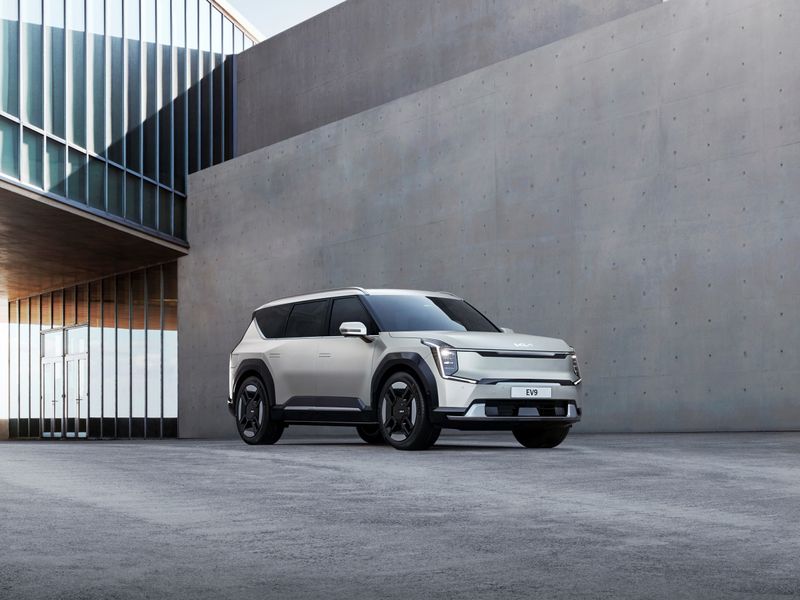
Images: Kia EV9 electric SUV (Credit: Pexels) | Electric vehicle charging at outdoor station (Credit: Pexels)
Sources: Electrek — Rivian Q2 2026 earnings | Yahoo Finance / GuruFocus — Q2 2026 earnings call highlights