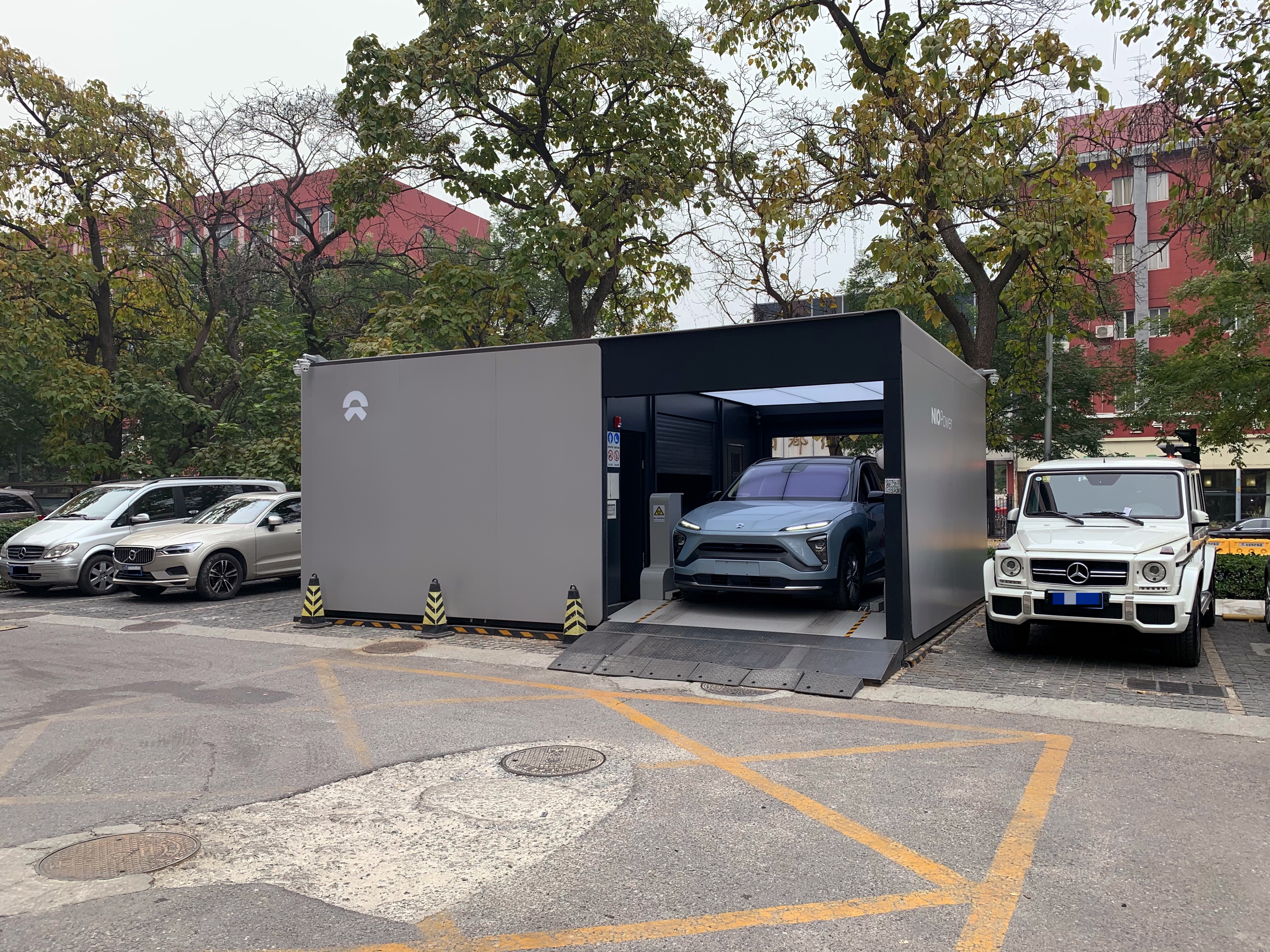
Nio's drivers changed 1,192,221 batteries between October 1 and 7, the Chinese National Day holiday week, according to a charging and battery swap report the company published on Friday. The single busiest day was October 5, when 183,664 swaps were completed as return traffic peaked. That is one car leaving a station every 0.47 seconds at the peak, Nio said.
The Shanghai-based EV maker operates 4,168 battery swap stations in China, and it set a daily record twice during the week. The previous record of 177,627 swaps had stood since February 22, during the Spring Festival travel rush. The network beat it twice in five days.
The reason this matters now is that the EV industry's central argument has been whether cars will refuel by plugging in or by swapping, and China just produced a full week of operating data at a scale no other market has attempted. Nio's swap system ran at gas-station volumes during a peak holiday. It is also a network that is now bringing in outside money, after Geely agreed on September 28 to take a 30% stake in Nio Power's battery swap assets. The company that has tied its identity to swapping is raising capital to keep the network growing, and whether the economics hold at that scale is still an open question.
What the holiday traffic showed
Highway demand drove much of the load. Nio's highway swap and charging stations supplied more than 24.83 million kWh of electricity during the week, up 30.8% year on year and equal to 13.7% of the nationwide highway total, according to the report. The company runs 1,073 swap stations on expressways, connecting more than 550 cities, and 250 of those stations set their own daily records.
The network saved users over 309,124 hours of waiting, Nio said, 14.7% more than a year earlier. The busiest highway station sat at the Rizhao service area on the G15 Shenyang-Haikou Expressway in Shandong province, and it handled a daily peak of 211 swaps.
The comparison with earlier holidays shows how fast the network is scaling. During this year's Labor Day break, 3,839 stations completed 1,031,469 swaps over seven days. The National Day week pushed roughly 156,000 more swaps through a network about 330 stations larger. Growth is coming from both more stations and heavier use of the ones that exist.
Long-distance behavior is the part that changes the story. During the holiday, 203,581 drivers relied entirely on battery swaps to replenish their vehicles on a road trip. Another 197,684 users drove more than 1,000 kilometers, a 65.1% jump year on year, and 127,542 drove more than 500 kilometers in a single day, up 74.6%. Drivers across Nio's three brands, Nio, Onvo and Firefly, covered more than 714 million kilometers during the week.

The alternative is faster plugs
Most of the industry is betting on faster charging instead. Truck makers are moving to megawatt-class systems, with BYD's electric semi lineup claiming a 20 to 80 percent charge in about 30 minutes and up to 1.5 MW at dedicated sites. European and American OEMs are pushing 350 kW cars and 400 kW stalls, and the argument for them is simple: a charger costs a fraction of a swap station and every car with the right port can use it.
Nio's counterargument is time and battery health. A swap takes three to five minutes, which is roughly what a fill-up costs, and the driver never owns a degraded pack. The station absorbs the degradation, and the fleet can be charged slowly overnight when power is cheap.
The tradeoff is design freedom. A swap-compatible car must accept a standardized pack footprint, and every station has to stock and maintain hundreds of batteries. That is a capital problem before it is an engineering problem, and it is why the charging-versus-swap fight keeps coming back to who pays for the hardware.
Reuters reported in early October that EV demand is lukewarm in the United States while European sales are running hot, a split that leaves fast charging as the default answer in both markets. Swap remains largely a Chinese phenomenon for now.
Standardization is the unsolved part
Nio's charging network is open to everyone. It runs 5,399 charging stations with 31,091 charging points, and vehicles from outside the Nio group account for 86.69% of the electricity delivered. Cumulative charging sessions passed 100 million on October 3.
Swap is different. The packs are proprietary, the stations are branded, and a car from another maker cannot use one. The Geely deal routes Nio's commercial fleet swap assets into a joint operation, with Geely contributing its stake in Yiyi Power and 640 million yuan in cash. William Li framed it as a way to fight the price war by sharing infrastructure instead of duplicating it. The deal covers commercial vehicles rather than passenger cars, so the interoperability gap for consumers is still wide open.
The driver experience is already close to hands-off. Nio's navigate-on-swap feature, which lets the car drive itself into a station and complete the swap, was used 105,403 times in September, or 24.7% of swap orders at stations where the feature was available.
Can the model travel outside China
The network keeps pushing geographic reach. Nio finished its Silk Road swap route on September 26, covering 3,605 kilometers from Xi'an in Shaanxi province to Horgos in Xinjiang, with 33 swap stations along the way. Drivers can now leave from any swap station in the country and reach every provincial-level region using swaps alone, the company says. It wants 100 scenic routes with charging and swap coverage by the end of 2026.
That is a specific infrastructure argument, and it does not travel automatically. A swap network at this density needs expressway corridors with predictable traffic, customers who pay for time saved, and a grid that can absorb it. Copying the station count without the traffic patterns would produce empty sheds.
In Southeast Asia, the relevant version of this lesson is corridor coverage rather than station totals. Indonesia's swap scene, built mostly around two-wheelers, has the fleet behavior without the long-distance highway traffic that makes Nio's numbers work. The interesting test will be whether any regional operator can turn the country's toll roads into a swap route, which is a logistics problem more than a battery problem.
The next real stress test comes in February, when Spring Festival puts hundreds of millions of people on the road at once. If the network handles that week with the same margins, the swap-versus-charge debate gets settled by throughput instead of by opinion.
More on the sector is filed under EV coverage, and earlier reports sit in the archive. Figures come from CnEVPost's report on the holiday swap data and Electrek's coverage of the milestone, with market context from Reuters.