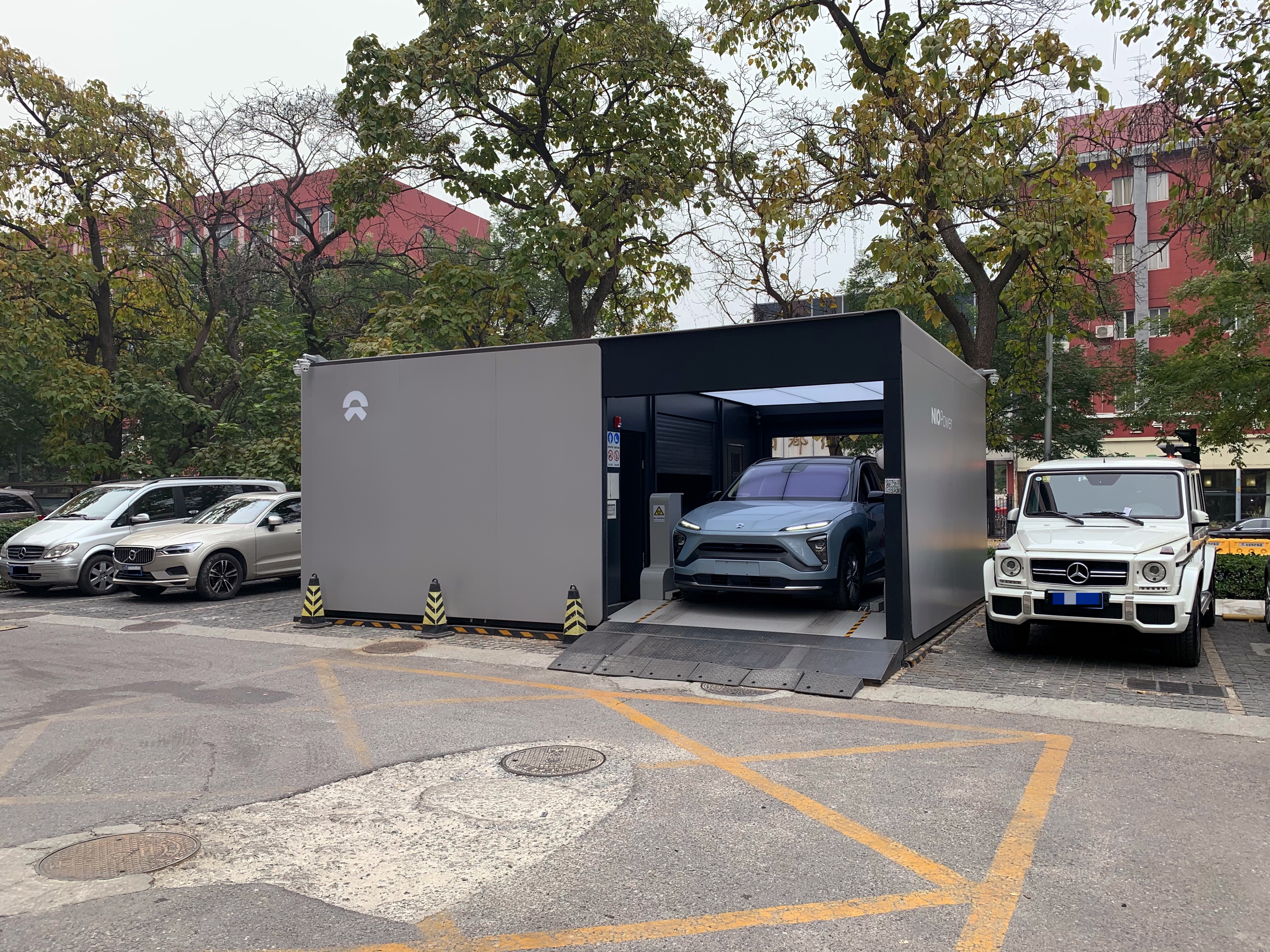
A NIO vehicle completed a battery swap and drove away every 0.47 seconds at peak demand on October 5, according to figures the Chinese EV maker published on Friday. That single number does more work than the headline statistic around it, because a network that can absorb a car every half-second has stopped being a pilot project and started being utility infrastructure.
The company's 4,168 battery swap stations handled 1,192,221 swaps between October 1 and 7, the seven-day National Day holiday in China. The daily average ran 22% above the same period a year earlier, per the holiday charging and battery swap report NIO released on October 9.

That's the point worth sitting with. Battery swapping spent most of the last decade as the punchline of the EV industry, the idea that failed to beat plugging in. In the last twelve months it has quietly become the busiest energy-dispensing layer in the world's largest car market, and the growth is coming from the roads rather than the showrooms.
Peak load is the only test that counts
NIO set a daily record of 183,469 swaps on October 1, National Day itself, then broke it four days later during the return travel rush. The October 5 figure of 183,664 was only 195 swaps higher, which suggests the network is now operating close to a ceiling it designed for rather than flexing into slack capacity.
The comparison that matters is against the Spring Festival peak in February, when the old record of 177,627 swaps was set. A holiday record falling in the autumn means demand isn't tied to one migration season anymore. Highway stations did the heavy lifting: 250 of NIO's 1,073 highway swap sites set their own daily records during the week.
Holiday travel is where EV charging networks normally fall apart, because concentrated arrivals turn a 20-minute stop into a 90-minute queue. NIO says its highway swap facilities saved users more than 309,124 hours of waiting for energy replenishment, a 14.7% increase over the prior year. Read that number backwards and it's a measure of how much waiting would have happened without the stations.
The single busiest site was the swap station at the Rizhao service area on the G15 Shenyang-Haikou Expressway in Shandong, with a daily peak of 211 swaps. That's roughly one exchange every seven minutes at a single concrete pad, around the clock, for the whole week.
The road trips got longer, and that's the real story
Swap volume rising 22% could just be more cars sold. The distance figures say something different. A total of 197,684 users drove more than 1,000 kilometers over the holiday, up 65.1% year-on-year. Another 127,542 drove more than 500 kilometers in a single day, a 74.6% jump. Users across NIO's three brands, NIO, Onvo and Firefly, covered more than 714 million kilometers.
The most telling statistic is the 203,581 users who relied entirely on battery swapping to replenish their vehicles during holiday road trips. Not as a backup. As the only method. Those drivers accepted a constraint most buyers won't: they planned routes around fixed stations rather than pulling into any parking space with a socket.

County towns showed the sharpest jump of all. Battery swap orders in county-level towns rose 144.2% from the preceding period during the holiday, and NIO's swap network now reaches more than 1,300 districts and counties. Plug-in adoption in China's cities has been steady for years. The rural tier-4 counties are where the growth curve bends, and swapping is getting there faster than DC fast charging because a station doesn't need a substation upgrade to run.
The company also finished its Silk Road battery swap route on September 26, running 3,605 kilometers from Xi'an in Shaanxi province to Horgos in Xinjiang with 33 stations along the way. NIO says a driver can now leave any swap station in China and reach every provincial-level region on the mainland using only swaps.
A rival built a charging empire on other people's cars
NIO's own numbers show a split personality. Its 5,399 charging stations and 31,091 charging points are open industry-wide, and vehicles outside the NIO Inc group accounted for 86.69% of the electricity those points delivered. Cumulative charging sessions passed 100 million on October 3.
That's the opposite of the swap business, which is a closed loop tied to NIO-compatible battery packs. The charging network has become a toll booth on other brands; the swap network is a subscription NIO sells to its own owners. Both are profitable in principle, but only one of them benefits from the whole market growing.
The distinction is now showing up in ownership. Geely agreed on September 27 to take a 30% stake in NIO Power, contributing its entire equity interest in Yiyi Power plus 640 million yuan in cash to fold commercial fleet swap operations into the business. Aulton, the cross-brand swap operator in which NIO Capital holds a 5.53% stake, revived its Hong Kong IPO bid in July aiming to be the first listed battery swap specialist.
What's still unproven
Here's the honest caveat: the holiday figures measure throughput, not margin. A network spending a week at record load tells you it works. It tells you nothing about whether a single swap at a station in Inner Mongolia pays for the land, the 13 batteries parked in it, and the technician.
NIO has been loss-making for years and swap infrastructure is capital-heavy by design. The Geely deal is the clearest signal that the company knows it can't fund the buildout alone, and the Aulton filing suggests outside investors want a standalone financial picture of this business before they commit.
Volume does help with the argument, though. 120 million cumulative swaps by early August, six months after the 100 million mark in February, means the fleet is compounding fast enough that per-station utilization should be improving. Whether it's improving fast enough is the question nobody has published an answer to.
Automation is taking over the labor piece. NIO's navigate-on-swap feature, which drives a car into a swap station and completes the exchange without driver input, was used 105,403 times in September, accounting for 24.7% of swaps at stations where it was available. A quarter of swaps happening hands-free within months of rollout is the kind of adoption curve that makes the staffing math work.
Standards are the next battleground
The interesting fight isn't NIO versus Tesla anymore. It's whether swap pack formats converge into a standard, because that determines whether the network effect belongs to one company or to a market.
Singapore published new standards for EV charging and battery swapping in June, and NIO was among the companies involved in shaping them. China's domestic competition is already narrowing: Seres-backed Aiva is reportedly in talks with CATL to join its swap network, and CATL's own swap brand has been pulling in third-party automakers. A shared pack standard would let a station serve any participating brand, the same way a fuel pump doesn't care whose badge is on the car.
Onvo, NIO's mass-market brand, passed 200,000 deliveries on October 8, roughly two years after its first handover. Every one of those cars becomes a node in the swap network, which is why the station count grew from 3,839 in May to 4,168 now. NIO aims for 100 scenic routes with combined charging and swap coverage by the end of 2026.
The test comes in February, when Spring Festival traffic runs at a scale this week didn't touch. If the network clears that without breaking, the people still calling swapping a dead end will have to explain the 0.47 seconds.
More from the desk: Battery Tech · Source data: CnEVPost · Related coverage: Europe's battery supply chain push · Full archive