HII Puts Up to $900 Million Behind Welding Robots to Build Navy Warships Faster
America's largest military shipbuilder is betting big on robots it believes can take on the hardest jobs in a shipyard. HII said on August 6 that it signed long-term, performance-based production agreements with Path Robotics and GrayMatter Robotics, two startups that specialize in autonomous welding and surface finishing. The deals could steer up to $900 million in shipbuilding work to the pair over seven years, provided they hit a series of technical and production milestones along the way. HII builds the Ford-class aircraft carriers, Virginia-class submarines, and Arleigh Burke destroyers that anchor the U.S. Navy's fleet.
The money is tied to output, not promises. HII will hand out work only as the two companies prove their equipment can meet Navy-grade quality standards for welding, grinding, blasting, painting, assembly, and inspection. The arrangement is a departure from the usual defense contract, where a prime awards work up front and manages a supply chain. Here, the two robotics firms are being asked to earn their volume by delivering production lines that actually work.
Why shipbuilding is a harder problem than a car plant
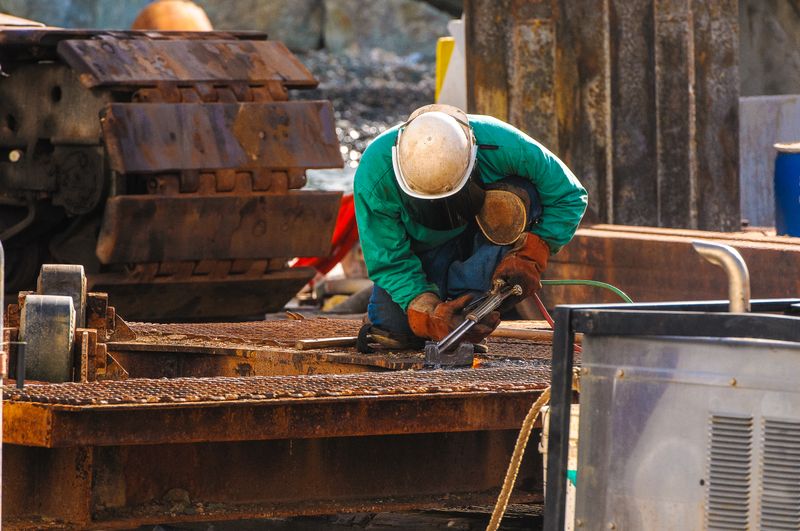
Car factories have been running robots for decades. The reason shipyards have not is simple: no two ships are the same. A production line that welds the same door panel 10,000 times a day has nothing in common with a yard where every steel section arrives in a different size, shape, and assembly order. Naval ships in particular are built in low volumes to exacting tolerances, with hull sections that can weigh hundreds of tons before they are ever lifted into a dry dock.
HII's argument is that physical AI — robots paired with machine vision, sensors, and software that adapts on the fly — has finally reached the point where it can handle that variability. "Together, we are defining a new approach to robotics in shipbuilding: automation that can adapt to extreme levels of complexity, mix, and size," said Eric Chewning, HII's executive vice president for maritime systems and corporate strategy. He described the deals as a generational investment in expanding capacity and feeding critical materials to the company's yards and workforce.
The scale of the labor problem makes the bet worth watching. HII plans to outsource more than 2.5 million hours of shipbuilding work in 2026, a 30 percent jump over 2025, and it is expanding a network of assembly partners so that more steel structures get fabricated outside its main yards before final assembly. Robots that can weld and finish steel sections at partner sites would feed directly into that distributed model.
The two startups carrying the workload
Path Robotics brings the welding expertise. The Columbus, Ohio company builds autonomous welding cells that use a proprietary AI model to decide where and how to weld, then adjusts in real time as the metal heats, warps, and shifts. It has raised roughly $271 million to date and sells its gear on a robotics-as-a-service basis, which lets factories adopt the systems without a big capital outlay. Late last year it also unveiled a mobile welding unit that pairs its software with a quadruped platform, aimed at the kind of large, immovable structures that shipyards and heavy construction sites produce.
GrayMatter Robotics, based in Los Angeles, covers the finishing side. Its Scan&Sand system uses a robotic arm equipped with 3D scanning to sand, grind, and polish surfaces automatically, work that is normally slow, dusty, and hard on human shoulders. The company raised a $20 million Series A in 2022 and has pushed since then into high-mix manufacturing settings where the parts being finished change constantly.
"We've believed for years that physical AI could fundamentally change manufacturing," said Andy Lonsberry, CEO and co-founder of Path Robotics. He called the HYPR program, as the collaboration is known, a validation that physical AI can scale shipbuilding capacity in one of the most demanding production environments in the world. Ariyan Kabir, CEO and co-founder of GrayMatter, framed the agreement as a step toward what his company calls Factory SuperIntelligence — "manufacturing that learns, adapts, and improves over time."

How the deal is structured
The agreements run in two stages. In the development stage, Path and GrayMatter work with HII to refine and qualify high-precision techniques for autonomous welding, grinding, blasting, painting, assembly, inspection, and other fabrication processes, then fold them into an automated production line. Every technique goes through a formal testing and qualification process so it can meet Navy standards, which are stricter than commercial ones on weld integrity, traceability, and documentation.
In the delivery stage, HII starts sourcing actual shipbuilding work through the new line, assuming cost, schedule, and quality all hold up. Production is expected to begin with small steel structures and grow from there into larger units and complete modules used on multiple ship classes. The companies describe the collaboration, which also includes joint development frameworks and governance agreements, as an attempt to push automation further than shipbuilding has ever seen it.
A fleet that needs more yards doing more work
The push comes at a moment when the Navy's demand for new hulls keeps climbing. HII's Newport News yard is the only U.S. shipyard that builds aircraft carriers, and it is also one of two that make Virginia-class attack submarines. The Navy has talked publicly for years about the need to rebuild its industrial base, and about the fact that the U.S. no longer has enough yards, workers, or suppliers to build ships at the pace it wants. Distributed shipbuilding — spreading fabrication work across more sites — is one answer, and it depends on the outsourced work being done well enough that the final yard can simply bolt it together.
That is where robots with a tolerance for variety come in. The steel sections sent to outside partners include stiffeners, bulkheads, and other structural pieces that have to line up precisely when they arrive at the yard. A welding robot that can measure what is in front of it and adjust its torch path accordingly could keep that work flowing without a surge of new welders, who are in short supply nationally and take years to become fully qualified.
There are reasons to be cautious about the timeline. The $900 million is a ceiling, not a guarantee, and it is spread across seven years. Milestones tied to technology readiness and manufacturing performance could slip, as they have in other defense automation programs. Welding is also a safety-critical trade: a bad weld on a submarine hull is not a rework item, it is a liability. HII says the qualification process is designed precisely to filter out any technique that cannot prove itself to Navy inspectors.
Still, the direction is hard to miss. Defense officials in Washington have been pushing shipbuilders to adopt more automation for years, and the private sector has slowly responded. HII already runs a smart-welding program that uses sensors and data to monitor weld quality, and the new agreements are the most explicit statement yet that the company sees robotics startups as part of its production strategy rather than a research curiosity.
What it means for the robotics industry
For the broader robotics sector, the deal matters as a proof point about where the money is. Industrial automation has long been dominated by a handful of large robot brands serving the auto industry. The rise of physical AI startups like Path and GrayMatter shows that specialized, software-heavy robotics companies can now chase large contracts in industries that traditional automation never cracked — welding, finishing, painting — where the work is dirty, variable, and indispensable.
Navy work also comes with a moat. Winning a contract like this takes years of qualification, security clearance, and demonstrated reliability, which is exactly why defense robotics startups that reach this point tend to stay occupied. The HYPR arrangement gives both companies a seven-year demand signal they can take to investors and use to build factories, hire engineers, and grow their workforces.
None of this makes shipbuilders obsolete overnight. The Navy's own estimates suggest the U.S. needs tens of thousands of additional skilled shipyard workers over the next decade, and robots will not erase that need — they will stretch the existing workforce further. HII's bet is that a smaller crew, backed by machinery that can weld, grind, and finish around the clock, can deliver more hulls per year than the current system manages.
Whether that holds depends on the next couple of years. The development stage starts now, and the first outsourced work under the new line is not expected until the techniques prove themselves to Navy inspectors. For more on how automation is changing industrial work, see our Robotics and Drones coverage.
The announcement was reported by HII's newsroom, with additional detail from Interesting Engineering and The Robot Report.
If the program hits its marks, the shipyard of the future will look less like a forest of welding booths and more like a factory floor where robots handle the heavy, repetitive fabrication and people handle the judgment. The Navy is counting on it — and so, at this point, are two robotics startups with a combined war chest built for exactly this moment.