Drone Delivery Reaches Maturity: DoorDash and Arrive AI Build the End-to-End Stack
Introduction
Autonomous drone delivery is crossing the chasm from experiment to infrastructure. Two announcements in early autumn 2026 — DoorDash's launch of DoorDash Air on September 30 and Arrive AI's partnership with Modovolo on October 9 — frame the same question from opposite sides: who owns the handoff? DoorDash starts with the order, the kitchen, and the consumer app; Arrive AI starts with the landing pad, the secure locker, and the flight corridor. Both are converging on a shared answer — a fully orchestrated system where the drone, the ground station, and the dispatch software all speak the same protocol.
The shift reflects a broader industry reckoning. For six years, commercial drone delivery has been limited to tightly controlled pilot programs — Zipline's medical corridors in Rwanda and Ghana, Wing's suburban runs in Australia, Amazon's Prime Air tests in Cambridge. Those programs proved the mechanics of flight. The new wave proves the mechanics of business. DoorDash's system is sized around real order data: 80% of its restaurant orders are light enough for a drone to carry, and early pilots show delivery times under five minutes from kitchen to doorstep. Arrive AI pairs a modular aircraft with a climate-assisted locker that can receive a package without a human standing in the yard. The problem is no longer "can it fly" — it is "can it scale."
DoorDash Air: Building Around Order Data, Not Aircraft Design
DoorDash's approach to drone delivery inverts the usual playbook. Rather than design a drone and then ask what would fit inside it, the company started with its historical order database — millions of restaurant deliveries, their weight distributions, their geographic spread — and built the aircraft around those constraints. The result is a six-rotor platform with slow-spinning propellers that limit cruising noise to roughly that of a passing car at delivery height, a winch system for pickup and drop-off, and failsafe mechanisms that bring the aircraft down gently if anything goes wrong.
The ground infrastructure received equal attention. Loading systems hand off meals from kitchen to aircraft without disrupting existing restaurant workflows. Packaging is designed around the weight and volume limits of flight, not the other way around. The Autonomous Delivery Platform (ADP) already coordinates Dashers, autonomous ground robots (Dot), and third-party partners; drone delivery is another mode within that same system, not a separate silo.
Early pilots will run in Northern California with Chipotle, Popeyes, and Momo N Curry — a mix of national chains and independent operators. For each merchant, the value proposition is simple: reach consumers by air without changing how the kitchen operates. For consumers, the promise is a five-minute delivery window tracked in real time through the app, from kitchen prep to order prep time to flight time to landing.
The economics of that five-minute window depend on density. A suburban cul-de-sac with sparse orders cannot support the flight path efficiency that makes drone delivery cheaper than a car. But a dense urban corridor — the exact footprint DoorDash dominates today — can. The company estimates that 80% of current orders in its core markets meet the weight and distance thresholds for drone delivery. Whether those orders also meet the regulatory and safety thresholds is where the FAA's Part 108 framework comes in.
Arrive AI and Modovolo: The Landing Pad as the Missing Link
Where DoorDash builds the order-to-aircraft pipeline, Arrive AI and Modovolo tackle the aircraft-to-doorstep gap. The partnership, announced October 9, pairs Modovolo's modular Lift drone platform — featuring interchangeable payload pods and RTK localization for centimeter-level precision — with Arrive AI's Arrive Point stations and Arrive OS software.
The joint system is designed for fully unattended delivery: the drone flies itself to its destination, lowers the package directly into the Arrive Point, and returns to base without human intervention. No pilot on the ground, no handoff, no package left exposed on a doorstep. That last point is critical — the "porch pirate" problem that has plagued ground delivery is structurally absent when the package never touches the ground until it is inside a locked, climate-controlled locker.
The test bed for this integration is Fishters, Indiana, a suburb of Indianapolis where Arrive AI has been operating its autonomous last-mile delivery network. The choice of location is deliberate: Fishters has a mix of residential density and open space that mirrors the conditions DoorDash will face in Northern California. The companies plan to begin live autonomous drone deliveries there, subject to regulatory approval, with customers ordering food and other goods for direct-to-locker delivery.
The infrastructure piece is what makes Arrive AI's approach different from earlier drone delivery attempts. Wing and Zipline have demonstrated that the aircraft can fly autonomously — but the receiving end has always required human involvement. A customer walks outside, opens a hatch, takes the package. Arrive AI's system eliminates that step. The drone's payload module docks into the Arrive Point, the locker door secures behind it, and the customer receives a notification that their order has landed. For time-sensitive deliveries — pharmaceuticals, hot meals, urgent documents — that unattended handoff is the difference between a novelty and a utility.
Regulatory Reality: Part 108 and the BVLOS Bottleneck
Both companies' rollouts come at a moment of regulatory transition. The FAA's Part 108 framework for beyond-visual-line-of-sight (BVLOS) operations is nearing final rulemaking, and the states are watching closely. On September 29, fifteen states and a Texas county sued the agency, arguing that its environmental review of expanded drone operations was inadequate. The lawsuit does not seek to stop Part 108 — it seeks to ensure that the rulemaking process accounts for noise, safety, and privacy impacts at the local level.
The practical effect is that operators like DoorDash and Arrive AI are building systems that can scale under whatever Part 108 ultimately delivers, rather than banking on a specific outcome. That means designing for the constraint: drones that can identify their own landing zones, software that can re-route around no-fly corridors, and infrastructure that can operate independently of a continuous visual observer. DoorDash's ADP already coordinates across multiple delivery modes, which gives it a routing layer that can shift orders between car, robot, and drone based on real-time conditions. Arrive AI's Arrive OS handles the same question from the ground side: which orders make sense for drone delivery today, given weather, range, and landing-zone availability.
The convergence of these two platforms — DoorDash's order orchestration and Arrive AI's ground infrastructure — points to a market structure where the winning companies are not necessarily the ones with the best drone, but the ones that have solved the most handoffs. The drone itself is becoming commoditized. The software that routes packages from kitchen to sky to locker is not.
Market Maturation: From Novelty to Necessity
The shift from demonstration to deployment is visible in the metrics each company is now willing to cite. DoorDash's internal data shows 80% of its restaurant orders are drone-eligible by weight and distance. Arrive AI's test bed in Indiana has processed thousands of autonomous ground deliveries already, and the company has mapped the regulatory path for air deliveries onto that same infrastructure. Both companies are moving from "if" conversations to "how fast" conversations.
The timing aligns with a broader cycle of robotics adoption. Humanoid robots are moving from trade-show floors to factory floors, as covered in our recent piece on humanoid robots entering real production environments. The same economic pressures — labor scarcity, rising costs, the need for reliability over novelty — are driving drone delivery from the margins of logistics into its mainstream. The first companies to prove that an unattended, end-to-end drone delivery can be cheaper than a human-driven van on a dense suburban route will find themselves in the position that Amazon, Wing, and Zipline held in the experimental phase: not the only player, but the standard-setter.
The infrastructure is being built on two tracks. On one side, DoorDash is integrating drone delivery into an existing marketplace that already knows the weight, value, and urgency of every order. On the other, Arrive AI and Modovolo are proving that the final inch of the last mile — the handoff from sky to locker — can be solved with a modular drone and a secure landing station. Neither alone is sufficient. Together, they sketch the outline of a delivery network where the aircraft, the ground station, and the dispatch software all operate as one coordinated system.

A delivery drone — the kind of multi-rotor platform now being deployed for local commerce — at an industry exhibition. The design principles shown here, including multiple rotors for redundancy and a secure cargo bay, are the same ones being adopted by DoorDash Air and the Arrive AI/Modovolo partnership. (Wikimedia Commons)
The Handoff Problem, Solved
The most persistent question in autonomous drone delivery has been deceptively simple: who retrieves the package? Early systems required a customer to walk outside, often at a specific time window dictated by the drone's flight schedule. That created friction — missed windows, weather delays, the need for someone to be home. Arrive AI's approach eliminates the human from the retrieval loop entirely. The drone docks with the Arrive Point, the package transfers inside, and the locker secures. The customer retrieves it on their own schedule.
This matters because it resolves the economic paradox that has kept drone delivery in the pilot phase for so long. The per-flight cost of a drone is low — a few dollars in electricity and maintenance. The per-delivery failure rate is what kills the business case: a 5% miss rate due to weather, a 3% miss rate due to no one home, and a 2% theft rate for exposed packages adds up to 10% of deliveries that either fail outright or require a human intervention to complete. By anchoring every delivery to a climate-assisted locker, Arrive AI's system addresses theft and weather simultaneously. By routing through an existing order platform, DoorDash's system addresses the no-one-home problem: the package lands, and the customer walks out to retrieve it whenever they are ready.

A Flytrex delivery drone in Iceland, captured during a cargo-loading operation. The hands-on preparation phase — securing packages, checking systems, confirming the flight path — remains a critical part of every drone delivery mission, even as the flight itself becomes autonomous. (Wikimedia Commons)
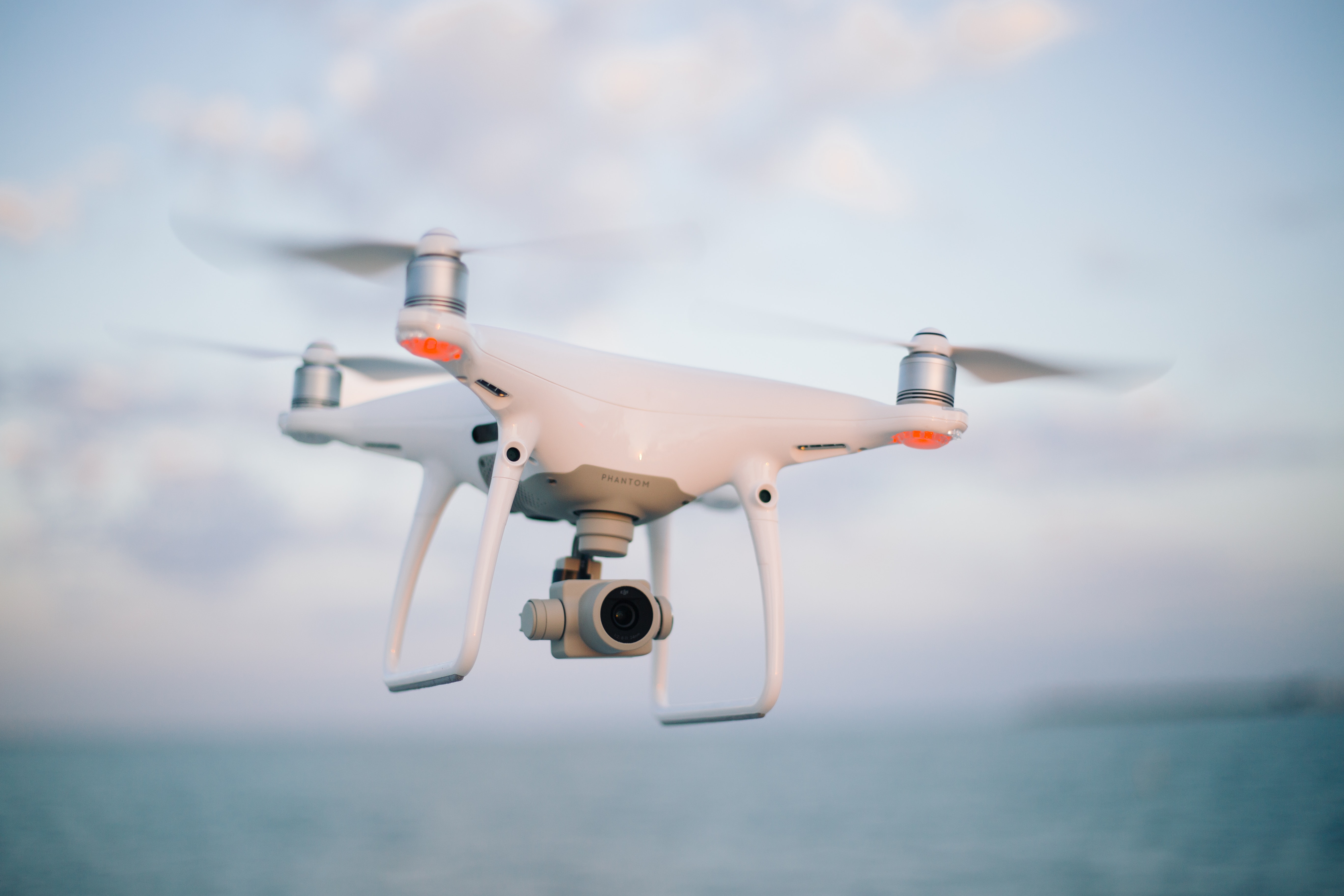
A quadcopter camera drone in flight. Generic multi-rotor platforms like this are the workhorses of autonomous delivery programs, carrying everything from food orders to medical supplies. (Wikimedia Commons)
Scaling Beyond the Test Bed
The next question is scale. DoorDash's pilot will start in Northern California with a handful of restaurant partners. Arrive AI's test bed in Indiana covers a geographic area the size of a small town. Neither company has disclosed a timeline for nationwide rollout, in part because the regulatory framework is still settling.
But the infrastructure decisions each company has made suggest they are planning for scale from day one. DoorDash is integrating drones into an ADP that already manages hundreds of thousands of daily deliveries across ground robots and human couriers. Arrive AI is designing its Arrive Point stations to be modular — a single landing pad can be deployed in a parking lot or on a rooftop, and the software stack can manage thousands of them across a metro area.
The convergence of these two approaches — platform-side orchestration and infrastructure-side autonomy — is the signal that drone delivery has moved from experiment to inevitability. The question is no longer whether drones will deliver packages, but when every delivery company will need to answer for the ones that did not — the packages left on doorsteps, the flights delayed by weather, the deliveries missed because no one was home to retrieve them.
Sources: DoorDash press release (September 30, 2026), Arrive AI/Modovolo joint announcement (October 9, 2026 via AccessWire), FAA Part 108 rulemaking documents.