DARPA's RACER Program Brings Autonomous Ground Vehicles to the Front Lines
The future of ground combat is being redefined at Fort Knox, where DARPA's Robotic Autonomy in Complex Environments with Resiliency (RACER) program has successfully demonstrated four autonomous unmanned ground vehicles operating in complex terrain with payload integration, marking a significant milestone in military robotics development.
The demonstration, held in October 2026 at Fort Knox's St. Vith Range, showcased how autonomous mobility technology can reshape the future of ground combat. Two dozen distinguished visitors from key military and government organizations observed the vehicles as they navigated the rolling landscape independently, without manual control.
Autonomous Mobility at Scale
Developed under the five-year RACER program, the autonomous ground vehicles demonstrated unprecedented mobility capabilities. The vehicles, equipped with sensor suites and drive-by-wire systems, operated as a coordinated team rather than individually controlled machines. As DARPA technical advisor Jason Gregory explained, "We can drop a 10-digit grid on a traversable mobility corridor that the ground vehicles use with their onboard sensors to understand the terrain and then drive to it comparable to a human."
The program's dual focus on speed and resiliency proved evident during the demonstration. Vehicles navigated challenging terrain while maintaining operational effectiveness, moving at speeds on par with human drivers while maintaining resilience in complex environments. This represents a significant leap forward in military robotics.

Photo: Small Unmanned Ground Vehicle demonstration from May 2007, a predecessor to modern autonomous ground vehicle programs like RACER
Technical Architecture and Integration
The RACER program combines the knowhow of three cutting-edge corporations working together on multiple technical fronts. These companies are addressing everything from durable all-terrain vehicle designs to algorithm technologies, super intelligence, and secure communications. The vehicles feature modular sensor suites that can detect terrain, targets, and environmental factors, enabling them to operate independently while maintaining human oversight.
The program built upon five years of software development for autonomous mobility to go high-speed off-road in complex environments. This foundation allowed the team to take vehicles with sensor suites and drive-by-wire systems and equip them with autonomy software so they can be tasked by a Soldier as opposed to manually driven.
Sensor Suites and Perception Systems
Each vehicle in the RACER demonstration carried an array of sensors including lidar, cameras, and radar arrays. These sensor suites enable the vehicles to understand their surroundings, identify traversable corridors, and detect potential threats autonomously. The sensors feed data to onboard computers running the autonomy software, which makes real-time navigation and obstacle avoidance decisions.
The sensor integration allows the vehicles to operate in GPS-denied environments, using alternative navigation methods when GPS signals are unavailable or jammed. This capability is critical for operations in contested electronic warfare environments.
Human-in-the-Loop Decision Making
While the vehicles operate autonomously in searching for targets and navigating terrain, human oversight remains critical for engagement decisions. "All the targets that are detected by our autonomous assets provide a chip of what they have seen downrange to a human, who then has to approve any type of engagement," said Gregory. "The operator has total control as to what they want to do about what the robots are seeing."
This controlled engagement model ensures that while mobility, movement, and detection remain fully autonomous, lethal actions require human authorization. The system allows for kinetic and non-kinetic payloads to be mounted on the vehicles, enabling missions ranging from reconnaissance to strike operations.
The human-in-the-loop approach addresses both operational and ethical considerations. Soldiers maintain authority over when and whether to engage, with the autonomous systems providing situational awareness and target identification but leaving final engagement decisions to human operators. This model has been refined through component testing and integration testing at performer sites, with Fort Knox representing the first end-to-end test from satellite imagery all the way down to the tactical ground.
Electronic Warfare Resilience
The demonstration highlighted the vehicles' ability to operate in electronically contested environments. Electronic warfare systems can scramble radio control links, block GPS, and cut off cloud-based AI coding tools. The RACER vehicles are designed to function independently of these systems, relying on onboard processing and alternative navigation methods.
As Maj. Gen. Jason Slider from the Army's Special Operations Forces noted, "Large Language Models, cloud-based services in general, and even GPS navigation are frequently jammed on battlefields in Ukraine. Even when they are available, soldiers must take care, lest their radio transmissions reveal their location to the enemy and bring down a devasting precision strike."
The RACER vehicles' resilience to these challenges makes them viable for real-world military operations where electronic warfare is a constant threat.
Payload Integration and Mission Flexibility
The demonstration highlighted the modular nature of the platforms, with three of the four UGVs carrying drone payloads on top for deeper reconnaissance or aerial strike capabilities. The vehicles demonstrated the ability to operate beyond the forward line of troops for early detection, responding to requests from U.S. European Command to figure out how to deploy robotic assets beyond traditional combat zones.
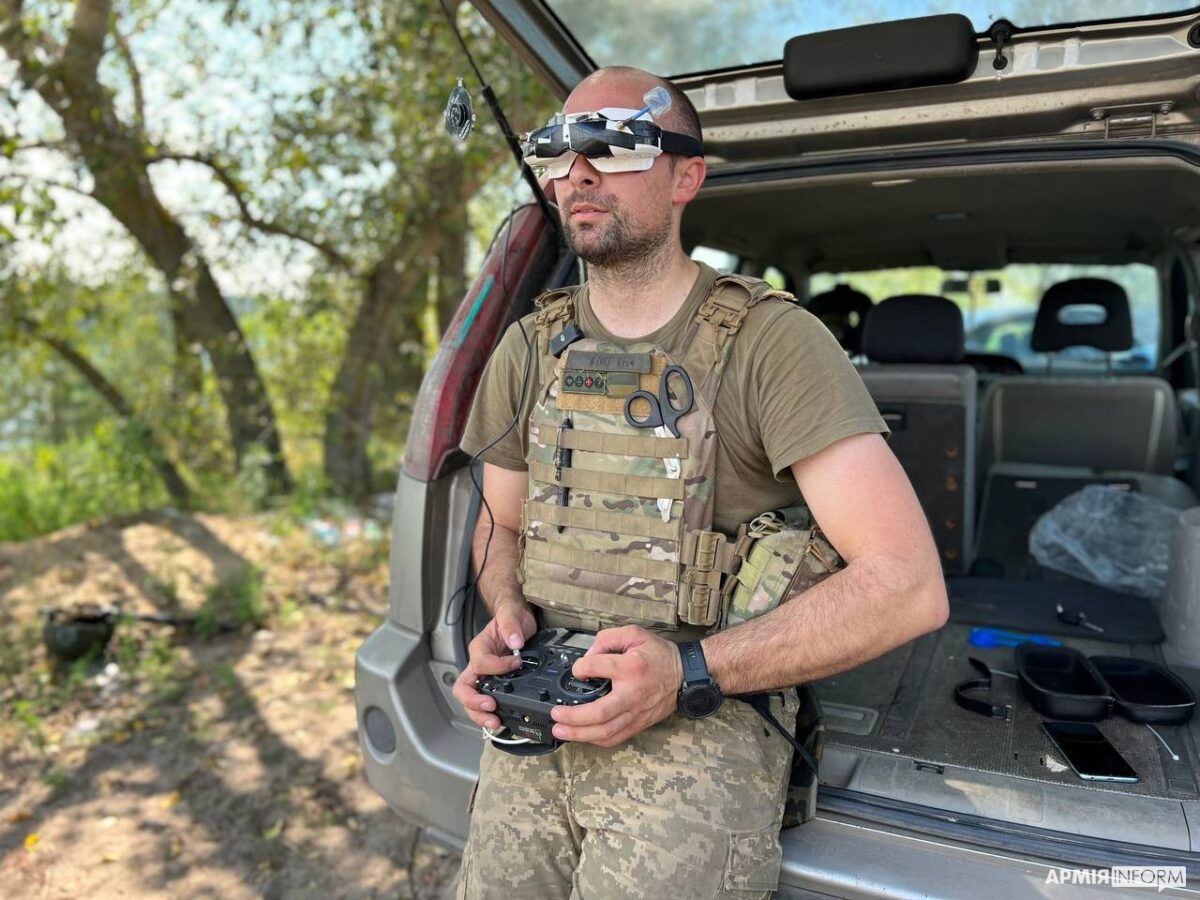
Photo: UA military FPV drones — an example of the type of drone payloads mounted on autonomous ground vehicles for reconnaissance and strike missions
As one technician noted, "They are super modular platforms, which soldiers can mount anything and everything onto – 240 Bravos, drones, rockets," adding that the vehicles could even serve as casualty evacuation platforms if needed. This modular design allows for rapid adaptation to changing mission requirements and battlefield conditions.
Drone Payload Integration
Three of the four autonomous ground vehicles had drone payloads mounted on top. In a real-world scenario, these drones could be launched to get a closer look at potential targets or packed with munitions to strike targets from the sky. The integration of drone payloads with ground vehicles creates a layered ISR (intelligence, surveillance, reconnaissance) and strike capability that can engage targets across multiple domains.
The drone payloads can be reconfigured based on mission requirements, with some configurations focusing on reconnaissance and others on strike capabilities. This flexibility allows commanders to adapt the system to evolving tactical situations.
Logistics and Casualty Evacuation
Beyond combat roles, the modular platforms can serve as casualty evacuation vehicles, transporting wounded personnel from forward positions to safer areas. The vehicles can also handle logistics missions including food, ammunition, and supply delivery to forward-deployed units. This capability reduces the number of soldiers needed for dangerous supply runs while maintaining operational tempo.
The technician's description of the vehicles as "super modular platforms" highlights the adaptability of the design. Soldiers can quickly swap between different payload configurations without extensive retooling or downtime, making the system practical for dynamic battlefield conditions.
Broader Implications for Modern Warfare
The RACER program represents a paradigm shift in military technology, moving from traditional vehicle control to autonomous system integration. By combining durable all-terrain vehicle designs with advanced algorithm technologies and secure communications, the program addresses the evolving nature of modern warfare where speed and adaptability are critical.
Tactical Advantages and Battlefield Applications
The autonomous vehicles provide significant advantages in force protection by reducing human exposure to dangerous environments. The vehicles can operate 24/7 without fatigue, maintain consistent performance in adverse conditions, and carry supplies to forward-deployed units without risking human transporters.
For reconnaissance missions, the vehicles can scout ahead of human forces, identifying threats and providing situational awareness well before troops encounter potential dangers. This early detection capability allows commanders to make informed decisions about force deployment and engagement strategies.
Integration with Joint Operations
The Fort Knox demonstration highlights the importance of ground robotic capabilities in combined arms operations. By working alongside infantry units, armor formations, and aviation assets, autonomous ground vehicles can enhance the overall effectiveness of military operations. The vehicles serve as force multipliers, allowing smaller units to accomplish more complex missions while reducing risk to human personnel.
This transformation requires new doctrinal approaches, training methodologies, and command and control structures to maximize the benefits of robotic technologies. The Army's new MOS 390A Robotics Technician program, which graduated its first class of warrant officers in October 2026, reflects the growing importance of robotic systems in modern military organizations.
Electronic Warfare and Operational Resilience
The demonstration highlighted the vehicles' ability to operate in electronically contested environments. As military operations in Ukraine have shown, electronic warfare systems can scramble radio control links, block GPS, and cut off cloud-based AI coding tools. The RACER vehicles are designed to function independently of these systems, relying on onboard processing and alternative navigation methods.
The Fort Knox demonstration builds upon lessons from recent conflicts where technological advantages have been countered by electronic warfare. The RACER program's resilience to these challenges makes it viable for real-world military operations where electronic jamming is a constant threat.
Related Coverage
For continued coverage of robotics and autonomous systems developments, follow robotics and drones coverage. More background on DARPA's RACER program and related military technology advancements is available through Defense News reporting. Additional coverage of autonomous vehicle developments can be found in recent reporting from Euronews on European defence technology and Breaking Defense on Army robotics training initiatives.
Key Takeaways
- Autonomous ground vehicles can operate independently in complex terrain at human-level speeds
- Human oversight remains essential for engagement decisions and ethical considerations
- Modular payload integration enables rapid mission adaptation and flexibility
- The technology has applications beyond combat operations in logistics and humanitarian missions
- Fort Knox demonstration marks a significant milestone in military robotics with future testing planned
- Electronic warfare resilience is critical for operational effectiveness in contested environments