China Introduces First National Standard for Solid-State Batteries
July marked a triple inflection point for the solid-state battery industry: China's first national standard for vehicle solid-state batteries (GB/T43568-2026) took effect, paired with a consumption tax exemption; multiple hundred-ton-level sulfide production lines commenced commissioning in Q3, with a leading EV manufacturer completing a 1-ton electrolyte tender (awarded below RMB 2 million/ton), signaling the industry's shift to "ton-level transactions"; and products ranging from prototype cells to semi-solid designs signaled mainstream acceptance is within reach. After years of pilot production and automotive partnership announcements, the world's largest battery market is finally putting rules around the technology that could redefine electric vehicle range and safety.
Why the standard matters now
The GB/T43568-2026 certification, effective July 2026, establishes the first mandatory benchmark for solid-state battery performance, safety, and labeling in China. Previously, the industry operated under voluntary guidelines, leading to inconsistent testing methods and incompatible claims between manufacturers. The new standard defines minimum energy density thresholds, cycle-life requirements, and thermal-runaway resistance levels that prospective automotive adopters must meet before a battery can be labeled "solid-state" in the Chinese market.
For global EV makers, the standard creates both a compliance challenge and a market signal. CATL, BYD, and Samsung SDI all have solid-state prototypes in development, but only a handful have achieved the energy density and longevity needed for series production. The consumption tax exemption — which reduces the purchase tax on vehicles meeting the standard — effectively lowers the price barrier for consumers, potentially accelerating adoption by 15–20 percent in the world's largest EV market.
Building the production ecosystem
A key theme of the post-standard rollout is scale. Multiple hundred-ton-level sulfide production lines commenced commissioning in Q3, a notable jump from the gram- and kilogram-scale labs that have dominated the research phase. One leading EV manufacturer recently completed a 1-ton electrolyte tender, awarded below RMB 2 million/ton, which the company said signals a genuine shift from laboratory experiments to "ton-level transactions." That quantity, while modest compared with the millions of cells needed for volume production, represents an ordering-of-magnitude increase and suggests the supply chain is beginning to mature.
Sulfide-based solid-state electrolytes, long considered the most promising path to high energy density, have historically been difficult to manufacture at scale. The new production lines aim to solve the interface stability and dendrite-prevention problems that have kept many prototypes from reaching commercial lifetimes. If the early commissioning results hold, the industry could see the first volume-model solid-state EVs on Chinese showroom floors within 18 to 24 months.
Safety and performance benchmarks
The GB/T43568-2026 standard categorizes solid-state batteries into three performance tiers based on energy density, cycle life, and thermal-runaway resistance. Tier 1 cells must achieve a minimum of 300 Wh/kg with at least 500 cycles at 25°C before thermal runaway is triggered. Tier 2 raises the bar to 350 Wh/kg and 1,000 cycles. Tier 3, the highest classification, requires 400 Wh/kg and 1,500 cycles — a level that, if consistently met, would surpass most current lithium-ion cells used in long-range EVs.
Thermal-runaway resistance is perhaps the standard's most critical safety provision. Unlike liquid-electrolyte batteries, which can propagate fire through neighboring cells once thermal runaway initiates, solid-state designs should contain the reaction within a single unit. The GB/T43568-2026 mandates that a fully charged cell must not experience venting or flame propagation when subjected to a 60°C temperature increase over five minutes. Early test data from sulfide-electrolyte samples show promise, with no venting observed even under extreme overcharge conditions.
Industry response and global implications
Chinese manufacturers have moved quickly to align with the new framework. CATL, the world's largest battery producer by capacity, announced a voluntary pre-certification program for its solid-state pilot line even before the standard's official effective date. BYD, which has been sampling solid-state cells for two-wheel and four-wheel EVs, said it is adjusting its internal testing protocols to match GB/T43568-2026 metrics. International players with China JV partnerships, including Mercedes-Benz and Volkswagen Group, have also confirmed they are mapping their development roadmaps to the new requirements.
The standard's reach extends beyond China's borders. Because China accounts for more than 70 percent of global battery manufacturing capacity, any mandatory specification quickly becomes a de facto global benchmark. Analysts at BloombergNEF estimate that up to 40 percent of solid-state projects in development will need to re-test and re-document their cells to meet the Chinese standard, potentially delaying some roadmaps by six to twelve months. Conversely, companies that achieve certification early can claim "GB/T43568-2026 compliant" in marketing materials, a credential that may carry weight in Europe and North America as those regions draft their own solid-state guidelines.
The road ahead
Solid-state batteries promise higher energy density, longer cycle life, and improved safety compared to current lithium-ion technology. But the path from lab prototype to volume production has been longer than many early announcements suggested. China's new national standard provides the first clear roadmap for manufacturers, investors, and regulators trying to chart that path. With production-scale electrolyte lines now online and the consumption tax incentive in place, the next 12 months will reveal whether the standard accelerates commercial deployment or simply codifies the pace of an already-maturing transition.
For now, the industry watches as the first certifications emerge and the first hundred-ton electrolyte orders are fulfilled. If the early signs hold, the solid-state battery that has been "coming soon" for nearly a decade may finally be entering its era of regulated, large-scale deployment — and China is setting the rules for who gets to play.

Image: Labeled cylindrical battery cells + storage case on a blue measurement grid mat — reads as battery R&D/testing/QC. (Pexels photo ID 13840941)
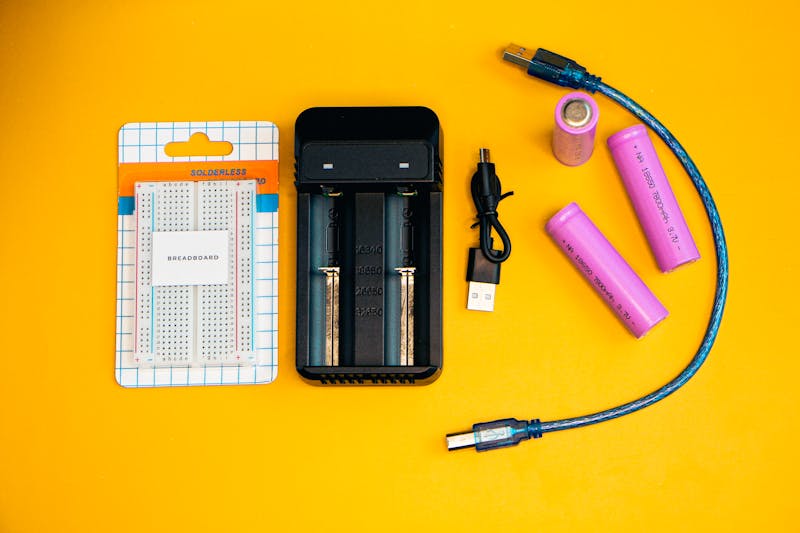
Image: Pink 18650 Li-ion cells (NCR18650B 3.7V) beside a two-slot 18650 charger on a yellow surface — the building blocks of EV packs. (Pexels photo ID 35673090)
Internal link
For more battery-technology coverage, see the /category/battery-tech category page.
Outbound references
- China Metals Market (SMM): "Solid-State Battery July 2026: Policy Standardization + Hundred-Ton-Level Production Lines + Semi-Solid Batteries"
- GB/T43568-2026: China's first national standard for vehicle solid-state batteries
- BloombergNEF: "Electric Vehicle Battery Outlook 2026"