Chery Q: A $13,300 Electric Hatchback Built Around Indonesian Driving Habits
TANGERANG — Chery is using Indonesia as more than a sales market. The Chinese automaker is building its cheapest electric car around local road conditions and commuter habits, and it has picked Jakarta's biggest auto show to prove the point.
The Chery Q, a compact battery-electric hatchback, launched at the 2026 Gaikindo Indonesia International Auto Show (GIIAS) with promotional pricing from Rp239.9 million, or about $13,300. A higher-spec Rizz version sells for Rp259.9 million, roughly $14,400. Both carry a 42.7-kilowatt-hour battery pack and a claimed 400 kilometers of range under the NEDC cycle.

The Q sits at the bottom of Chery's electrified lineup, and the company framed it as "The Most Complete Compact EV." That claim rests on a mix of hardware usually reserved for bigger, pricier models: a 70-liter front trunk, 38 interior storage compartments, 1,520 liters of combined cargo space, and an 82-percent high-strength-steel body. Dual-zone air conditioning, a custom user interface, and vehicle-to-load capability round out the package.
Chery's vice country director for the business unit, Budi Darmawan Jantania, said the launch was a moment to deliver a complete compact EV package for Indonesian buyers. The company's philosophy, he said, comes down to "Big, Strong, Intelligent, and Understand You Better."
Fast charging and the small-car economics question
Charging speed is the Q's most compelling number. DC fast charging pulls the battery from 30 percent to 80 percent in 16.5 minutes, which puts it ahead of several rivals in Indonesia's compact EV segment. The Rizz variant adds a 540-degree panoramic camera, autonomous parking assistance, and 20 driver-assistance systems. A free SIGMA package sweetened pre-orders through August 9 with an electric tailgate, 17-inch wheels, 50-watt wireless charging, and ambient lighting.
On looks alone, the Q has picked up design awards before it reached showrooms. Chery says the hatchback's "harmonious square and rounded" styling, shaped around golden-ratio proportions with a smiling front fascia and Q-shaped lighting signatures, earned both a Red Dot Design Award and an iF Design Award. Inside, the cabin leans on soft-touch panels, glass runs with a fine fiber layer for quieter movement, premium upholstery, and an N95 cabin air filter. Chery also put physical buttons where it counts, a detail reviewers tend to notice in a market increasingly stocked with touchscreen-only cabins.
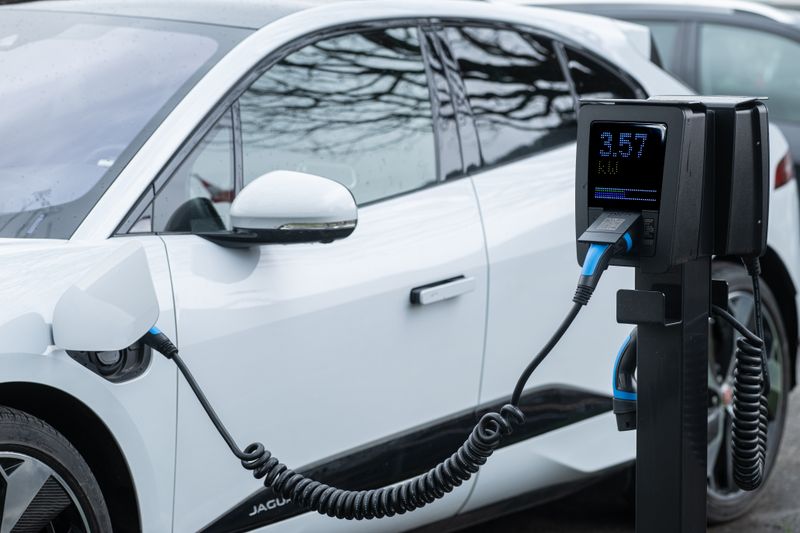
Indonesia has been slow to embrace battery cars compared with neighboring Thailand. Price is the main barrier, and the Q's Rp239.9 million sticker undercuts most of what the local market has seen in the hatchback class. Chery said the car averaged about 200 test-drive sessions a day during GIIAS and won the show's Favorite Vehicle award in the passenger-car hatchback category, announced at the August 8 Exhibitor Night.
That enthusiasm does not guarantee sales. Promotional pricing, dealer networks, and charging infrastructure will all decide whether the Q becomes a volume model or a show-floor curiosity. But the early response tells you where Chery sees the opening: a compact EV with a low entry price, fast charging, and features normally associated with larger vehicles.
Built for Indonesia, made for ASEAN
The Q's development story runs deeper than a badge swap. Chery assembled the car at the Handal Indonesia Motor plant in Bekasi, West Java, and used the Indonesian market as the reference point for a regional strategy built around right-hand steering.
The Q shares its engineering logic with the Tiggo V, a three-in-one SUV, MPV, and utility vehicle that made its first appearance outside China at GIIAS. Chery's global research team ran field surveys in Indonesia starting in February 2024, then held hundreds of discussions with local teams and consumer groups. The findings pointed toward higher ground clearance, strong climbing capability, a three-row cabin, improved air conditioning, and flexible cargo space. The result measures 4,910 mm long with 220 mm of ground clearance and can wade through water up to 700 mm deep. An Easy Turn system brakes the inside rear wheel to shrink the turning radius by about half a meter, a feature aimed squarely at narrow neighborhood lanes.
The Q's platform takes the opposite approach. At 2,700 mm of wheelbase on a dedicated electric architecture, the hatchback stretches the cabin outward: 977 mm of rear legroom, 985 mm of headroom, and a flat floor. Cargo expands from the 70-liter front trunk to 1,450 liters in the rear with seats down. That adds up to a package Chery calls the most complete in its class.
"The development of the Tiggo V started with the real needs of Indonesian consumers," Jantania said at the show. "Based on the research, consumers needed a vehicle capable of meeting family requirements, dealing with different road conditions, remaining comfortable to use and providing flexibility for productive activities and hobbies."
The same logic applies to the Q, only in reverse: instead of adapting a global car to local conditions, Chery built a small EV around the way Indonesians actually use cars, then positioned it for export to other ASEAN markets that also use right-hand steering.
A regional base for an export machine
Indonesia's domestic-content rules are doing Chery a favor. Local assembly in West Java satisfies those requirements while giving the company a production hub for ASEAN markets with right-hand steering. It is the same playbook BYD, Wuling, and Hyundai are running from their own Indonesian plants: build where you sell, then export.
Chery Group's numbers explain the ambition. The company sold 256,612 vehicles in June 2026, up 9.8 percent year over year, with exports jumping 79.7 percent to 191,062 units. First-half 2026 sales hit 1,357,533 units, while exports reached 943,817 units — making Chery the first Chinese automaker to ship more than 900,000 vehicles abroad in a single half-year, according to the company's own first-half results release. Sales of new energy vehicles, the company's label for EVs and hybrids, grew 32.3 percent to 475,238 units in the same period.
Indonesia matters to that export story in a way China's domestic market no longer does. The country is one of the largest and most diverse automotive markets in Southeast Asia, and the government's tax breaks for locally assembled EVs have turned it into a manufacturing anchor for the region. Industry Minister Agus Gumiwang Kartasasmita visited Chery's GIIAS booth in late July to look over the Q and the J6T REEV SUV, a sign of how closely the government is watching the electrification push.
The wider Chery display at GIIAS points in the same direction. Alongside the Q, the company showed the Omoda E5 battery-electric crossover and hybrid versions of the Tiggo 7 Pro and Tiggo 8 Pro, while its Jaecoo brand displayed a locally assembled J7 plug-in hybrid. Rather than betting on one powertrain technology, Chery is spreading across BEVs, plug-in hybrids, and conventional hybrids — an "all powertrain" strategy tailored to markets where charging infrastructure is still uneven.
The Q is the sharpest test of that strategy so far. Chery has already previewed the same car in the Philippines at P1.12 million, with a 405-kilometer NEDC rating and the same 16.5-minute fast-charge time, and the Q's launch pricing positions it against the Wuling Air EV and the upcoming small EVs from BYD and Hyundai. Read more EV coverage
Industry watchers are watching one number above all: whether the 200 daily test drives at GIIAS turn into monthly registrations. CleanTechnica's report on the GIIAS launch notes the Q's award came at the show's Exhibitor Night on August 8, and Chery's own materials stress the pre-order program that ran through August 9. The next sales report from Gaikindo will show whether Indonesia's cheapest new EV hatchback is finding buyers or just crowds.
For Southeast Asia's emerging electric market, the Q may prove more consequential than the latest high-performance electric SUV. The region's shift to electric mobility depends not on premium models but on whether manufacturers can bring battery cars into price ranges accessible to a much broader group of urban buyers. At Rp239.9 million, Chery is betting that number is somewhere around $13,000 — and that Indonesia is ready to test the theory at scale.