CATL says its new 350 Wh/kg aviation battery has passed a thermal runaway test that the company calls a world first — triggering two adjacent cells simultaneously and seeing no fire spread. The test was witnessed by Chinese aviation regulators, and the cells are slated to enter mass production for Autoflight passenger eVTOLs.
Ningde, Fujian — The world's largest battery maker says it has cleared a safety hurdle that has dogged electric aviation for years. Contemporary Amperex Technology (CATL) announced Sunday that its aviation battery system, built around prismatic cells packing 350 Wh/kg, survived a dual-cell thermal runaway test without propagation — a result the company says no other high-energy aviation pack has achieved.
The test, conducted under the watch of the Civil Aviation Administration of China (CAAC), triggered two neighboring cells at once in multiple pack locations, including the center and corners. Neither event sparked a chain reaction. In the industry's standard validation, only one cell is triggered at a time. CATL's protocol is roughly twice as severe.
"Thermal runaway propagation is one of the core risks of high-energy-density batteries, and it is especially sensitive in aviation applications," CATL said in its statement. The company added that the system is ready for mass production and will first power passenger eVTOL aircraft from Autoflight, a Shanghai-based developer in which CATL invested hundreds of millions of dollars in August 2024.
The result matters because aviation authorities have long treated energy density and safety as a zero-sum trade-off. Commercial jet fuel delivers roughly 12,000 Wh/kg. Current automotive cells top out around 260-280 Wh/kg. CATL's 350 Wh/kg prismatic cells sit in a middle ground that could give a four-seat eVTOL enough range for urban hops of 100-150 km while meeting the CAAC's emerging airworthiness standards for battery-powered flight.
Why dual-cell triggering changes the calculus
Battery safety tests usually follow a single-cell abuse model: nail penetration, overcharge, or external heating of one cell, then observation of whether neighboring cells catch fire. The logic is that a random defect will hit one cell first. But in a high-vibration, high-G environment like an eVTOL rotorcraft, a structural impact or manufacturing flaw could compromise adjacent cells simultaneously — exactly the scenario CATL tested.
The company did not disclose the exact trigger method (nail, heater, or electrical abuse), but it said the test covered "middle and corner" positions in the pack. Corner cells are thermally harder to isolate because they have fewer neighbors to absorb heat; center cells are surrounded on all sides. Passing both suggests the pack's thermal barrier — likely a combination of aerogel insulation, phase-change material, and a redesigned busbar architecture — works across the geometry.
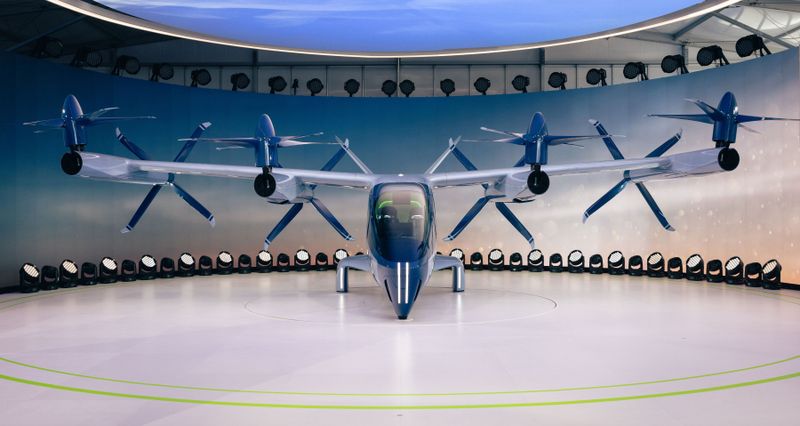
Autoflight, founded in 2017, has accumulated roughly 2,000 commercial orders as of late 2025, according to its own figures. Its flagship Prosperity I is a lift-plus-cruise design with a wingspan of 13.6 meters and a claimed 250 km range. The partnership gives CATL a launch customer and Autoflight a battery that regulators have already seen survive the toughest thermal test yet devised for the class.
From EV dominance to sky ambition
CATL commanded 39.9% of global EV battery installations in the first half of 2026 — 242.7 GWh, up 25% year-on-year, per SNE Research. That scale lets it amortize aviation R&D across a massive automotive base. The 350 Wh/kg prismatic cell uses a high-nickel cathode and a silicon-carbon anode, chemistries already proven in its Qilin and Shenxing EV packs. The aviation variant swaps the aluminum casing for a lighter composite shell and adds the thermal barrier layer.
The company has also signaled plans for electric vessels and has teased a 500 Wh/kg "condensed" battery for longer-range flight, though no timeline for certification has been published. For now, the 350 Wh/kg system is the only one with a CAAC-witnessed test report in hand.
Regulatory momentum
China's CAAC has been moving faster than EASA or the FAA on eVTOL airworthiness criteria. In 2024 it issued draft guidelines requiring battery packs to demonstrate no propagation after "multiple simultaneous cell failures" — a phrase industry insiders read as a direct nod to dual-cell triggering. CATL's public test appears designed to that spec. If the final rule mirrors the draft, CATL and Autoflight could hold a de facto first-mover advantage in the Chinese market, which analysts at UBS estimate could reach 50,000 eVTOL units by 2035.
Western regulators are watching. The FAA's current Means of Compliance for electric propulsion (PS-ACE) still centers on single-cell thermal runaway. EASA's SC-VTOL special condition is similar. A CAAC mandate for dual-cell proof would force foreign applicants to re-test or risk exclusion from the world's largest aviation market.
Supply-chain implications
The test also underscores a shift in how battery makers compete for aviation contracts. Until recently, the pitch centered on specific energy (Wh/kg) alone. Now the conversation includes pack-level thermal architecture, witness-test transparency, and integration with a specific airframe. CATL's tie-up with Autoflight — including a joint floating vertiport demo in late 2025 — shows the model: battery plus OEM plus infrastructure, delivered as a certified system.
For rivals like BYD, Samsung SDI, and LG Energy Solution, the bar has moved. Samsung SDI has targeted 2027 for solid-state aviation cells. LGES is developing pouch cells for regional electric aircraft. Neither has yet published a CAAC-witnessed dual-cell result.
What's next
CATL said mass production of the aviation pack begins this year. Autoflight aims for type certification of the Prosperity I in 2027, with commercial operations shortly after. The first revenue flights will likely be short hops — airport-to-city-center shuttles in the Greater Bay Area — where the 250 km range leaves ample reserve.
If the dual-cell test becomes the global benchmark, the economics of eVTOL certification could tilt toward incumbent battery giants with the scale to run such tests repeatedly. For an industry that has burned billions chasing range, a safety milestone may prove more valuable than the next 50 Wh/kg.
According to CATL, the CAAC-witnessed test report will be submitted as part of the Prosperity I's type certificate application. The agency has not commented publicly on the result.
Read more about CATL's EV market share EV battery technology Semiconductors driving battery management