British Defense Drone Startup Cambridge Aerospace Raises $300 Million as Cheap UAVs Redraw Air Defense Economics
LONDON — A British startup building low-cost interceptors to shoot down drones and cruise missiles has raised $300 million in Series C funding at a $3.4 billion valuation, the latest signal that the air defense market is being upended by the proliferation of inexpensive unmanned aerial vehicles. The round, led by DFJ Growth and joined by Lux Capital, Accel, Lakestar, Never Lift, Ora Global, and Elad Gil, values Cambridge Aerospace at more than triple its 2024 mark and positions it as one of Europe's best-funded defense technology companies.
The capital influx comes as military planners across NATO and the Indo-Pacific scramble to close a cost gap that has widened dramatically over the past three years. In Ukraine, Russia has launched thousands of Iranian-designed Shahed-136 loitering munitions — each costing roughly $20,000 to produce — against air defense missiles that can run $1 million to $2 million per shot. Iran's April 2024 barrage of more than 300 drones and missiles toward Israel, and the Houthi campaign in the Red Sea that has forced commercial shipping to reroute around Africa, have only sharpened the realization that legacy interceptors are economically unsustainable against massed, low-cost threats.
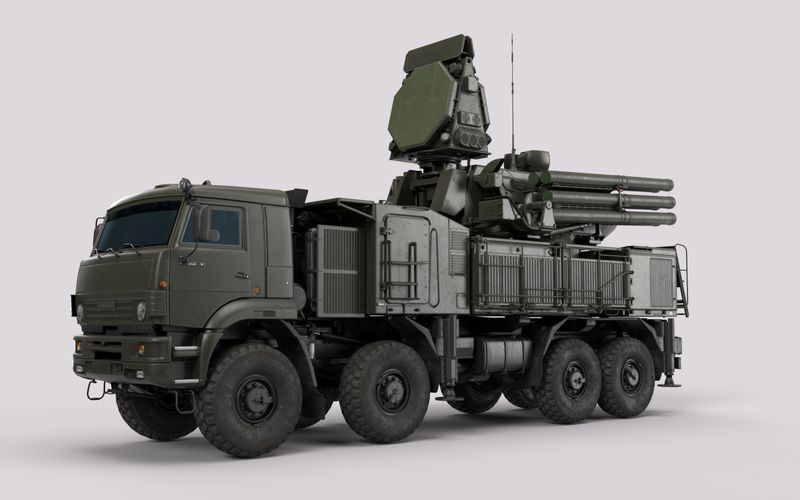
Cambridge Aerospace, founded in 2019 by a team that includes veterans of the U.K. Ministry of Defence's Defence Science and Technology Laboratory, is betting on a different arithmetic. Its core product, the Skyhammer interceptor, is designed to cost a fraction of existing systems while retaining the kinematics to engage Group 1 through Group 3 drones — the small-to-medium tactical UAVs that dominate modern battlefields — as well as subsonic cruise missiles. The company says it has already secured multiple U.K. government contracts and is in advanced talks with several NATO allies.
"We're not trying to build a better Patriot missile," said a person familiar with the company's roadmap who asked not to be named discussing private strategy. "We're building the missile you fire when a $15,000 drone shows up over your forward operating base, and you don't want to burn a $1.5 million round to kill it."
The Cost Curve Problem
The economics of air defense have traditionally favored the defender with the deeper magazine. A U.S.-made PAC-3 MSE interceptor for the Patriot system costs approximately $4 million. The Aster 30 Block 1 used by the SAMP/T system run by France and Italy is in a similar bracket. Even shorter-range systems like the U.S. Army's Indirect Fire Protection Capability Increment 2 (IFPC Inc. 2), which uses the Tamir interceptor borrowed from Israel's Iron Dome, carry per-shot costs north of $100,000.
Those numbers made sense when the threat was a handful of high-performance aircraft or ballistic missiles. They collapse when the threat is a swarm of 50 loitering munitions launched from the back of a truck. Ukrainian officials have publicly estimated that Russia produces 1,000 to 1,500 Shahed-type drones per month, a production rate that no Western interceptor supply chain can match dollar-for-dollar.
Cambridge Aerospace's answer is to strip the interceptor down to what is strictly necessary for the engagement envelope it targets. The Skyhammer uses a solid-fuel rocket motor, a commercial off-the-shelf seeker head adapted from imaging sensors produced at scale for the automotive and consumer electronics markets, and a guidance algorithm that relies on predictable drone flight profiles rather than the exotic maneuvering logic needed to hit a hypersonic glide vehicle. The result, the company claims, is an all-up-round cost "in the low five figures" — a 20-to-100x improvement over legacy systems.
A Broader Portfolio
The Series C will fund more than just the Skyhammer. Cambridge Aerospace is also developing a larger, rocket-powered interceptor for ballistic missile defense — a segment where the physics demand higher speed and altitude but where the cost asymmetry is even more extreme. A single U.S. Ground-Based Interceptor for homeland missile defense costs roughly $70 million; a Chinese DF-21D anti-ship ballistic missile costs a fraction of that. If a low-cost kinetic kill vehicle can credibly engage medium-range ballistic missiles, the strategic calculus for island chains and forward bases shifts dramatically.
In parallel, the company is fielding a multi-function radar system built around software-defined radio and gallium-nitride solid-state arrays. The radar is designed to plug into the same command-and-control architecture as the interceptors, creating a vertically integrated "detect-track-engage" loop that Cambridge argues can be deployed in weeks rather than the years required to integrate legacy radars with new effectors.
"The kill chain is only as fast as its slowest link," the same source said. "If you have a cheap missile but it takes six months to certify it on your existing radar, you've lost the war of tempo. We're delivering the whole stack."
U.K. Defence Industrial Strategy Gets a Test Case
The investment also puts a spotlight on the U.K. government's 2023 Defence Command Paper refresh, which explicitly called for "a new generation of low-cost, high-volume effectors" and promised to streamline procurement for ventures that can demonstrate sovereign capability. Cambridge Aerospace is one of the first portfolio companies to reach unicorn valuation under that framework, and its trajectory will be watched closely by policymakers who have long argued that British defence innovation stalls at the "valley of death" between prototype and production order.
The company's existing MoD contracts cover live-fire trials at the Aberporth range in Wales and integration work with the British Army's Air Defence Regiment. A successful outcome there could open the door to a program of record for the British Army's future Short Range Air Defence (SHORAD) replacement, a requirement that has been kicking around Whitehall since the retirement of the Rapier system in the early 2000s.

NATO Interoperability and the Export Question
For Cambridge to justify a $3.4 billion valuation, it eventually needs to sell beyond the U.K. The company has structured its data links and fire-control software to comply with NATO's STANAG 4586 standard for UAV control and the evolving STANAG 4607 for air defense coordination. That means, in theory, a Skyhammer battery could plug into a Polish or Baltic air defense network without bespoke integration work — a critical selling point for Eastern European members that face the most immediate drone threat from the east.
Export licensing, however, remains a hurdle. The U.K.'s Export Control Joint Unit applies a "presumption of denial" for missile technology to non-NATO, non-EU, non-Five Eyes nations. Cambridge's investors are betting that the company's focus on Group 1-3 drone interceptors — rather than strategic ballistic missile defense — will keep it on the right side of the Wassenaar Arrangement's dual-use thresholds, allowing broader sales to partners in the Indo-Pacific and the Middle East where drone threats are equally acute.
What Comes Next
The Series C gives Cambridge Aerospace roughly three years of runway at its current burn rate of $8-10 million per quarter. Milestones for the next 18 months include: completion of Skyhammer qualification firing at Aberporth by Q1 2027, first integration with a NATO partner's battle management system by mid-2027, and a decision point on whether to pursue a U.S. production line — either through a subsidiary or a teaming arrangement with a prime contractor — to access the much larger American market.
If those markers are hit, the company could be positioned for an IPO or strategic acquisition by a prime like BAE Systems, Leonardo, or RTX by 2028. If they slip, the valuation becomes a paper number in a sector where technical risk and procurement cycles have humbled better-funded ventures.
For now, the $300 million round is a statement that the market believes the cost curve has finally turned. The drone threat is not going away, and the side that figures out how to kill cheap things cheaply will write the next chapter of air defense doctrine.
The robotics and drones coverage tracks this shift, as does the cybersecurity desk where electronic warfare and autonomy intersect.
Source: Axios — Anti-drone defense startup raises $300 million, August 10, 2026; ARM Institute — Project Call for Defense Manufacturing Solutions, August 12, 2026.
Keywords: Cambridge Aerospace, Skyhammer, air defense, drone interceptor, anti-drone, Series C funding, DFJ Growth, Lux Capital, U.K. defence, NATO, SHORAD