Minerva Humanoids walked out of stealth this week with roughly $10 million in pre-seed funding and a two-armed robot named Roger that its founders say went from an idea to a walking machine in five months.
The San Francisco startup, founded at the end of 2025 by CEO Sandor Felber and CTO Maurice Rahme, is pointing Roger at work nobody wants a body in: explosive ordnance disposal, hazardous material response, and high-voltage or offshore energy sites. General Catalyst led the round, with Long Journey Ventures and Credo Ventures as co-leads, the company announced on October 6. First paid pilots start this fall.
That timing matters. The humanoid capital that poured into warehouse and factory automation is now chasing a narrower, harder problem, and the money is enormous. Figure AI was marked at $39 billion in September 2025, Skild AI at $14 billion in January 2026, and Munich-based RobCo crossed $1 billion this month, as Dealroom and Tech Funding News reported. Almost all of it backs machines meant to work near people. Felber is betting the other way. He wants to remove the person entirely and leave only a trained specialist's judgment in the loop.
"People are dying every day doing jobs the rest of the world takes for granted," Felber said in the company's announcement. "We didn't set out to replace the people doing them. We set out to build a robot that lets them do the job efficiently from the comfort of their office or home."
The problem with one arm and four wheels
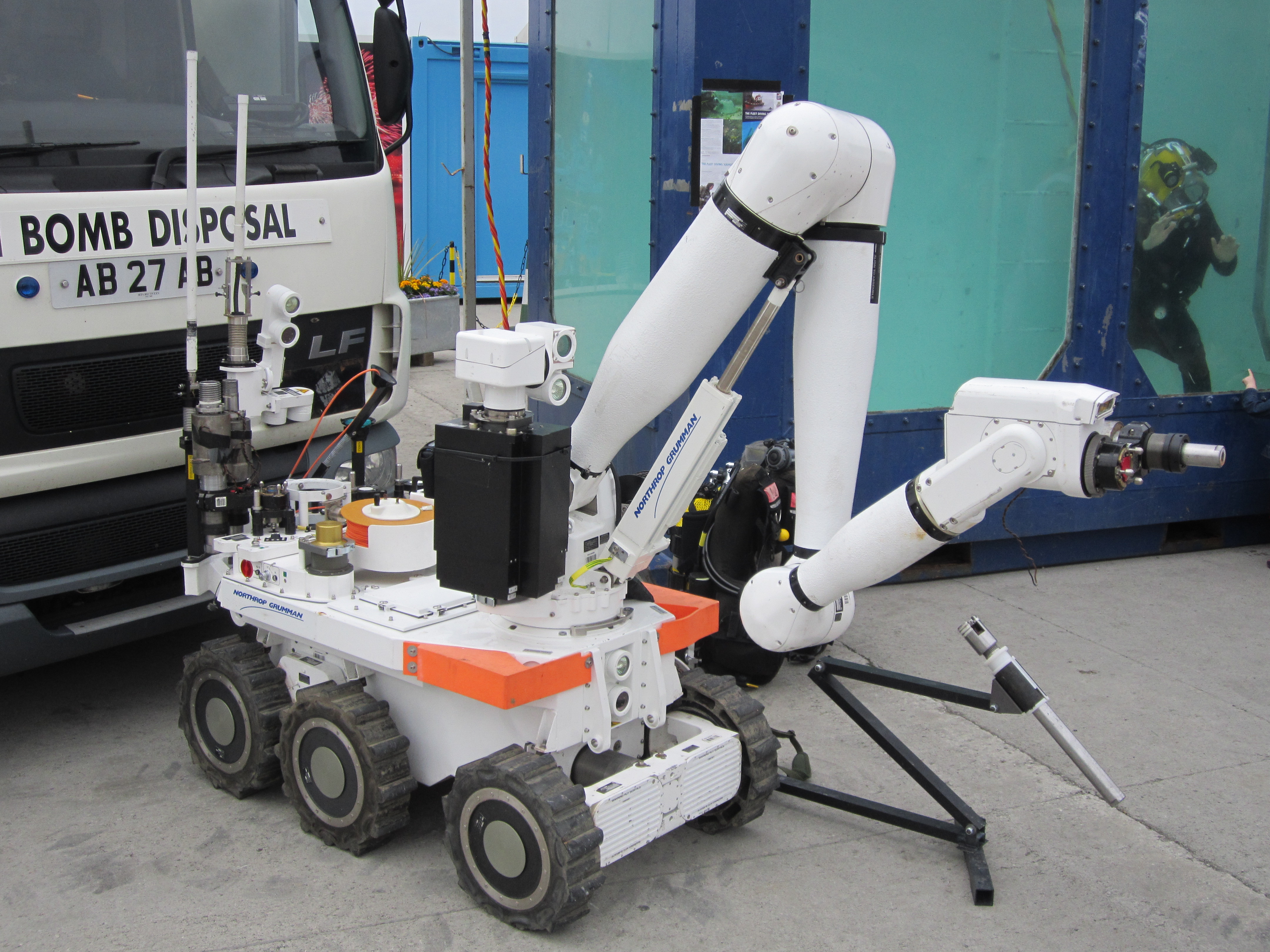
The unit of work in bomb disposal and hazmat response is still a technician in a suit. NATO consistently ranks EOD and hazardous materials teams as the highest-risk segment of each unit, and the tools they carry into the danger zone have barely changed since the 1990s: a wheeled or tracked chassis with a single manipulator arm and a camera. Two hands, fine motor control, and any task that needs both are still done by the human, in the suit, alone.
Dominic Asquith, a British Special Forces veteran who heads hazardous operations at Minerva, put it plainly.
"Every EOD operator knows the long walk," he said. "When the robot can't complete the task and the operator has to put the EOD suit on and approach the device alone. The tracked, single-arm systems we've relied on for decades send a lot of people on that walk because the task needs two hands and real dexterity."
The energy side carries its own arithmetic. Minerva applied the International Labour Organization's global fatal work accident rate, 330,000 deaths across a 3.46 billion person labour force, to the International Energy Agency's estimate of 76 million energy workers worldwide. The result is the number the company keeps repeating: about 7,000 energy deaths a year, one roughly every 75 minutes. That's the company's own calculation, not an audited figure, but the shape of the problem isn't in dispute.
Teleoperation with an AI assist, not a self-driving bomb squad
Here's where Roger's design is worth a second look. Minerva is not shipping an autonomous robot that decides for itself. The operator wears a VR headset, sees through the robot's eyes, and drives every critical action by hand. Minerva Intelligence, the company's in-house control layer, handles balance, fall recovery, and navigation so the specialist can focus on the task.
"Roger is a step-change for our community: the operator's judgement and hands are on the device while their body stays in the safety of the command post," Asquith said. "I'd have wanted this on every deployment I did."

That architecture is a more honest read of the current state of physical AI than the autonomy-first pitches that have dominated humanoid funding rounds this year. Keep the human for judgment, automate the part that kills people. The open engineering question is latency and comms. Low-latency control loops over a clean demo link are one thing; the same loops across a smoke-filled room, a salt-sprayed rig, or a radio link under interference are another. Minerva's answer so far is a research partnership with the University of Waterloo on humanoid perception in smoke, darkness, and sensor failure, which is the right problem to be working on and a long way from solved.
German assembly, and a supply-chain point
Roger's first prototypes are manufactured and assembled in Sindelfingen, Germany. Minerva says the German base lets it iterate on hardware quickly and that it plans to produce the robots in both Germany and the United States without depending on single-source Chinese components. That's a deliberate positioning move, not an accident of geography.
Dealroom's figures, reported earlier this month, put China at about two-thirds of all humanoid robotics funding in 2026, up from a quarter in 2020, while the US share has fallen to 15%. Founders who want defence-adjacent customers are finding that "Western sovereign" is a sales requirement, not a marketing line.
The founders' résumés match the pitch. Felber worked on Tesla's Optimus program and helped launch MIT CSAIL's research line on humanoid robots using AI. Rahme spent six years at Boston Dynamics as a technical lead on the Stretch warehouse robot, taking it from prototype to commercial deployment.
"Building a humanoid from scratch is often a years-long project, but Sandor and Maurice did it in less than six months," said Robin Dechant, a partner at General Catalyst. "Shipping hardware at this speed takes physical AI out of the lab and into the world where it matters."
What happens next, and what would prove it
Minerva has already run on-site testing at two of the world's 10 busiest airports, focused on high-risk public safety applications, and gave a keynote at the NATO Explosive Ordnance Disposal Centre of Excellence in Samorin, Slovakia. It also struck a research partnership with the Mohamed bin Zayed University of Artificial Intelligence on energy-sector humanoids. Paid pilots begin this fall, with deployments later in the year.
A pre-seed cheque of this size is small against the numbers elsewhere in the category, and hardware pilots in EOD and hazmat run on long procurement cycles. It's not clear the five-month build speed carries over to a manufacturing ramp, or that a VR control station passes muster with military units that have never trusted a link they can't physically yank.
The test isn't the demonstration in Slovakia. It's whether an EOD unit signs off on the headset as its primary station and whether the German line can produce Roger at a price that keeps a human out of the suit.
More robotics and drone coverage lives on the desk's robotics page, and the full archive is here.