523,000 Webmail Servers, Four Months Late: Inside the Roundcube Pre-Auth SQL Injection Now Being Exploited in the Wild
Introduction
On 21 September 2026, the Canadian Centre for Cyber Security quietly amended a May advisory with a single sentence that changed its meaning entirely: "Open-source reporting indicates that CVE-2026-48842 is being exploited in the wild." Four days later, BleepingComputer reported the same warning. By 3 October, Singapore's Cyber Security Agency had escalated the same flaw to a "patch immediately" alert, scoring it 8.1 out of 10 on CVSS v3.1.
The vulnerability itself is not new. Roundcube's security team shipped the fix in two releases on 24 May, closing a pre-authentication SQL injection in the virtuser_query plugin that lets an unauthenticated attacker inject arbitrary SQL into the mail database underneath a webmail front end. What is new is the second act: attackers who spent four months waiting are now scanning for the installations that never applied a patch they had every opportunity to read about.
This is the part of the incident that deserves sustained attention, because it is not really about a clever bug. It is about the arithmetic of exposure. Roundcube is a browser-based IMAP client that thousands of hosting providers ship as the default mail interface, and it is pre-installed with cPanel. Shadowserver, the non-profit threat-monitoring organisation, counts more than 523,000 Roundcube instances directly reachable from the public Internet. Nobody knows how many are unpatched, how many are honeypots, or how many belong to organisations that simply stopped paying attention after May.
Main Content
What the flaw actually is
CVE-2026-48842 sits in a plugin most administrators have never consciously enabled. virtuser_query handles database-driven virtual user lookups — the mechanism that maps an inbound username typed at the login screen onto a real mailbox account on the mail server. When a hosting provider runs a large mail system, that mapping is stored in a relational database, and the plugin builds its lookup query by concatenating user-supplied input directly into a SQL template.
The protection layered on top of that concatenation was PHP's preg_replace() filter, which applies backslash escaping to neutralise quote characters in the input. According to SentinelOne's analysis as reported by SecurityWeek, attackers defeat that escaping with crafted queries containing backslash sequences that break the regular expression's own sanitisation. The quote characters survive the filter, get concatenated into the SQL string, and reach the database engine intact.
The affected ranges are wide relative to the obscurity of the code path. Singapore's CSA advisory lists Roundcube Webmail 1.6.0 up to but not including 1.6.16, and 1.7.0 up to but not including 1.7.1. Fixes are 1.6.16 and 1.7.1, the versions Roundcube's team "strongly" recommended in May.
Why pre-authentication changes the severity calculation
A flaw that requires a valid login is a flaw with a user population attached to it. A flaw that requires no login at all is a flaw against the entire internet-facing surface of an organisation. BleepingComputer was explicit about the consequence: successful exploitation lets attackers with no privileges bypass authentication, inject and execute arbitrary database commands, and steal data from Roundcube's database in high-complexity attacks that require no user interaction at all.
That last clause matters most for defenders running lean security teams. There is no phishing lure to train employees against, no attachment to strip, no macro policy to enforce. The attack begins with an HTTP POST to the login endpoint and ends wherever the database user has permission to reach.
Paymob's information security lead Omar Ahmed, quoted by SecurityWeek, framed the practical blast radius: successful exploitation lets an attacker tamper with database operations, reach protected information, access user identities, messages and address books, and map authentication workflows and administrative functions. Those are not abstractions. An address book in a university mail system is a list of every student and staff member. An identity table is a mapping from email address to mailbox, password hash and session token. This is the same harvest-and-pivot shape described in our earlier coverage of how pre-authentication edge flaws become footholds, and the reason edge appliances and cloud edge computing infrastructure keep producing the same class of incident.
The patch window nobody closed
The uncomfortable detail in this story is the interval. The fix shipped on 24 May. The first official warning of active exploitation came on 21 September — roughly four months later.
TechRepublic put the uncomfortable truth plainly in its coverage of the disclosure, framing it as the problem that emerges after a fix becomes public: once a patch is available, attackers can diff the vulnerable and fixed code, work out exactly how the flaw functions, and then scan methodically for systems that have not yet installed the update. A public patch is therefore two assets at once. It is a remediation, and it is a blueprint.
That reframing inverts the usual intuition. The instinct is to think a vulnerability ends when it is fixed. In practice, a vulnerability gets more dangerous at the moment the fix is published, and stays that way until the tail of unpatched installations is exhausted. Four months is a long tail. For academic, municipal and small-business mail servers — the kind that sit on a shared cPanel host and get maintained by whoever answered the last ticket — four months is comfortably enough.
Roundcube is a repeat target, and the catalogue shows why
Roundcube has been catalogued by CISA's Known Exploited Vulnerabilities list eleven times since May 2022. That is not a coincidence of webmail popularity; it is what a widely deployed, frequently unpatched, internet-facing application looks like over four years.
The BleepingComputer report traces the lineage. The Winter Vivern group, tracked as TA473, exploited the CVE-2023-5631 cross-site scripting zero-day against European government entities. APT28 used CVE-2020-35730, CVE-2020-12641 and CVE-2021-44026 to breach Ukrainian government email systems. More recently, in February 2026, CISA flagged CVE-2025-49113 and CVE-2025-68461 as actively exploited and ordered federal agencies to secure their networks within three weeks. SecurityWeek also cites CVE-2024-37383 among the recent run.
An application that has been breached by both state-aligned espionage groups and commodity exploitation chains, repeatedly, on the same plugin-and-authentication surface, should be treated as a permanent priority rather than an item to be closed from a ticket queue. The pattern is consistent with the recurring management-layer breach wave we documented previously, where attackers go after the administrative and lookup plane because it is where identity assertions are made.
What defenders should do this week
The remediation itself is not complicated, and the reason it has not been completed is organisational rather than technical. Upgrade to 1.6.16 on the 1.6.x branch or 1.7.1 on the 1.7.x branch. That is the whole fix.
For organisations that genuinely cannot upgrade immediately, BleepingComputer reports that Roundcube's guidance is to disable or remove the virtuser_query plugin, which eliminates the vulnerable attack surface outright. That is a meaningful mitigation for the large majority of installations, because most Roundcube deployments do not use database-driven virtual users — they use local accounts or IMAP logins — so the plugin may be present but dormant. Anyone who does use it for a large hosted mail system will need to weigh the outage against the exposure.
The wider point applies beyond Roundcube, and it is the same point we made when IoT fleets were found shipping default credentials years after the fix: a released patch is an announcement, not a remediation. Only the installation is a remediation. Where an organisation cannot patch at scale, disabling the specific component is a legitimate and immediate control, not an admission of failure.
Conclusion
CVE-2026-48842 will not be remembered as an elegant bug. A backslash-escape bypass in a plugin most deployments never enable does not require novel tradecraft, and the fix was available for four months before anyone warned the public that it was being used.
What makes it useful as a case study is the shape of the exposure. A single unremarkable flaw, sitting in a widely deployed open-source component that ships pre-installed with one of the most common hosting control panels, was reachable on more than 523,000 hosts on the public internet. No user action was required. No social engineering was required. The attack surface was the login page.
For the organisations running those installations, the closing note from TechRepublic is the one worth carrying: a temporary outage or a broken feature can usually be fixed, while a compromised mail system exposes years of correspondence, credential material and contact lists, and hands an attacker a authenticated foothold into everything else. Patch window management is not administrative hygiene. In a case like this, it is the entire security control.
Images
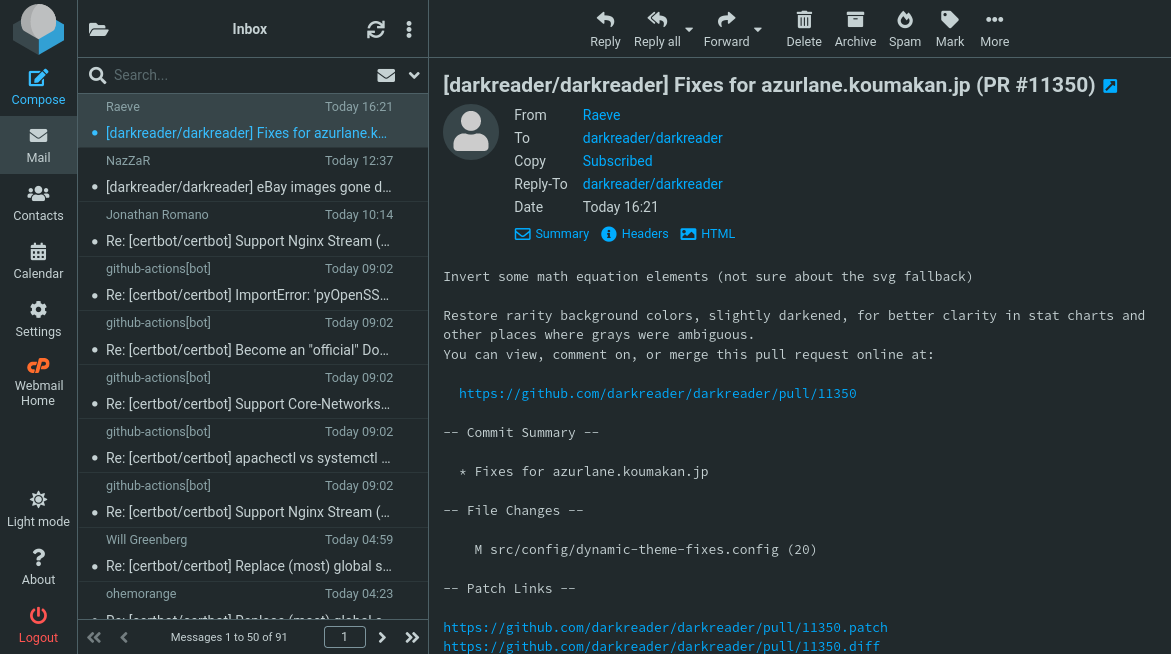
A Roundcube Webmail 1.6.0 inbox screenshot in a dark theme, showing an authenticated mailbox with a message list and one open message. Note what is not visible: there is no login form, because the CVE-2026-48842 attack path begins before authentication, at the sign-in page. Wikimedia Commons.

A French-language webmail inbox from the Roundcube Inbox file on Wikimedia Commons, showing the three-pane structure — folders, message list, reading pane — whose contents a successful pre-authentication SQL injection would expose. Wikimedia Commons.

The kind of self-hosted rack where the vulnerable mail database sits: a floor-standing cabinet with an HP server, network equipment and an APC uninterruptible power supply. Illustrative of typical hosting-provider installations, not the site of any specific incident. Wikimedia Commons.
References
- Cyber Security Agency of Singapore, Active Exploitation of Vulnerability in Roundcube Webmail (AL-2026-131), 3 October 2026
- BleepingComputer, Hackers now exploit critical Roundcube flaw in code injection attacks, 24 September 2026
- SecurityWeek, Roundcube Webmail Vulnerability in Attackers' Crosshairs, 25 September 2026
- TechRepublic, Attackers Target Unpatched Roundcube Servers With CVE-2026-48842, 25 September 2026
- Images: Wikimedia Commons —
Roundcube 1.6.0 screenshot.png,Roundcube - inbox -fr.PNG,Computer rack HP.jpg