BYD has opened pre-orders for the Great Han, its new flagship electric sedan that delivers more than 1,000 kilometers of range on China's CLTC cycle at a starting price of 249,900 yuan — about $37,200. The vehicle, known as the Da Han in its home market, marks the Chinese automaker's most aggressive push yet into the premium D-segment dominated by Tesla's Model S and the Lucid Air.
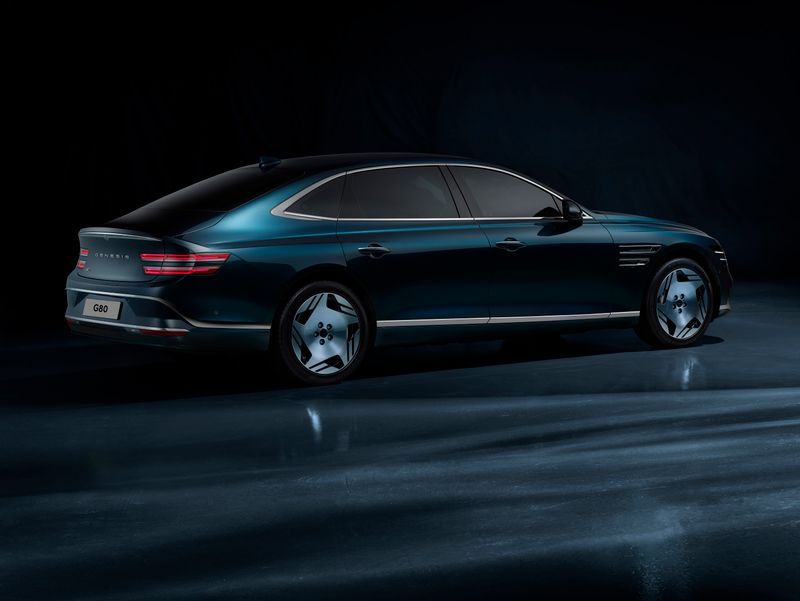
The Chengdu Auto Show debut, confirmed by BYD Dynasty series general manager Lu Tian last month, revealed three variants spanning rear-wheel-drive and all-wheel-drive configurations. All versions share a 102.3 kWh Blade Battery 2.0 pack and the company's new Flash Charging platform, which BYD says can replenish the battery from 10 percent to 70 percent in five minutes using 1,500 kW chargers. A full charge from 10 to 97 percent takes nine minutes.
Range and powertrain specs that reset expectations
The two rear-wheel-drive trims — Premium and Flagship — each use a single 370 kW motor (496 horsepower) driving the rear wheels. Both achieve a CLTC range of 1,008 kilometers (626 miles). The all-wheel-drive version adds a front motor for combined output of 570 kW (764 hp) and returns 880 kilometers (546 miles) on the same cycle.
Peter Johnson, reporting for Electrek, noted that the Great Han measures 5,256 mm long, 1,999 mm wide, and 1,510 mm tall with a 3,130 mm wheelbase. Those dimensions place it above the Tesla Model S and Lucid Air in overall size, closer to the long-wheelbase Mercedes-Benz S-Class. Riz Akhtar, writing for The Driven, reported the gross vehicle weight exceeds 2,500 kilograms — mass that the dual-motor version's 570 kW must manage.
Standard equipment across the range includes BYD's DiSus-A dual-chamber air suspension, rear-wheel steering, and zero-gravity front seats. The God's Eye B advanced driver-assistance system brings navigation-on-autopilot and remote parking functions. A LiDAR unit mounted at the front of the show car signals the hardware suite intended for higher-level automated driving.
Flash Charging changes the calculus
Five-minute charging for a 60-percent state-of-charge gain has been the holy grail for EV adoption. BYD's 1,500 kW architecture — if the supporting charger network materializes — would make a coffee-stop recharge genuinely viable for long-distance travel. The company claims the Blade Battery 2.0 chemistry, still lithium-iron-phosphate at its core, tolerates the extreme charge rate without accelerated degradation.
Analysts have treated similar claims cautiously. The 1,500 kW figure requires liquid-cooled cables and connectors that remain rare outside China's newest highway corridors. Most public chargers today top out at 350 to 400 kW. Even Tesla's V4 Superchargers, currently rolling out in Europe and North America, peak at 350 kW per stall. BYD has not disclosed a timeline for deploying its own ultra-fast network beyond the Chinese market.

Pricing undercuts the premium establishment
At 249,900 yuan ($37,200) for the base RWD Premium, the Great Han undercuts the Tesla Model S (roughly 698,900 yuan in China) and the Lucid Air (well over 1 million yuan) by a wide margin. The Flagship RWD lists at 269,900 yuan ($40,200). The AWD variant's pricing was not specified at the show but will likely sit under 300,000 yuan.
That pricing strategy mirrors BYD's approach with the Great Tang SUV earlier this year, which collected more than 30,000 orders in its first 24 hours. The Driven reported that the Da Han could follow a similar trajectory, with deliveries expected to begin within weeks. International availability remains unconfirmed, though BYD's expanding global footprint — including recent launches in Europe, Southeast Asia, and Australia — suggests exports will follow domestic ramp-up.
Battery technology and supply chain implications
The 102.3 kWh Blade Battery 2.0 uses a revised cell-to-pack architecture that BYD says improves volumetric energy density while maintaining the safety characteristics that made the original Blade Battery an industry benchmark for puncture resistance. The company has not published detailed chemistry changes, but the shift to 1,500 kW charging implies either thinner electrodes, advanced electrolyte additives, or both.
CATL, the world's largest battery maker, unveiled its own 6C "Shenxing" fast-charge cell earlier this year with similar five-minute claims. The parallel announcements signal that Chinese cell manufacturers are converging on extreme charge rates as the next competitive frontier — ahead of solid-state commercialization, which remains years from volume production.
For global supply chains, BYD's vertical integration — cells, packs, power electronics, and vehicle assembly under one roof — gives it cost control that legacy automakers struggle to match. The Great Han's price point likely reflects margins that would be impossible for a company buying cells on the open market.
What this means for the premium EV segment
The premium electric sedan category has been defined by low-volume, high-margin vehicles from Tesla, Lucid, and traditional luxury brands. BYD's entry rewrites the value equation. A full-size luxury sedan with 1,000-kilometer CLTC range, five-minute charging capability, and a sub-$40,000 price tag has no direct competitor in any market.
Tesla's Model S Plaid starts above $90,000 in the United States and offers 637 kilometers of EPA range. Lucid's Air Grand Touring exceeds $130,000 for 830 kilometers EPA. Neither offers charging speeds approaching BYD's claimed figures. German rivals — Mercedes EQS, BMW i7, Porsche Taycan — all start higher and charge slower.
The risk for BYD is execution. The 1,500 kW charger network exists largely on paper outside a few pilot sites in China. CLTC range figures are notoriously optimistic compared to WLTP or EPA cycles; real-world highway range at 120 km/h will likely fall 30 to 35 percent short of the advertised number. And the Great Han's size and weight make it a poor fit for European streets and parking structures, limiting its immediate addressable market.
Still, the signal is clear. Chinese automakers are no longer competing on price alone. They are delivering specifications that force the rest of the industry to respond — or cede the premium segment entirely.
Competitive response and market outlook
Legacy automakers face a narrowing window. Volkswagen Group's PPE platform, shared between Porsche and Audi, targets 800-volt architecture and 350 kW charging — half of BYD's claimed rate. Mercedes-Benz has partnered with CATL for its own LFP chemistries but has not announced a 1,500 kW roadmap. Ford and General Motors remain committed to NMC chemistries that charge more slowly but offer higher energy density per kilogram.
In China, the response is already visible. NIO's ET9 flagship, due later this year, targets 1,000-kilometer CLTC range with a 120 kWh semi-solid-state pack and 600 kW charging. Xpeng's P7+ refresh aims at the same segment with 800-volt architecture. The domestic arms race benefits Chinese consumers first, but the technology will migrate globally as these brands expand overseas.
Tariff walls and the global trade dimension
The Great Han's arrival coincides with escalating trade tensions. The European Commission's provisional tariffs on Chinese-made EVs — up to 37.6 percent on top of the standard 10 percent duty — took effect in July. The United States maintains a 25 percent tariff on Chinese vehicles alongside a 100 percent levy on EVs specifically. Canada announced matching measures in August.
BYD has so far absorbed the European tariff hit on its Seal and Atto 3 models without passing the full cost to buyers, a tactic made possible by the cost advantages of vertical integration. Whether the same math works for a flagship sedan with a larger battery and more expensive suspension remains an open question. The company has hinted at local assembly in Hungary and Turkey as a long-term hedge, but production lines take years to commission.
Sources: Electrek — BYD opens orders for its new flagship EV with over 1,000 km of range for under $40,000, The Driven — BYD launches its most luxurious electric sedan, with 5 minute charging and 1,000 km of range
Internal links: Battery Tech, Semiconductors
Keywords: BYD, Great Han, Da Han, electric sedan, Blade Battery, flash charging, Chengdu Auto Show, premium EV, China auto market